Silicon Savannah, Inc.: Who Actually Owns Nairobi's Tech Story?
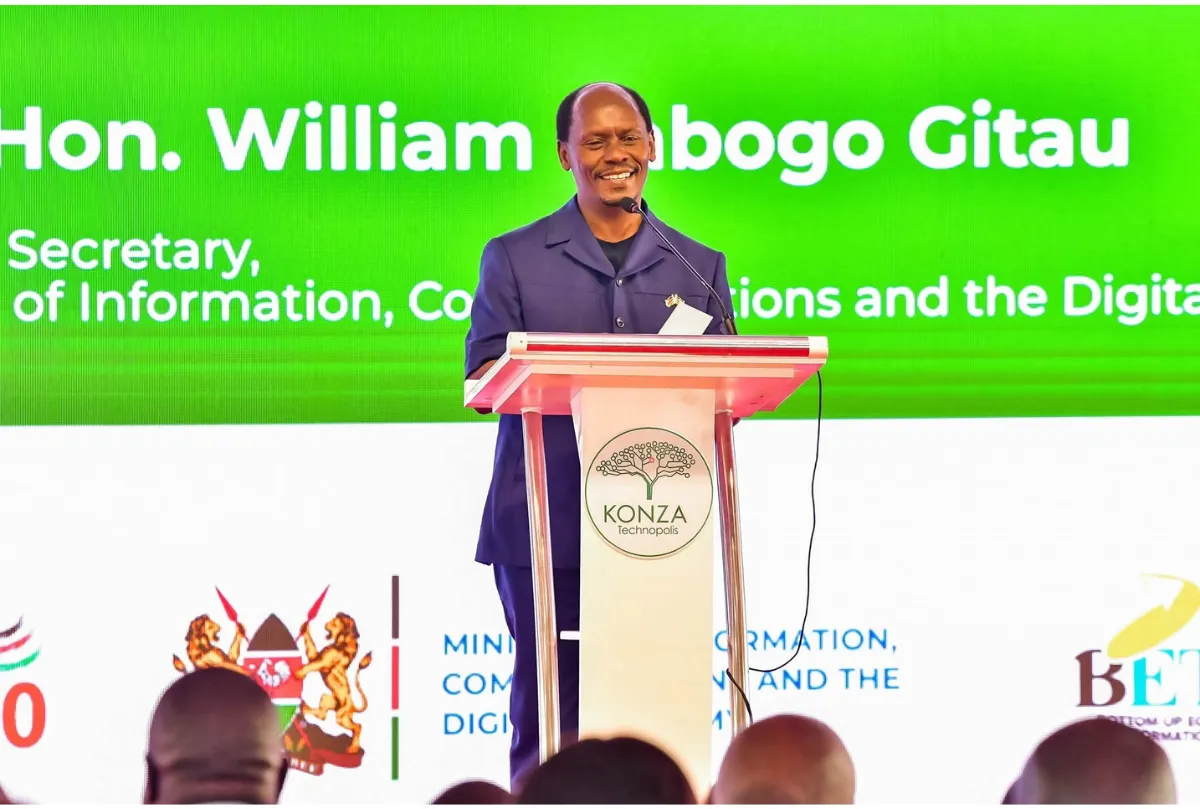
On 14 October 2025, President William Ruto stood on 40 kilometres of freshly laid "smart roads" and declared Phase 1 of Konza Technopolis officially open — 170km of utility networks, a Tier III national data centre, a 120MW substation, and East and Central Africa's first vacuum-based waste system, planted on grassland 60km south of Nairobi 1. It was the physical manifestation of a brand Kenya has spent fifteen years building: the Silicon Savannah, Africa's answer to the valley in California.
The branding works. "Silicon Savannah" is arguably the single most recognised tech label on the continent, invoked in every investor deck, every ministerial speech, every glossy feature about African innovation. But a brand is a promise about who captures value. And on that measure, the Silicon Savannah is a story still being fought over — between the African economy that authored it and the foreign capital that has learned to profit from it.
The one asset that is unambiguously Kenyan
Start with what is genuinely home-grown, because it is the reason the label exists at all. M-Pesa — launched by Safaricom in 2007 — is not a startup that took foreign money and flew a flag of convenience. It is national financial infrastructure, invented in Nairobi for a problem Nairobi had.
Nearly two decades on, the scale is staggering. In the financial year ending March 2025, M-Pesa moved Sh38.3 trillion in transaction value and generated Sh161.1 billion in revenue — 41.5% of Safaricom's total 2. By late 2025, more Kenyans were active on M-Pesa than on Safaricom's own mobile network, a first in the company's history 3. Mobile-money penetration in Kenya now runs around 91%, the highest on earth.
This is the template the entire Silicon Savannah brand rests on: African problem, African-owned rail, African value retained at home. The trouble is that almost nothing built since has matched it.
The capital that arrived, and where it came from
By the raw scoreboard, Nairobi is winning. Kenyan startups pulled in Sh127 billion (roughly $985 million) in 2025, keeping the country at or near the top of Africa's funding tables 4. More than 150 hubs, incubators and accelerators now orbit the original iHub. The government's 2022 Startup Act promised tax breaks and lighter regulation, and a new technopolis law is pushing the model out to the counties to chase startups and foreign direct investment.
But trace the money to its source and the picture darkens. The Kenya Innovation Outlook 2024, produced by the state-backed Kenya National Innovation Agency (KeNIA) with StartupBlink and GrowthAfrica, found that 81% of startup funding comes from international sources 5. There is barely any domestic venture capital willing to write early cheques; local founders are left to a thin layer of angels while the serious money flies in from London, New York and the Gulf — carrying return expectations calibrated to markets that look nothing like East Africa.
That foreign capital does not arrive neutrally. It has a long-documented preference for founders who look like the people writing the cheques. Studies of the East African ecosystem have repeatedly shown expatriate-founded startups capturing the overwhelming majority of large rounds — with local founders in some analyses receiving as little as 6% of capital raised, and the bulk of million-dollar-plus deals going to companies started by expats. A Kenyan-registered company with a European founder is a very different value-capture story from a Kenyan-owned one, even when both operate from the same Westlands co-working space.
The same KeNIA report flags the concentration risk: more than 75% of Kenya's business-development support sits in Nairobi, and women-led startups take just 12% of funding 5. Foreign money also imports foreign timelines — pressure to chase rapid user growth, regional expansion and valuation before a business is operationally stable, priorities set in venture markets that have never had to price Kenyan risk. When the global funding tide went out in 2024, ecosystems built on that capital felt it first.
The hubs: talent magnet or talent tap?
The most visible endorsements of the Silicon Savannah are the global logos. Google, Microsoft and Visa have all planted flagship centres in Nairobi. Google chose the city for its first Product Development Centre on the continent, part of a pledged $1 billion African investment 6. Microsoft opened its first Africa Development Centre and research institute here, and in 2024 announced, with UAE-backed G42, a $1 billion digital-ecosystem package including a green data centre 7. Visa built its first African innovation studio in the city.
Read one way, this is validation: the world's biggest technology companies concluding that Nairobi has the engineers to build for a global market. Read another, it is an extraction architecture. These centres hire Kenya's best-trained developers — often at salaries local startups cannot touch — to build intellectual property owned in Mountain View, Redmond and San Francisco. The talent story cuts both ways. Kenya trains and attracts formidable engineers; the question is whether the value they create compounds inside a Kenyan cap table or is exported as a service, with the equity, the patents and the platform economics banked offshore.
Konza sharpens the same tension. It has been fifteen years in the making, remains chronically under-capitalised against a bill running well past Sh80 billion, and its marquee wins are frequently foreign-financed — a $284 million Digital Media City backed by South Korea 1, Gulf and Asian data-centre money, Korean concessional loans. A smart city is only a sovereign asset if Kenya owns what runs on it.
The brand versus the balance sheet
None of this makes the Silicon Savannah a mirage. The engineering depth is real, M-Pesa is a genuinely African-owned crown jewel, and being the continent's default innovation destination is worth something no marketing budget can buy. Kenya authored the category.
The risk is subtler than failure. It is that Kenya keeps authoring the culture — the talent, the reputation, the label the whole continent borrows — while foreign capital keeps authoring the ownership. A brand that attracts a billion dollars but banks 81% of the upside abroad is not an African tech champion; it is a very effective import-substitution scheme running in reverse, exporting equity instead of retaining it. The Silicon Savannah has proven it can build the shop window. The unfinished work is owning the shop.
So what
The scoreboard Kenya should watch is not total dollars raised — a number that flatters foreign investors as much as local founders. It is the share of value that stays: locally-owned equity, domestic capital in the cap table, IP registered and monetised in-country, and second-generation founders funding the next cohort with M-Pesa-scale wealth. Until those lines move, "Silicon Savannah" describes where the work happens, not who owns it.