THE MONOKROMATIK DECODE
Our editorial read across the four dimensions we use to assess creative work — an authorship-weighted Cultural-Signal Score, reflecting judgement, not a measured metric.
80 /100AACULTURAL-SIGNAL SCOREStrong — clear authorship, real consequenceConsequence is held at 4 rather than 5 partly because the AFCON 2025 title sits under an unresolved CAS appeal, which we do not adjudicate. A ruling either way is a checkable event that changes what can be claimed, in either direction.
Assigned 2026-07-21. An outlook states at least a one-in-three likelihood of a change over the next twelve months. How outlooks work
Running an academy, hosting rights, federation politics and a marketable captain as one sovereign portfolio rather than four separate ambitions is coherent and unusually long-dated. Strong and well adapted.
Holds at the already-corrected 4. Strategy, capital and institutions are unambiguously Moroccan and state-owned, but the playing talent is largely developed abroad — 14 of the 26-man 2022 squad born outside Morocco, Hakimi himself a Real Madrid academy product. Morocco captured the international rights to finished players rather than authoring their development.
Dropped from 5. The delivery record is outstanding — a CAF Player of the Year, a Champions League final goal, back-to-back World Cup quarter-finals, a delivered AFCON, a 2030 co-hosting slot by acclamation. But 5 requires coherence across every surface, and the crowning asset was awarded by an appeal board with an unresolved CAS challenge against it. A contested title is a gap, not a flaw-free finish.
Holds. The strongest consequence case in the batch and the one closest to a 5: FIFA-confirmed 2030 hosting rights, a permanent FIFA office in Rabat, committee seats held since 2014/2021/2025, an academy operating since 2010 — structural, verifiable, African-captured and persisting well beyond 12 months. It stops at 4 because the largest quantified outcome, the 19.8m tourist arrivals, is explicitly disclaimed as causally linked to the football strategy, and the AFCON title is unresolved.
THE CONTEXT
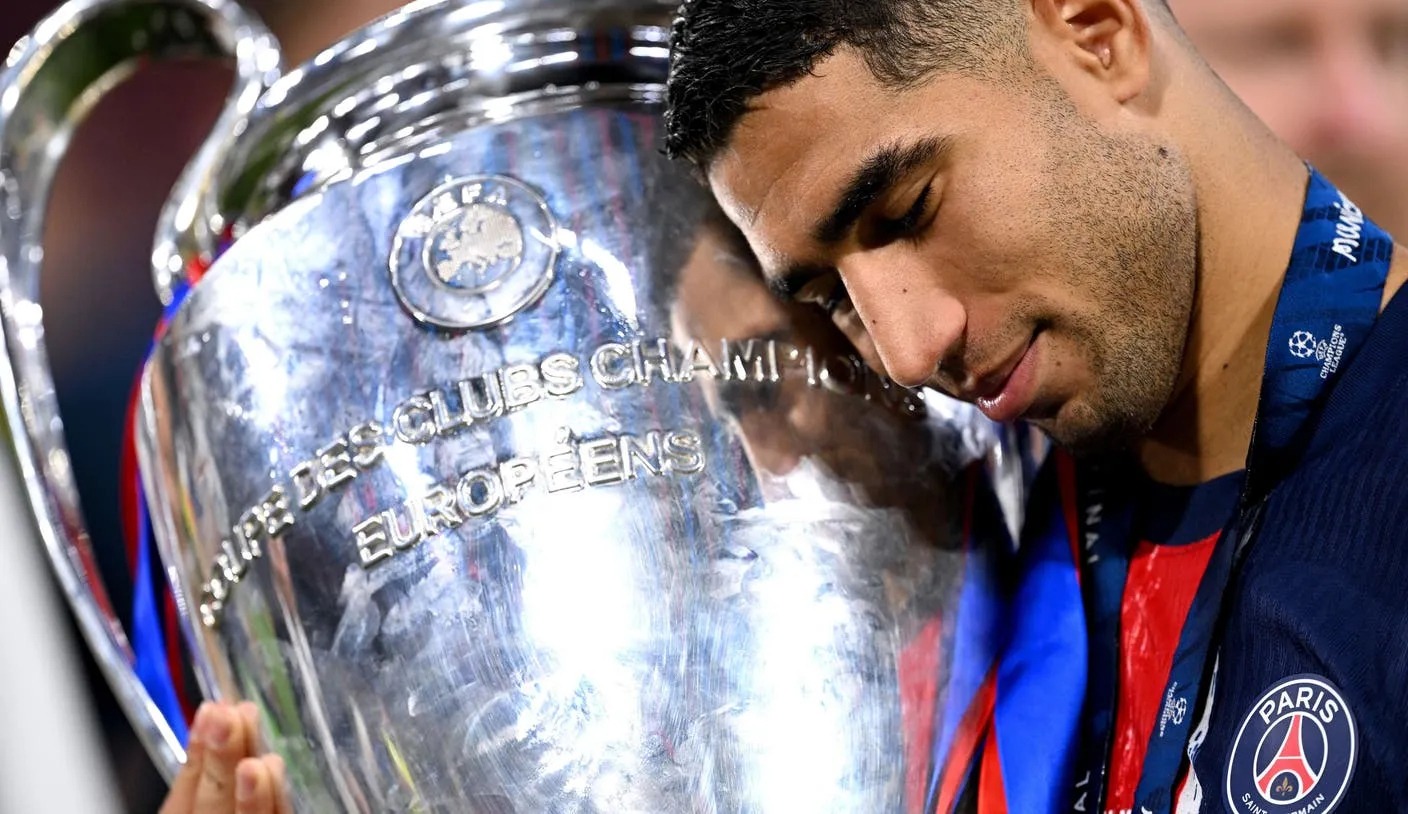
In November 2025, at the CAF Awards in Rabat, Achraf Hakimi was named African Player of the Year ahead of Mohamed Salah and Victor Osimhen — the first Moroccan to take the prize since Mustapha Hadji in 1998, and the first defender to take it since 1973. The season behind it was not a sentimental one. Hakimi had been a starting full-back in Paris Saint-Germain's treble, scoring the opening goal in a 5-0 Champions League final win over Inter Milan. Whatever else is arguable about the Morocco story, the merit of its most visible figure is not.
The individual award sits on top of a national arc that Morocco has been building for close to two decades. The Mohammed VI Football Academy opened outside Rabat in 2010, built for roughly $13 million at a point when the country had not reached a World Cup since 1998. A far larger technical complex followed at Maâmora in 2019, consolidating the federation's national teams onto a single site. By the 2022 World Cup, Morocco had become the first African side to reach a semi-final. By 2026 it had gone further in institutional terms than any African football nation before it.
The last eighteen months compressed a decade of that arc. On 11 December 2024 an extraordinary FIFA Congress appointed Morocco, Spain and Portugal as hosts of the 2030 World Cup by acclamation — only the second time an African nation will stage the tournament. Morocco hosted AFCON across December 2025 and January 2026. Fouzi Lekjaa, president of the Royal Moroccan Football Federation since 2014, is simultaneously a FIFA Council member, CAF's first vice-president since 2025, chair of the country's 2030 organising structure and, in his day job, Morocco's Minister Delegate for the Budget. FIFA has agreed to open an Africa office in Rabat.
Then, at the 2026 World Cup, Morocco reached a second consecutive quarter-final — the first Arab or African nation to do so — before losing 2-0 to France on 9 July. Hakimi, now on 19 World Cup appearances, holds the record for an Arab or African player, and captained a side that scored eleven goals in six matches, its most prolific campaign. He also took the sharpest domestic criticism of his career for his performance in the France defeat. The machine works. What follows is a test of who it works for.
PREMIUM CASE STUDY
The full strategic decode — the bet, the creative move, the evidence ledger and the lessons — is part of the Intelligence membership.