THE MONOKROMATIK DECODE
Our editorial read across the four dimensions we use to assess creative work — an authorship-weighted Cultural-Signal Score, reflecting judgement, not a measured metric.
56 /100BBCULTURAL-SIGNAL SCOREWeak — visibility without value captureNo one-in-three likelihood of movement identified in the next twelve months.
An outlook states at least a one-in-three likelihood of a change over the next twelve months. How outlooks work
Dropped from 4. A 40th-anniversary sponsorship collectible is the conventional move for a long-tenured sponsor. The collectible instinct is sound; the idea is the category's standard play.
Corrected from 1 (20 July 2026). Our earlier note said the remembered canon is "explicitly non-African". We cannot stand that up: AB InBev states the pack runs eleven designs covering the past ten World Cups plus 2026 from Mexico 1986, a scope that entails South Africa 2010 — though no published source shows that design, so we claim the entailment, not the artwork. The level moves to 2 on African cultural input at the activation layer: SOLIBRA’s Bud FC Fan Festival in Abidjan programmed a named roster of Ivorian artists in Ivorian genres. It is not a 3 — those artists were booked into a global template they did not write, and the sourcing is brand-supplied. The sharper structural fact is that AB InBev substituted Budweiser out of Africa entirely: every African operating company ran the World Cup under a local brand (Carling Black Label, Nile Special, Safari Lager, 2M, CLUB), with Budweiser as the rights vehicle and the local brand as the face. Fact-checkers note: the agency credited on the hero film as "Africa Creative" is Africa Creative DDB of São Paulo.
An 11-piece collectible pack and Bud FC events across 40+ countries are confirmed, consistent and well-made. Holds.
No commercial outcomes claimed and no African-authored edition. A campaign launch plus a product drop — capped at 3, with value captured by AB InBev.
THE CONTEXT
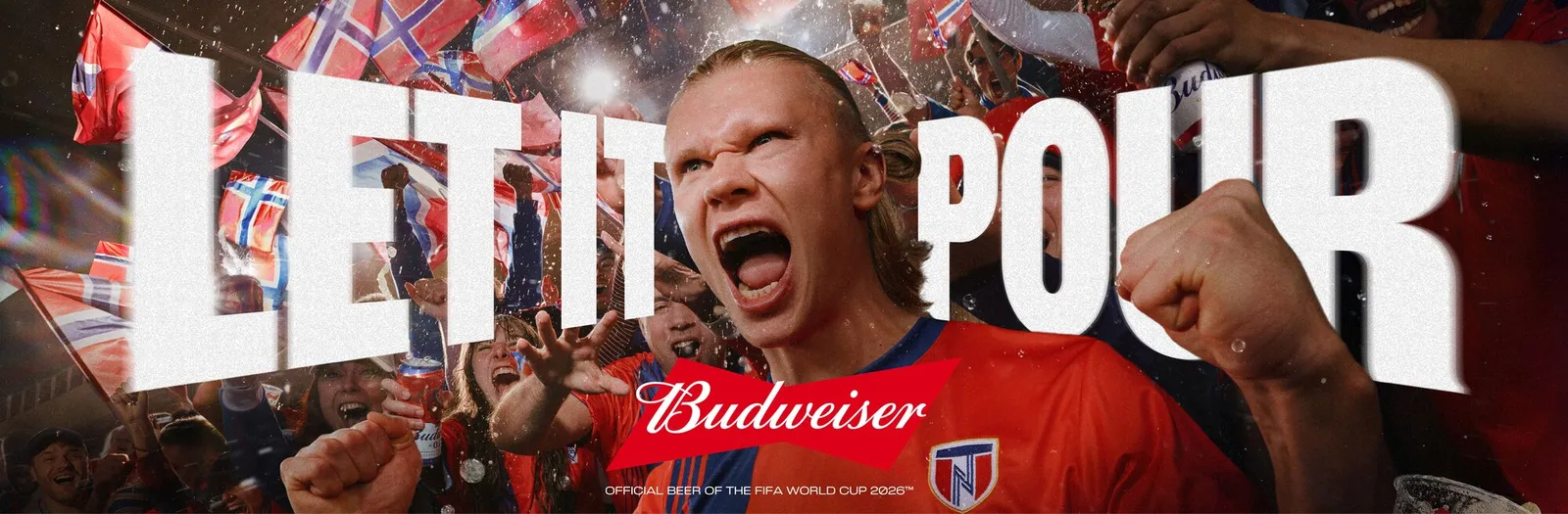
Budweiser, the Official Beer Sponsor, launched Let It Pour across more than forty countries (Bud FC fan events, The Bud Fan Store, a global film with Erling Haaland and Jürgen Klopp), and a separate Budstalgia platform marking 40 years with FIFA. The centrepiece is the Anniversary Pack — 11 aluminium bottles and cans honouring the past 10 World Cups and 2026, from Mexico 1986 to now. All reported by AB InBev's newsroom.
It is a nostalgia-and-collectible system: convert four decades of sponsorship into a curated object fans want to keep.
A collectible is powerful because memory is identity — which is exactly why an incomplete canon is a quiet exclusion.
THE STRATEGIC BET
The bet is that memory is the most durable brand asset in football, and that a collectible turns memory into something owned, displayed and traded — not just watched.
Budstalgia monetises longevity itself: only a 40-year sponsor can sell forty years of nostalgia.
THE CREATIVE MOVE
The creative move is the physical collectible — the 11-piece pack as a designed artefact — paired with a global icon film. It treats the can as a canvas for history.
The instinct is right and ahead of most sponsors: an object people keep beats an ad people skip. The limit is whose history the canon contains.
THE EVIDENCE
Confirmed: The Let It Pour platform, the Budstalgia 40th-anniversary campaign, the 11-piece collectible Anniversary Pack and Bud FC events across 40+ countries — reported by AB InBev.
Confirmed: SOLIBRA, AB InBev’s Ivorian partner, ran the Bud FC Fan Festival in Abidjan (11 June – 19 July 2026) programming named Ivorian artists in Ivorian genres.
Confirmed: AB InBev states the Budstalgia pack comprises eleven designs covering the past ten World Cups plus 2026, beginning at Mexico 1986 — a scope that entails a South Africa 2010 design, though no published source depicts it.
Confirmed: AB InBev’s African operating companies ran the 2026 World Cup under local brands — Carling Black Label (South Africa), Nile Special (Uganda), Safari Lager (Tanzania), 2M (Mozambique), CLUB (Ghana) — with the rights flowing through the global Budweiser partnership.
Reported independently: The Haaland/Klopp creative and the Mexico-1986-to-2026 pack composition are documented in AB InBev releases and trade coverage.
Reported independently: The Nigeria and Côte d’Ivoire activations are documented in branded content and publi-reportage — brand-supplied rather than independently reported. The named Ivorian line-up is corroborated by the festival’s own programme site.
Not claimed at this stage: Commercial outcomes; any African-authored edition or African-market-specific collectible.
Not claimed at this stage: Whether African players or moments appear in the QR-unlocked content behind the collectible pack. Per-design contents are not published and we could not verify them in either direction.
Not claimed at this stage: That no African crew worked on "Let It Pour". Full crew credits for that film are not published anywhere we could reach, so their absence is unverified rather than established.
Not claimed at this stage: That the Budstalgia pack was distributed in any African market. Announced distribution is Brazil, China and select European countries; we could not verify African availability either way.
THE AFRICAN READ
A nostalgia canon running from Mexico 1986 to 2026 spans eleven tournaments, which by AB InBev’s own stated scope must include South Africa 2010 — though no published source shows that design, and nothing indicates whether Roger Milla, Senegal 2002, Ghana 2010 or Morocco 2022 appear in the QR-unlocked content behind it. So the honest charge is not that African football is missing from the memory. It is that the memory is authored entirely outside the continent, and that Budweiser itself was substituted out of Africa: every AB InBev operating company on the continent ran this World Cup under a local brand instead. The inversion is stark next to FIFA’s own tournament music, which leans heavily on African artists while Budweiser reached for a 1969 Joe Cocker record.
There is a sharper opportunity for any brand — including a publication building its own collectibles: author a collectible whose remembered history includes African football's milestones, and whose objects are designed with African creators, not only distributed into African markets through AB InBev's breweries.
LESSONS FOR BRAND BUILDERS
A collectible beats an ad. An object fans keep, display and trade is more durable brand equity than a film they skip.
Memory is identity — so the canon matters. A nostalgia pack encodes whose history counts; an incomplete canon is a quiet exclusion.
Design with a market, not only distribute into it. The stronger move is a collectible co-authored with the culture, not shipped to it.
PUBLICATION VERIFICATION STATUS
CORRECTED 20 July 2026. This piece originally scored AUTHORSHIP 1 and stated the remembered canon was "explicitly non-African". That was wrong — AB InBev’s stated scope for the pack necessarily includes South Africa 2010. The score is raised to 2 on evidence of commissioned Ivorian cultural input at the Abidjan activation, and the argument is narrowed to where it holds: the memory is authored outside the continent and sold into African markets that had no hand in composing it. Campaign facts are reported by AB InBev and trade press; outcomes are not claimed.