THE MONOKROMATIK DECODE
Our editorial read across the four dimensions we use to assess creative work — an authorship-weighted Cultural-Signal Score, reflecting judgement, not a measured metric.
95 /100AAACULTURAL-SIGNAL SCOREExceptional — authored, executed and consequentialNo one-in-three likelihood of movement identified in the next twelve months.
An outlook states at least a one-in-three likelihood of a change over the next twelve months. How outlooks work
Turning Addis Ababa's geography into a global hub and building every adjacent capability — cargo, MRO, training — is structural rather than clever, but executed as a coherent thesis no African peer sustained.
Confirmed wholly owned by the Ethiopian state via Ethiopian Investment Holdings, training its own pilots and technicians and financing its own expansion. Every layer — hub, cargo arm, maintenance base, training pipeline, equity — is retained.
Confirmed 170 aircraft, 161 destinations, 19.1m passengers, ~785,000 tonnes of cargo and Star Alliance membership since 2011, with profitability held while Kenya Airways took repeated bailouts and SAA has not turned an annual profit since 2011.
Published multi-year financials — $7.02bn revenue and $1.053bn profit in FY2023/24, $7.6bn up 8% in FY2024/25 — plus ~17,591 employees and a continent-serving academy. Durable across decades, checkable by a third party, and with the value wholly captured by the African owner.
THE CONTEXT
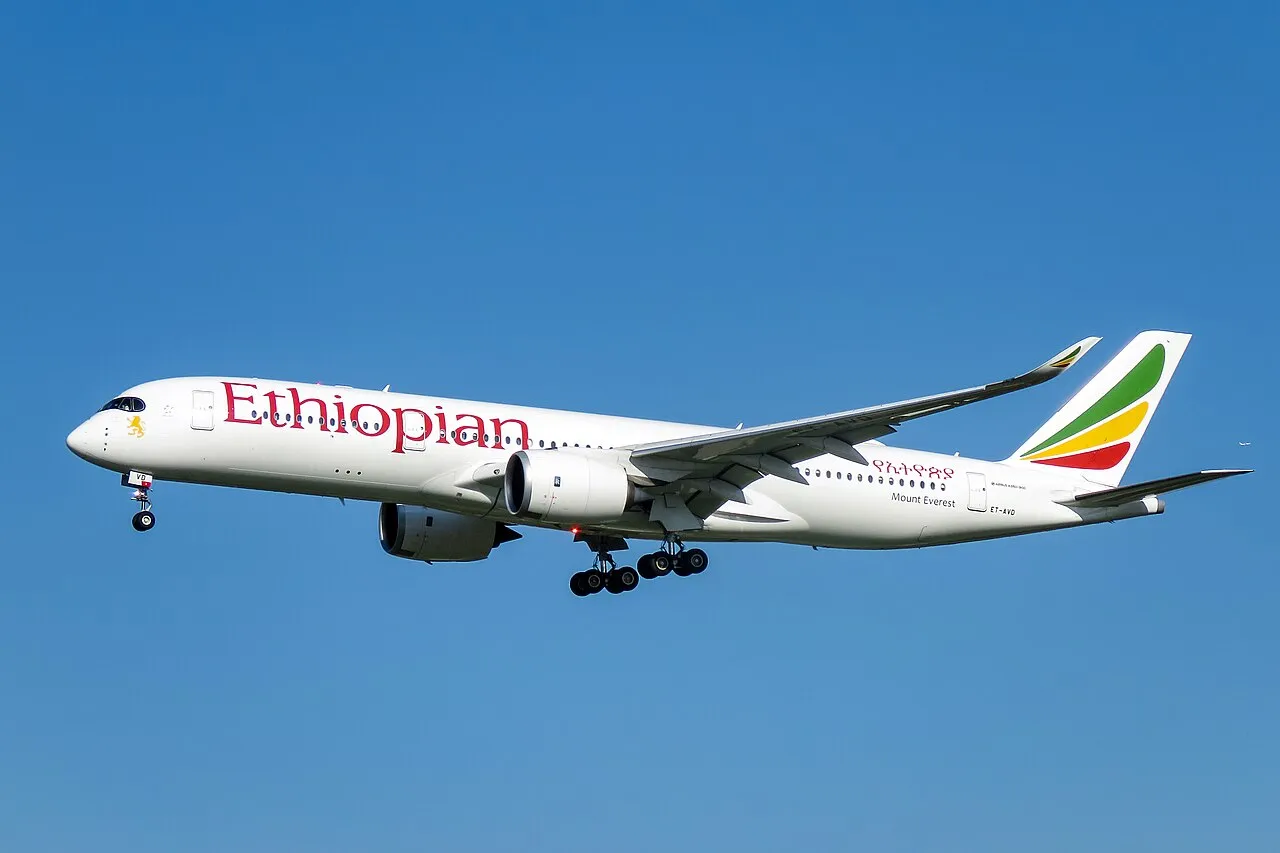
Ethiopian Airlines is the exception that the rest of African aviation is measured against. Founded in 1945 and flying since 1946, it is today the continent's largest carrier by passengers, destinations, fleet and revenue — and, more unusually, its most consistently profitable. For the 2024/25 Ethiopian fiscal year it reported $7.6bn in revenue, an 8% year-on-year rise, carrying 19.1 million passengers (15.2m international, 3.9m domestic) and roughly 785,000 tonnes of cargo across a fleet of more than 150 aircraft. In the prior year it posted a $1.053bn profit. Those are not African numbers graded on a curve; they are competitive with mid-sized global carriers.
What makes the story matter to MonoKromatik is not the balance sheet alone but who owns it. Ethiopian Airlines is wholly owned by the Ethiopian state through Ethiopian Investment Holdings, the country's sovereign wealth fund. There is no foreign carrier holding a strategic stake, no private-equity turnaround, no franchised brand licence. The airline that connects Africa to Beijing, São Paulo, Washington and London is African-owned from the hub to the cockpit — and it got there while its peers, structured more conventionally, went to the wall.
The contrast is stark and current. Kenya Airways — part-owned by KLM under a much-praised strategic partnership — has needed repeated government bailouts and saw losses balloon during COVID, tripling to around $333m in 2020. South African Airways has not turned an annual profit since 2011 and was lined up for roughly a $1bn bailout after accumulating around $1.2bn in losses between 2018 and 2022. Nigeria has spent two decades failing to stand up a durable flag carrier. Across the continent, with a small number of exceptions, national airlines lose money. Ethiopian makes it — at scale, in a low-income country, as a state-owned enterprise. That combination is supposed to be impossible, and the conventional wisdom explains it away as luck or subsidy. It is neither.
The airline is also more than a passenger business, and that matters to how it survives. Its footprint spans cargo — Ethiopian runs one of the largest freighter networks on the continent, serving 68 dedicated cargo destinations — alongside aircraft maintenance, a catering arm, ground services, an in-house technology unit and the training academy. Secondary hubs and logistics nodes reach into Liège, Lomé, Lilongwe and Lusaka. Where a single-line passenger carrier is fully exposed to fuel spikes, currency shocks and demand collapse, Ethiopian sits on a diversified stack of aviation businesses that rarely fail all at once. When one leg buckles, another carries. That structural resilience is not an accident of size; it was deliberately built, decade over decade, as the point of the enterprise.
PREMIUM CASE STUDY
The full strategic decode — the bet, the creative move, the evidence ledger and the lessons — is part of the Intelligence membership.