THE MONOKROMATIK DECODE
Our editorial read across the four dimensions we use to assess creative work — an authorship-weighted Cultural-Signal Score, reflecting judgement, not a measured metric.
82 /100AACULTURAL-SIGNAL SCOREStrong — clear authorship, real consequenceNo one-in-three likelihood of movement identified in the next twelve months.
An outlook states at least a one-in-three likelihood of a change over the next twelve months. How outlooks work
Naming the brand after an immigrant métro stop and treating the Goutte d'Or as the design language rather than a reference is an original founding premise, strongly adapted rather than category-defining.
Confirmed founder-owned by the two Fofana brothers, fabric bought from the same Goutte d'Or merchants the brand is named for, and collections produced in Paris. When Jordan wanted the story it had to negotiate with the rights-holder.
A decade of confirmed sustained output — Paris production, the 2019 Air Jordan 1 Mid SE 'Fearless', and Monoprix collaborations begun in 2018 and renewed across clothing and homeware. Disciplined and consistent, still boutique in scale.
The 35,000-pairs-in-hours figure is reported and not independently confirmed, and the piece explicitly declines to quantify how much money Les Oiseaux Migrateurs has channelled into African SMEs or name a single enterprise built. The funding-engine claim, which is the whole consequence argument, has no published number behind it.
THE CONTEXT
Château Rouge is a métro station on Line 4 in the Goutte d'Or quarter of Paris's 18th arrondissement — the stretch of the city Parisians have long called 'Little Africa'. It is where the West African diaspora buys its wax fabric, its hair products, its bissap and its ginger juice; a dense, loud, trading neighbourhood usually written about in the register of poverty, overcrowding and policing, rarely as a source of cultural authority. In 2015 two brothers, Youssouf and Mamadou Fofana, launched a lifestyle label and named it after exactly that station. The choice was the whole thesis: the place other brands sanitise into vague 'ethnic inspiration' was, for Maison Château Rouge, the literal address on the label — a deliberate act of putting a stigmatised postcode at the centre of a desirable brand rather than airbrushing it out.
The commercial origin story is unusually literal. Before the clothing, the Fofanas were selling a hibiscus (bissap) drink — a diaspora staple in West African homes — as an early product, and the brand grew out of that lifestyle-and-food impulse rather than any fashion-school pedigree; Youssouf had worked in banking before this. That matters because it means the aesthetic was never abstracted from the community. The garments that followed used wax cloth and patchwork sourced from the Goutte d'Or's own merchants and were produced in Paris, so the supply chain physically began and ended in the neighbourhood the brand invokes. What reads to an outsider as a marketing conceit is, in the actual sourcing and production, structurally true — the story and the logistics are the same story. That integrity of origin is rare enough in fashion to function, on its own, as a competitive position: the brand's authenticity is not a claim it makes in its copy but a fact embedded in where its materials come from and where its clothes are made.
Crucially, the fashion label sits underneath a mission, not the other way around. In 2014 — a year before the clothing launched — the brothers created an association, Les Oiseaux Migrateurs ('the migratory birds'), aimed at participating in the development of small and medium-sized enterprises in Africa. Maison Château Rouge was conceived, in the founders' own telling, as the commercial vehicle to fund that work: a for-profit brand engineered to bankroll a development agenda. That sequencing is the tell. Most 'mission-driven' fashion brands bolt a cause onto an existing commercial engine; here the cause came first and the brand was built to feed it. That inversion — product as the means, continental value-creation as the end — is what separates this from a wax-print streetwear line trading on aesthetics alone, and it is the frame every subsequent move should be judged against.
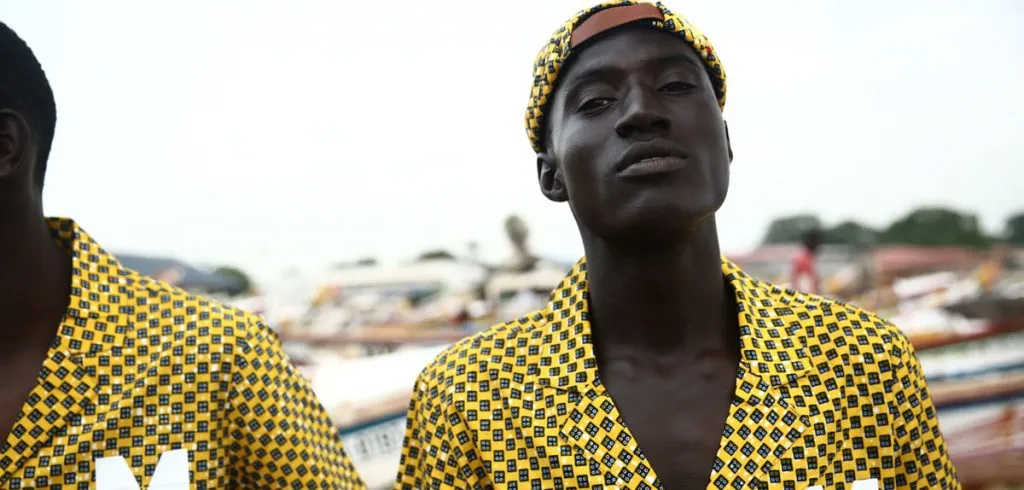
The place other brands sanitise into 'ethnic inspiration' was, for Maison Château Rouge, the address on the label.
THE STRATEGIC BET
The strategic bet is that authenticity of place is a defensible moat that outsiders cannot buy. Every global luxury and sportswear house can license a wax motif and shoot it against a colourful wall; almost none can credibly say the fabric was bought two streets from the studio, from the same traders who serve the diaspora that wears it. Maison Château Rouge bet that in a market saturated with borrowed African motifs — a market where 'Afro' prints cycle through European collections every few seasons and vanish — provenance would become the scarce and premium asset. Real, verifiable, neighbourhood-level provenance is the one thing a competitor with more capital cannot simply outspend. The brand name is the standing guarantee that the story cannot be detached from the product: you cannot copy Château Rouge without conceding that Château Rouge got there first.
The second bet is diaspora-first, not Africa-abstract. Rather than positioning as 'African fashion' aimed at a Western gaze, the label speaks to the specific, lived identity of second-generation Africans in France — people navigating what Youssouf Fofana has described as a double identity between the banlieue and the continent, at home fully in neither and fluently in both. That precision is commercially counterintuitive: the natural instinct of a young brand is to broaden its addressable market as fast as possible. Instead the brand narrowed — to a community that had disposable income, deep cultural fluency, and no premium label that reflected it back to them with dignity. The wager was that this underserved audience would become the most loyal early base, and that global desire would then arrive on top of that foundation, pulled by the brand's obvious rootedness rather than manufactured for an international buyer who was never the point.
The third bet is the hardest and the most distinctive: that a clothing brand can function as a genuine economic instrument for the continent. Tying Maison Château Rouge's proceeds to Les Oiseaux Migrateurs reframes each sale as capital allocation — a jacket bought in Paris becomes, in the model's logic, a contribution toward an enterprise being built in West Africa. It is a bet that consumers, and diaspora consumers especially, will pay a premium for a purchase that carries a development thesis, and that the brand can hold a fashion standard and a mission standard simultaneously without either quietly collapsing the other. This is the exact place most 'purpose' brands fail: the mission becomes marketing, or the commercial pressure hollows out the cause. The Fofanas' bet is that structural sequencing — mission incorporated first, brand built to fund it — is what keeps the dual mandate honest under growth pressure. Whether that holds at scale is the open question the model has not yet fully answered.
THE CREATIVE MOVE
The signature creative move was refusing to treat wax print as decoration. In mainstream fashion, African cloth typically appears as a seasonal accent — a lining, a trim, a single loud 'statement' piece designed to be noticed and then retired. Maison Château Rouge built its grammar the other way round: wax and Dakar-sourced patchwork as the base material, cut into the everyday silhouettes of Parisian streetwear — bombers, tracksuits, tote bags, hoodies, caps — the wardrobe of the neighbourhood, not the runway. The move fused two vocabularies that fashion usually keeps carefully apart, so a single garment reads simultaneously as contemporary Paris streetwear and as diaspora Africa, with neither swallowing the other. The cloth stopped being a costume worn to signal difference and became a uniform worn to signal belonging — a subtle but decisive shift in what the material is allowed to mean.
The most consequential execution was the 2019 Jordan Brand collaboration — the Air Jordan 1 Mid SE 'Fearless', released 30 November 2019. Reporting has it that Jordan's team was moved by the brand's story after encountering it around the Quai 54 international streetball tournament in Paris, and the resulting shoe carried Maison Château Rouge's codes onto one of the most sanctified silhouettes in global culture: a UNC-blue base nodding to Jordan's own heritage, warmed with the browns and yellows and baseball-style craft-stitching that evoke the label's wax roots and the tailors of the Goutte d'Or. The direction of travel matters more than the sneaker itself. A Paris diaspora micro-brand, less than five years old and rooted in an immigrant high street, was invited to author a Jordan — not to license a logo, but to put its neighbourhood's grammar onto Nike's most iconic shape. For a diaspora label to be the creative counterparty in that exchange, rather than the flattered recipient of a licensing cheque, is the whole point.
Around that halo, the brand executed a patient distribution ladder that kept its centre of gravity in the neighbourhood while steadily extending reach. It sustained its own boutique presence and stocked at established Parisian retailers, then ran repeated collaborations with the mass-market French chain Monoprix — a first collection in 2018, renewed across subsequent years, spanning clothing, homeware and household linen and putting diaspora-authored design onto an everyday high-street shelf at accessible prices. Read together, the ladder is deliberate: from Little Africa boutique, up through Jordan hype at the luxury-sneaker tier, across to Monoprix at genuine mass-market reach. Each rung addresses a different consumer and a different price point, but all of them route back to the same source material and the same neighbourhood. That is how the brand managed to be a cultural signifier and a reachable everyday product at once, without the mass-market extension diluting the credibility that made it desirable in the first place.
THE EVIDENCE
Confirmed: Maison Château Rouge was founded in 2015 in Paris by brothers Youssouf and Mamadou Fofana, and named after the Château Rouge métro station in the Goutte d'Or (18th arrondissement).
Confirmed: The brand uses wax fabric and patchwork sourced from Goutte d'Or merchants and produces collections in Paris.
Confirmed: The association Les Oiseaux Migrateurs was created in 2014 to support the development of small and medium-sized African enterprises, and the fashion label was launched to help fund that mission.
Confirmed: Maison Château Rouge collaborated with Jordan Brand on the Air Jordan 1 Mid SE 'Fearless', released 30 November 2019.
Confirmed: The brand has run repeated collaborations with the French retailer Monoprix, beginning in 2018 and renewed in later years across clothing and homeware.
Reported independently: That the Jordan collaboration sold roughly 35,000 pairs within hours of release (widely reported, not independently confirmed here).
Reported independently: That the founders' family heritage is West African (variously described as Senegalese and/or Malian across profiles); the brothers grew up around Villepinte in the Paris region.
Reported independently: That Jordan Brand's interest was sparked by encountering the brand around the Quai 54 streetball tournament in Paris.
Not claimed at this stage: We do not assert any collaboration with adidas — the documented sportswear collaboration is with Nike's Jordan Brand, not adidas.
Not claimed at this stage: We do not quantify how much money Les Oiseaux Migrateurs has channelled into African SMEs, nor claim specific enterprises built.
Not claimed at this stage: We do not claim precise revenue, unit volumes beyond what is reported, or valuation figures for the brand.
When Jordan wanted a diaspora story, it did not manufacture one internally — it came to the people who already lived it.
THE AFRICAN READ
The African read here is about authorship in its strictest sense: who holds the pen, who owns the equity, and who decides what the culture means. Maison Château Rouge is not a global house borrowing African aesthetics under a European creative director's supervision; it is two Franco-African brothers who own the company outright, source from their own community, and set the terms on which wax print enters the luxury-adjacent conversation. When Jordan wanted a diaspora story, it did not manufacture one inside its design studio — it came to the people who already lived it and asked them to author the work. That reversal, from extraction to invitation, is the entire lesson. It is the difference between the diaspora being a reference the industry mines for free and the diaspora being the rights-holder the industry has to negotiate with. Ownership, not visibility, is the metric that matters — and here the ownership is unambiguous.
It also reframes the diaspora as a market with standards, not a demographic to be talked down to. For a long time 'African' product aimed at Europe was priced and positioned as craft or charity — worthy, cheap, exotic, bought to feel good rather than to look good. Maison Château Rouge insisted on the register of desire and price power that the culture had rarely been granted in the mainstream: a covetable, collaborated-upon, sometimes sold-out brand built entirely from diaspora material and sold at prices that assumed the customer had both taste and money. That is a quiet act of economic dignity. It says the second-generation African consumer is not a beneficiary of representation to be thanked for showing up, but a taste-maker with buying power whose preferences set trends — and that African aesthetic ownership can command premium demand rather than discount pity. Reframing the audience upward is itself a form of authorship.
The most ambitious part of the read is the brand-as-economic-vehicle thesis embodied in Les Oiseaux Migrateurs. The model proposes that a diaspora brand can be a mechanism for redirecting capital and capability back toward the continent — turning cultural production in Paris into enterprise-building in Africa, closing a loop that usually runs one way, from Africa outward. That is the frontier the culture economy keeps promising and rarely delivering: not merely African-owned brands, but African-owned brands wired to fund African-owned production and African SMEs. We should be precise about the limits of the claim. Maison Château Rouge does not, on the public record we can verify, claim to have single-handedly built continental value chains, and we do not assert it either — the concrete scale of what the association has funded is not something this piece can quantify. What the brand has proven is the harder, prior half of the thesis: that diaspora authorship, held tightly and priced with confidence, can generate the commercial surplus a development agenda has to run on in the first place. Cultural ownership is being converted into economic capacity. The unfinished work — the test that will decide whether this is a model or a moment — is scale: how much capital the loop can actually move, and how many enterprises on the continent it can stand up. That is the number the next decade has to produce.
LESSONS FOR BRAND BUILDERS
Provenance is a moat competitors can't license Anyone can print a wax motif; almost no one can say the cloth was bought two streets away from the same merchants the brand is named after. Maison Château Rouge turned neighbourhood-level authenticity into a defensible premium asset. For African-authored brands, the lesson is to make the supply chain part of the story that outsiders literally cannot replicate.
Narrow to a community with power before chasing the world The brand designed for second-generation Africans in France — a specific diaspora with money and cultural fluency — rather than an abstract global 'African' consumer. Global desire then arrived on top of a real base. Precision beat breadth: the tighter the identity, the stronger the demand it eventually radiated outward.
Own the pen, and the big platforms will come to you Jordan didn't build a diaspora narrative in-house; it invited the people who owned one to author a shoe. Holding equity and cultural authorship flipped the usual extraction into an invitation. African creators should treat ownership not as a moral position but as the leverage that makes them the counterparty blue-chip brands need.
A brand can be an economic instrument, if the mission sits underneath the product By wiring proceeds to Les Oiseaux Migrateurs, the founders reframed a purchase as capital allocation toward African enterprise. The mission is the end and the product is the means — the reverse of most 'purpose' branding. It only works because the fashion standard is held as seriously as the development one.
PUBLICATION VERIFICATION STATUS
Founding, ownership, materials and headline collaborations are well-documented; sales figures and precise family heritage are reported and treated as such.