THE MONOKROMATIK DECODE
Our editorial read across the four dimensions we use to assess creative work — an authorship-weighted Cultural-Signal Score, reflecting judgement, not a measured metric.
78 /100ACULTURAL-SIGNAL SCORESound — good work, incomplete captureNo one-in-three likelihood of movement identified in the next twelve months.
An outlook states at least a one-in-three likelihood of a change over the next twelve months. How outlooks work
Downgraded. 'Outspend the league to make continental and global competition the baseline' is the category's standard play — Al Ahly and Zamalek ran continental dominance long before Sundowns, and heavy-owner funding is the default model in world football. Run knowingly and well, but not new to this market or the category.
Wholly South African-owned by the Motsepe family since 2004, with trophies, players, IP and revenue captured on the continent. Held at 4 rather than 5 because the club's global relevance runs on platforms it does not own (FIFA's Club World Cup, CAF's competitions), and the Motsepe CAF presidency makes the governing layer an external dependency the entry itself flags.
Eight consecutive league titles, 15 PSL-era titles, two CAF Champions Leagues, the men's-and-women's continental double, the inaugural African Football League, and the first win by an African club at the expanded 32-team Club World Cup — all confirmed from third-party records. This is the standard others in the confederation copy.
Held. The sustained domestic and continental position is confirmed and has persisted well beyond 12 months. But value capture beyond Southern Africa is unproven — valuations are conflicting reported estimates (~US$29-39m), the entry explicitly notClaims any measurable growth in global fanbase, and the group-stage exit is the counter-evidence. Documented outcome, capture partial = 4.
THE CONTEXT
Mamelodi Sundowns are, by trophy count and financial firepower, the most dominant football club brand Africa has produced in the modern era. Founded in 1970 and based in the township of Mamelodi outside Pretoria, the club is nicknamed 'The Brazilians' — an identity borrowed decades ago when a previous owner reshaped the kit in the yellow, green and blue of Brazil's national team. That visual borrowing is worth pausing on: the most recognisable African club brand defined itself, from the start, by reference to a foreign footballing icon. The question this case study asks is whether Sundowns have since built something ownable and native, or whether the borrowing runs deeper than the shirt.
The turning point was 2004, when mining magnate Patrice Motsepe took full control of the club. Motsepe — one of South Africa's wealthiest people, whose fortune runs through African Rainbow Minerals and the Ubuntu-Botho / African Rainbow Capital investment vehicles — set an explicit goal: win the CAF Champions League, Africa's premier club competition. That goal was reached in 2016 under coach Pitso Mosimane, and again in the 2025-26 season. Domestically the dominance is close to total. Sundowns have won the South African top flight in every season from 2017-18 onward — an eight-title streak and counting — alongside a stack of domestic cups. In continental terms they became, in 2021, the first African club to hold both the men's CAF Champions League and the CAF Women's Champions League, and in 2023 they won the inaugural African Football League. In 2025 they reached the expanded FIFA Club World Cup in the United States.
The engine underneath is a patronage-plus-diversified-revenue model that no PSL rival can match. Sundowns draw from the same league broadcasting pool as everyone else — South African league TV rights are substantial by African standards — but they layer on direct corporate backing from Motsepe's businesses, premium sponsorships (a long-running Puma kit deal, a reported multi-year Ferrari sleeve partnership, Betway league sponsorship), and consistently strong match-day attendances. Reported wage figures put their top earners far above the league norm; the club does not publish audited accounts, so exact numbers are contested, but the directional truth is uncontested: Sundowns simply spend at a different altitude. In market-value league tables of African clubs they sit at or near the top, jockeying with Egypt's Al Ahly. This is the raw material of a brand. The strategic question is whether raw material has been converted into durable, ownable equity.
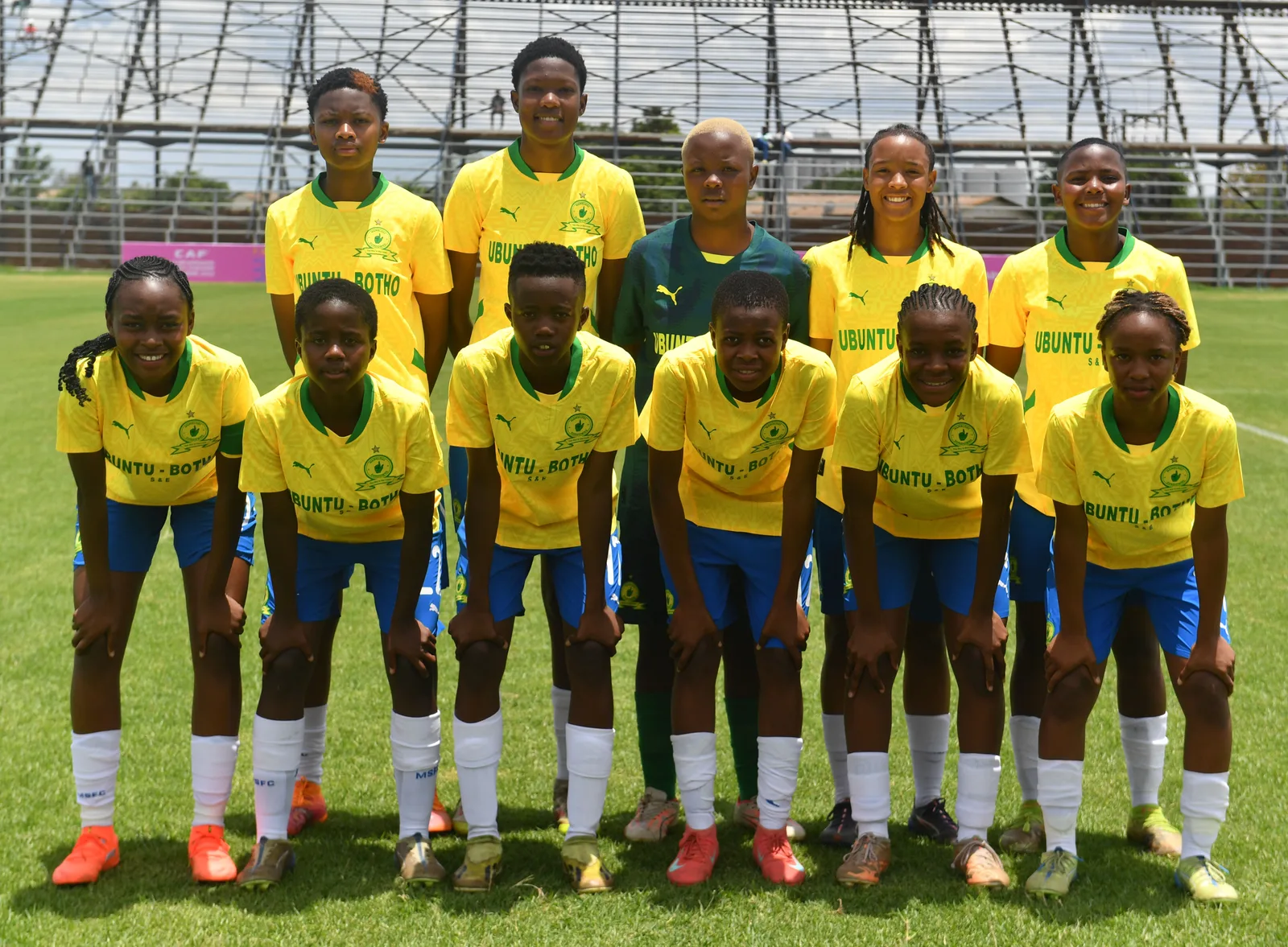
Dominance travelled as far as respectability and stopped short of gravity.
THE STRATEGIC BET
The bet is that dominance is a brand strategy. In football, unlike most categories, winning is the product and the marketing at once — a club that wins relentlessly manufactures its own highlight reel, its own narrative, its own reasons to watch. Motsepe's wager was that if you fund an African club to consistently beat its continent and then show up on the global stage, you build something that African fans will choose on merit rather than as a patriotic obligation. It is a deliberately maximalist bet in a market where most clubs are structurally under-capitalised and where the default consumption for a young South African, Nigerian or Kenyan football fan is the English Premier League, not the club down the road.
There is a sharper, less comfortable layer to the bet. Since 2021 Patrice Motsepe has been president of CAF, the body that governs the very competitions Sundowns compete in and profit from. To manage the obvious tension he handed day-to-day control of the club to his son, Tlhopie Motsepe, who now chairs it. This is a genuine strategic asset and a genuine liability at once. As an asset, it plugs the club's owning family into the commercial and governance machinery of the entire African game — no rival sits closer to the levers that set the calendar, the prize money and the media strategy of continental football. As a liability, it means every marginal refereeing call, every scheduling quirk, every prize-money decision that touches Sundowns invites a conflict-of-interest reading. A brand whose dominance is even partly attributed to proximity to power is a brand that can be argued with, and 'they only win because of who owns them' is the single most corrosive story a sports brand can carry.
The commercial logic of the bet depends on media rights and attention, not gate receipts. African club football's structural problem is that value has historically leaked to Europe: the continent's best players are sold young, its biggest fanbases spend their viewing hours and their replica-shirt money on foreign clubs, and its domestic leagues capture a fraction of the broadcast value their talent ultimately generates abroad. Sundowns' strategy is an attempt to plug that leak at one point — to build a single African club big enough to keep some of that attention, talent and money on the continent. The Club World Cup appearance is the clearest expression of the bet: a shop window in which an African club stands, for once, on the same commercial stage as Borussia Dortmund and Fluminense, in front of a global audience and global sponsors.
THE CREATIVE MOVE
The creative move worth decoding is not a campaign — it is the decision to treat an African club as a serious, sustained investment rather than a rich man's hobby or a civic charity. Most African clubs are run hand-to-mouth or as vanity projects that spike and collapse with an owner's enthusiasm. Sundowns institutionalised the spending: a stable ownership structure, a recruitment operation that pulls the best players from across Southern Africa and beyond, continuity in coaching philosophy (the quick-passing 'Shoe Shine and Piano' style is a recognisable on-pitch signature, not just a results machine), and a women's team funded seriously enough to win its own continental title. The brand equity lives in that consistency. When a club wins for a decade without wobbling, the winning itself becomes the identity — 'Sundowns win' is now a fact the way 'Bayern win' is a fact, and that predictability is, counter-intuitively, a durable brand asset.
The second move is the yellow. The Brazilian-inspired kit is a double-edged piece of brand design. On one hand it is instantly legible — bright, warm, associated globally with beautiful, winning football, and impossible to confuse with a European club's palette. It gives Sundowns a visual identity that reads as celebratory and distinctly non-European, which matters for a brand trying to own African attention on its own terms. On the other hand, an identity built by pointing at Brazil is an identity that has outsourced its origin story. The most ownable brands author their own mythology; Sundowns' most famous nickname is, at root, a comparison. The strategic upside is that a decade of dominance and two continental titles have begun to fill 'The Brazilians' with home-grown meaning — the reference now points as much to Sundowns' own swagger as to Brazil's. Whether that transfer of meaning completes is one of the real open questions about the brand's durability.
THE EVIDENCE
Confirmed: Patrice Motsepe took full control of Mamelodi Sundowns in 2004; the club is now chaired by his son Tlhopie Motsepe (Wikipedia: Mamelodi Sundowns F.C.; Wikipedia: Patrice Motsepe)
Confirmed: Sundowns have won the South African top-flight title every season from 2017-18 onward, an eight-consecutive-title streak, and 15 PSL-era league titles (Wikipedia: Mamelodi Sundowns F.C.)
Confirmed: Sundowns won the CAF Champions League in 2016 and again in 2025-26, and in 2021 became the first African club to hold both the men's and women's CAF Champions League titles (Wikipedia: Mamelodi Sundowns F.C.)
Confirmed: Sundowns won the inaugural African Football League in 2023 (Wikipedia: Mamelodi Sundowns F.C.)
Confirmed: At the 2025 FIFA Club World Cup, Sundowns beat Ulsan HD 1-0 — the first win by an African club at the expanded 32-team tournament — via an Iqraam Rayners goal (FIFA match report)
Confirmed: Sundowns finished third in Group F on four points, behind Borussia Dortmund (7) and Fluminense (5), after a 4-3 loss to Dortmund and a 0-0 draw with Fluminense, and were eliminated (Foot Africa; FIFA)
Confirmed: Patrice Motsepe has been president of CAF since his election on 12 March 2021, after the other candidates withdrew (Wikipedia: Patrice Motsepe)
Reported independently: Sundowns are widely reported as one of the richest and most valuable clubs in Africa, at or near the top of market-value tables alongside Al Ahly, with reported valuations in the range of roughly US$29m-39m depending on source and date (Statista; Africa Facts Zone; Moor Sportz)
Reported independently: The club's revenue is reported to combine league broadcasting money, premium sponsorships (Puma kit deal, a reported ~US$62m Ferrari sleeve partnership, Betway), match-day income and direct corporate backing from Motsepe's businesses (Moor Sportz)
Reported independently: Reported top wages (e.g. Peter Shalulile / Lucas Ribeiro) sit far above the PSL norm, though the club does not publish audited accounts and figures vary by outlet (Moor Sportz; inquiresalary.co.za)
Reported independently: Sundowns chairman Tlhopie Motsepe has described the CAF Champions League as more 'rewarding' than domestic title dominance (Goal.com)
Not claimed at this stage: We do not claim any specific, audited figure for the club's revenue, wage bill or market value — the club does not publish accounts and reported figures conflict
Not claimed at this stage: We do not claim that Sundowns' results are caused by Motsepe's CAF role; we report only that the overlap invites conflict-of-interest scrutiny and note it as a brand-perception risk
Not claimed at this stage: We do not claim Sundowns command a large following outside Southern Africa, nor that the Club World Cup appearance measurably grew their global fanbase
The trophies are the easy part. The attention is the moat, and the moat is still being dug.
THE AFRICAN READ
MonoKromatik's read is that Sundowns are the most important African club-brand experiment of the era precisely because they test, in public, whether African ownership can hold African attention against Europe. The authorship story is genuinely strong and deserves to be said plainly: this is a wholly African-owned institution that captures its value at home. The trophies, the transfer fees, the sponsorship revenue, the intellectual property of the brand — none of it is rented from a European league or a foreign platform. In a continental economy where the dominant pattern is African talent and African audiences generating value that settles overseas, a self-funded African super-club that keeps the money, the players and the glory on the continent is a structurally different and more valuable thing than another export pipeline. On the sharpest question the Index asks — who owns the value — Sundowns answer better than almost any African cultural or sporting brand of comparable scale.
But dominance and brand equity are not the same asset, and this is where the honest downside lives. Sundowns win at home almost by default, and a competition without jeopardy erodes the very drama that makes a sports brand compelling to neutrals. Domestic dominance is real, but it is dominance of a league whose commercial ceiling is a fraction of Europe's, and it is partly manufactured by a spending gap rather than earned in a fair fight — which is exactly the critique that dogs state-and-billionaire clubs everywhere. The global test was unambiguous: at the 2025 Club World Cup, Sundowns beat South Korea's Ulsan HD — the first win by an African club at the expanded 32-team tournament, a genuine milestone — then lost a seven-goal thriller to Borussia Dortmund and drew with Fluminense, finishing third in their group and going home. They competed with dignity and did not embarrass the continent. They also did not advance, and no neutral global fan converted to Sundowns fandom on the strength of it. Dominance travelled as far as respectability and stopped short of gravity.
The durability question, then, resolves into three dependencies the brand has not yet escaped. First, the patron: a brand this reliant on one family's wealth and one man's institutional position is a brand with a single point of failure, and the CAF-presidency overlap means even the club's cleanest wins carry an asterisk in the minds of rivals. Second, the ceiling: without a stronger, more competitive continental and domestic product to test against, Sundowns risk becoming very good at winning a competition too few people outside Southern Africa are watching. Third, the meaning: 'The Brazilians' is a borrowed frame that a decade of success is slowly repaying, but the brand does not yet own a native mythology as distinctive as its results. Our verdict is that Sundowns have built the most valuable African club asset of the era and the clearest proof that African ownership can compete — but that converting dominance into a brand Africans actively choose over Europe, rather than admire from a distance, is a job that is maybe half done. The trophies are the easy part. The attention is the moat, and the moat is still being dug.
LESSONS FOR BRAND BUILDERS
Owning the value beats renting the reach. Sundowns' real achievement is not the trophies — it is that a wholly African-owned club captures its talent, revenue and IP on the continent instead of exporting it. In a market built on value leaking to Europe, keeping the value home is the rarer and more defensible move. That is the authorship lesson every African brand-builder should copy.
Dominance is a product, not yet a brand. Winning manufactures narrative, but a competition without jeopardy erodes the drama that makes neutrals care. Sundowns proved they can win everything at home and still fail to convert a global audience. Equity comes from being chosen, not from being unbeatable in a league few outsiders watch.
A single patron is a single point of failure. Billionaire backing bought a decade of dominance, but a brand this dependent on one family's wealth — and one man's seat atop the governing body — carries a structural fragility and a permanent asterisk. Diversify the base of support, or the story stays 'they win because of who owns them.'
Borrowed identity has a repayment schedule. 'The Brazilians' gave Sundowns instant legibility by pointing at someone else's icon. A decade of success is slowly transferring that meaning home, but the most durable brands author their own mythology from the start. Borrow the frame if you must — then spend relentlessly to make it yours.
PUBLICATION VERIFICATION STATUS
League title counts, CAF Champions League wins (2016 and 2025-26), the 2023 African Football League title, the 2025 Club World Cup group results, ownership by the Motsepe family, and Patrice Motsepe's CAF presidency are confirmed by primary and major secondary sources. Wage figures, market valuations, and sponsorship values are reported estimates that vary by outlet and currency conversion, and the club does not publish audited accounts — treat all money figures as directional, not exact.