THE MONOKROMATIK DECODE
Our editorial read across the four dimensions we use to assess creative work — an authorship-weighted Cultural-Signal Score, reflecting judgement, not a measured metric.
61 /100BBBCULTURAL-SIGNAL SCOREMixed — the idea outruns the ownershipNo one-in-three likelihood of movement identified in the next twelve months.
An outlook states at least a one-in-three likelihood of a change over the next twelve months. How outlooks work
Taking the lane Nike and adidas ceded and making the AFCON aesthetic a signature is a strong, well-adapted competitive idea — owning a tournament's visual identity while rivals contest Europe. Recognisable strategy, sharply applied to a new theatre.
Named diaspora designers genuinely shaped the marquee kits, but that is authorship of artwork, not of value: the IP, the margin, the brand equity and next year's strategy all settle on a Frankfurt-listed balance sheet. Federations receive supply and undisclosed fees; designers receive a commission and a credit. African creative input, external ownership.
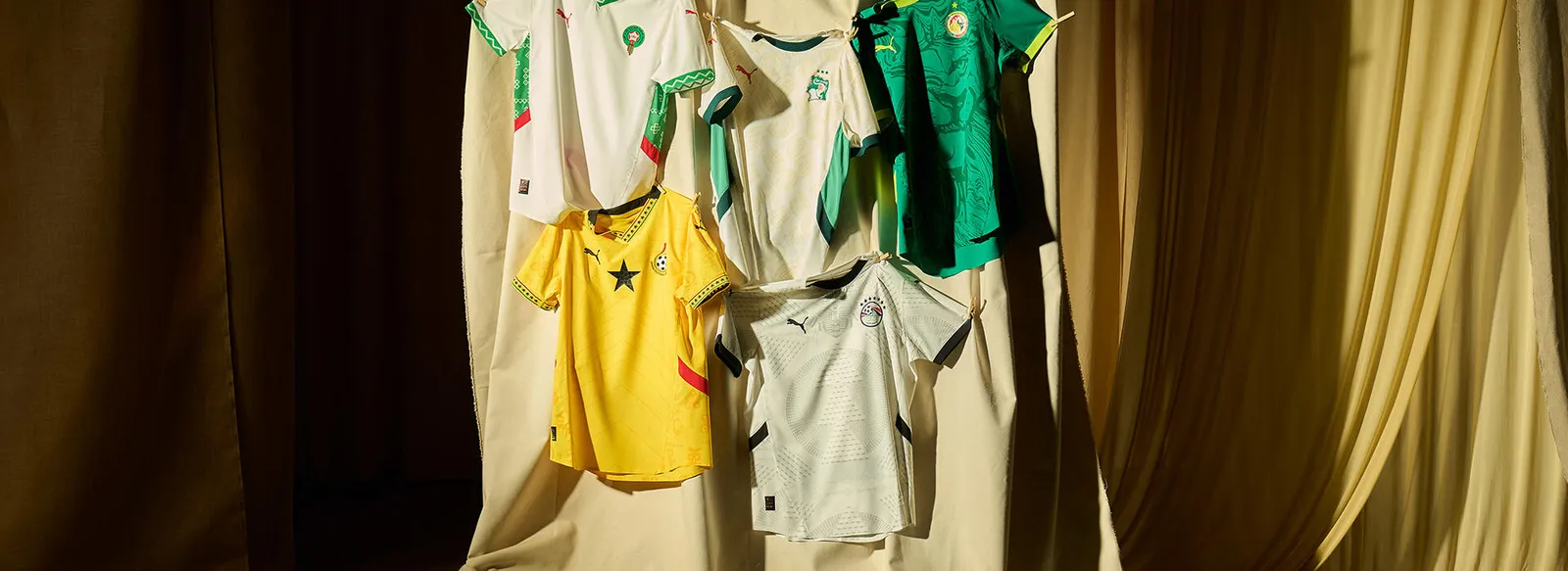
Confirmed and strong: bespoke home-and-away sets for five federations, the CAF technical-partner match ball and referee equipment, heat-activated Adinkra print work. Clearly above template-kit standard; not flawless across every surface.
Confirmed that Puma is the most-represented supplier at AFCON 2025 while Nike and adidas dress one team each — real cultural stakes. But the value accrues to a German group posting a €357m operating loss on 13% lower revenue, no African segment figure is disclosed, and the compensation terms for designers and federations are private. Impact accruing mainly to a non-African counterparty is a 3.
THE CONTEXT
Walk through the group stage of the 2025 Africa Cup of Nations — staged in Morocco from 21 December 2025 to 18 January 2026 — and one leaping cat recurs more than any other logo. Puma dresses the tournament's aristocracy: Egypt, Côte d'Ivoire, Morocco, Senegal and Ghana are all, per Puma's own newsroom, Puma federations, and Footy Headlines' brand audit of the 24-team field counts Puma as the single most-represented supplier at the finals. Nike and adidas — the two brands that dominate the World Cup, the Premier League and the global sneaker war — field just one team each. On African football's biggest stage, the German challenger is the incumbent.
That dominance is not an accident of a single cycle. Puma has kitted more national teams across Africa than any rival for close to three decades; its Ghana partnership dates to 2005 and its current Senegal agreement was struck in February 2018, announced as a long-term deal by then-CEO Bjorn Gulden and SFA president Augustin Senghor. For AFCON 2025 Puma also serves, for the second time, as the Confederation of African Football's official technical partner — supplying the match ball, named ITRI after the Amazigh word for 'star', and the referee equipment. It is both outfitter and infrastructure.
What sharpens the story is the backdrop. Puma is dressing a continent's showcase from a position of corporate weakness, not strength. The group closed 2025 with revenue of roughly €7.3bn — down more than 13 percent on a reported basis — and swung to an operating loss of €357m against a €549m profit the year before, per WWD's reporting of the results. New chief executive Arthur Hoeld, poached from adidas, has cancelled the dividend, cut hundreds of white-collar roles, and told investors 2026 is a 'transition' year with a return to growth targeted only for 2027. Against that ledger, African football is one of the few places Puma still unambiguously wins. The question this case examines is what that winning is actually worth — and to whom.
PREMIUM CASE STUDY
The full strategic decode — the bet, the creative move, the evidence ledger and the lessons — is part of the Intelligence membership.