THE MONOKROMATIK DECODE
Our editorial read across the four dimensions we use to assess creative work — an authorship-weighted Cultural-Signal Score, reflecting judgement, not a measured metric.
51 /100BBCULTURAL-SIGNAL SCOREWeak — visibility without value captureNo one-in-three likelihood of movement identified in the next twelve months.
An outlook states at least a one-in-three likelihood of a change over the next twelve months. How outlooks work
Lowered from 4. Casting a musician on a runway among professional models is a familiar fashion-week device, and the entry's own note concedes the wider Afrobeats-luxury wave gives it tailwind rather than rupture. Competent and conventional, executed knowingly.
Lowered from 3. The notClaimed field is decisive: no capsule, no co-design credit, no attributed IP, no one in Rema's ecosystem credited. Creative direction, styling, casting and the archive concept are Glenn Martens' and Diesel's. An artist walking someone else's show in someone else's clothes is African talent and aesthetics used as input — that is a 2, not participation in the making.
Held. The show itself is well documented and coherent — the archive-warehouse staging, the styling fit, the fast TikTok-native distribution — corroborated across fashion-week and pan-African press. Minor gaps only; correctly short of 5 because it is an appearance rather than a co-creation.
Lowered from 3. The entry explicitly confirms that no public reporting shows Diesel investment in Nigerian design infrastructure, any talent pipeline, or any co-created IP. The evidence offered for consequence is a positive quote from Rema after the show. That is the moment passing without discernible consequence — a 2. Revisable upward if a pipeline is later evidenced.
THE CONTEXT
The week Rema walked into a stark white Milan warehouse, he was already inside a pattern much bigger than one runway appearance. By 2026 virtually every major European luxury house carries some Afrobeats cultural adjacency — and the commercial logic is now measurable.
Brand Africa 100’s 2026 index records luxury goods claiming 13 of Africa’s 100 most-recognised brands, up from 12 in 2025 — driven by rising aspirational consumption among Gen Z across sub-Saharan Africa and the Maghreb, with French houses leading the category.
But the industry’s mode of engagement has been structurally thin: African cultural authority acquired through casting, campaign photography and front-row invitations. Rema × Diesel arrives inside that pattern — with one decisive operational difference. The front-row invitation became a runway walk.
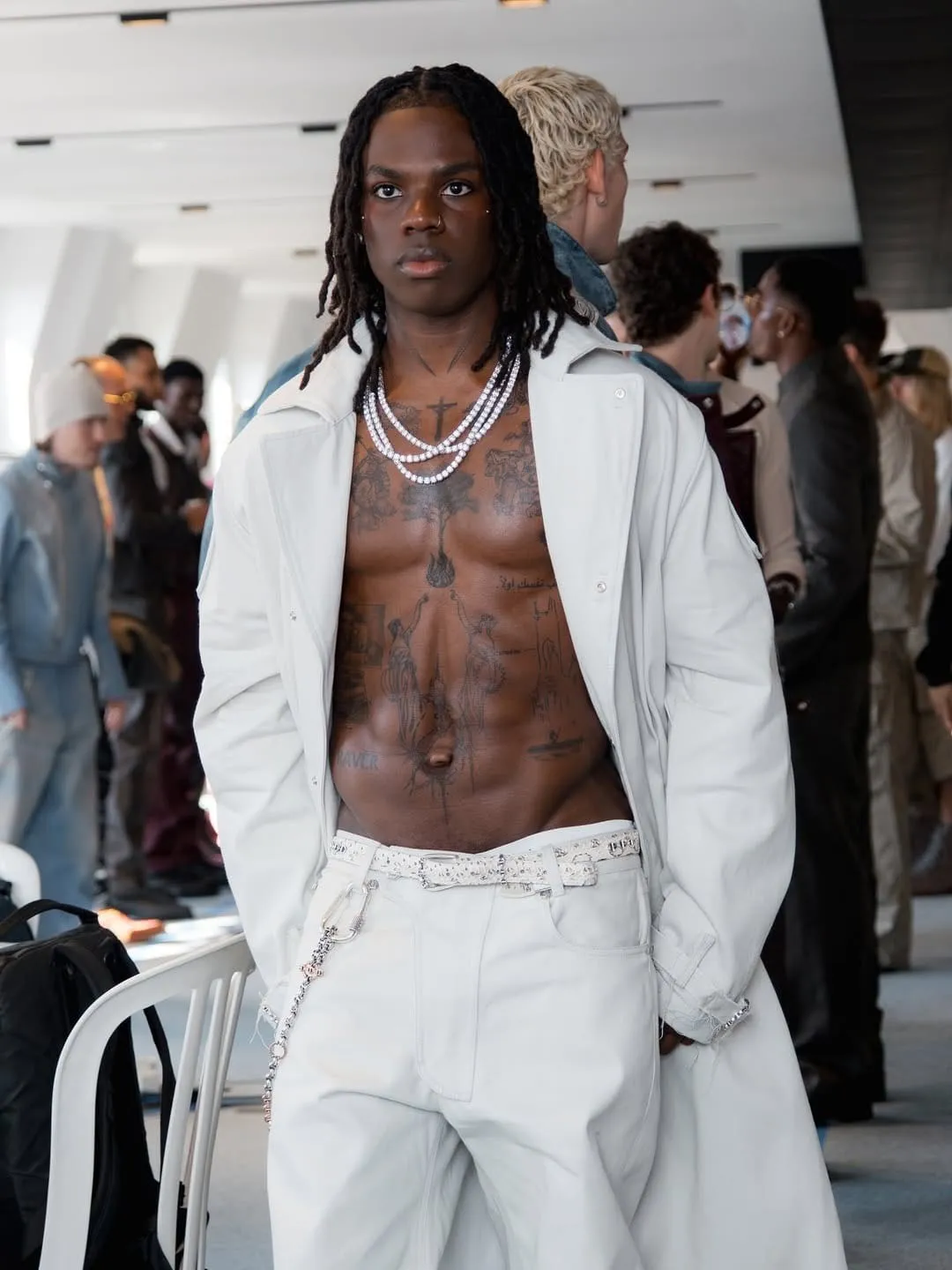
The body — not just the name — is the medium.
THE STRATEGIC BET
Diesel’s rationale runs on two tracks. First, Afrobeats cultural credibility with Africa’s Gen Z — the youngest major consumer market on the planet, with African dollar-millionaires projected to reach ~195,000 by 2031. Second, the jeans-as-luxury argument Glenn Martens has been consolidating: Rema’s denim-native aesthetic reinforces it with genuine credibility rather than borrowed prestige.
For Rema, the bet runs the complementary way. Walking is a higher-equity position than attending: it produces editorial photography in which the artist is the product, not the spectator — and expands his brand beyond music into the fashion industry proper.
The runway also lets Diesel reach Africa’s aspirational class without reading as a cynical ‘Africa-targeting’ campaign. In a globally prestigious context, Rema’s presence reads as an aesthetic choice, not demographic outreach.
THE CREATIVE MOVE
Rema made his runway debut at Diesel’s AW26 show on 25 February 2026 — not as a celebrity guest but walking the catwalk among professional models, in heavily distressed denim and a metallic-gold shearling-collar vest continuous with the collection’s vocabulary.
Glenn Martens staged the show as a ‘good walk of shame’ inside a white warehouse, a vault of 50,000 archival artefacts as backdrop — inflatables, toy animals, a car — models in glitter-dusted faces, crystal-covered denim and patchwork. Rema’s look read coherently inside that register.
The tell is fit, not fame. Diesel’s archive-surfing, controlled-disorder, hyper-textured-denim aesthetic is structurally compatible with Rema’s own street-and-performance codes. Martens didn’t need to dress Rema up; he needed to dress him accurately — a directorial choice to cast on visual fit, not name value. The body, not just the name, is the medium.
THE EVIDENCE
Confirmed: Rema walked the Diesel AW26 runway at Milan Fashion Week on 25 February 2026, among professional models, in distressed denim + a metallic-gold shearling-collar vest (multiple fashion + African entertainment outlets).
Confirmed: The show was directed by Glenn Martens and staged in a white warehouse with a ~50,000-item Diesel archive backdrop.
Confirmed: Coverage spanned the fashion-week press (Dazed, Wonderland), Afrobeats fan press and pan-African entertainment newsrooms; Rema called the experience ‘incredible’ post-show.
Reported independently: Brand Africa 100 (2026): luxury = 13 of Africa’s top-100 brands (up from 12); African dollar-millionaires projected ~195,000 by 2031 (cited via OMIREN’s analysis).
Reported independently: Rema’s prior runway/brand history (e.g. 424).
Not claimed at this stage: No public reporting confirms Diesel investment in Nigerian design infrastructure, a talent pipeline, or co-created/attributed IP from the partnership.
Not claimed at this stage: No capsule or co-design credit to anyone in Rema’s ecosystem — it remains an appearance, not a co-creation. No deal value is claimed.
Afrobeats has been an audio export. This is Afrobeats becoming an aesthetic export.
THE AFRICAN READ
The deeper consequence is category definition. Afrobeats has been an audio export. What Rema’s walk accelerates — alongside Blaqbonez for Vivienne Westwood and Wizkid for Dior Men’s AW26 — is Afrobeats becoming an aesthetic export: a visual and sartorial language houses build collections around, not merely score campaigns with.
That moves cultural power, slowly, back toward the continent — and opens room for different body language, hair stories and styling references on runways that have historically skewed Euro-centric.
But the durability depends on what follows. If the stylists, designers and glam teams from the continent get credited and paid into the campaigns and editorials that follow, Rema’s Diesel moment becomes a pipeline. If not, it is a single-season credibility withdrawal — the look mined from afar.
LESSONS FOR BRAND BUILDERS
Walk, don’t sit. Runway participation is a categorically higher-equity brand position than front-row attendance — the artist becomes the product, not the spectator. For African talent courting global houses, push for the participant role, not the photo op.
Cast on fit, and the authorship reads true. The collaboration worked because Diesel’s aesthetic genuinely matched Rema’s codes. Alignment of visual language is what separates credible cultural casting from borrowed prestige.
The outstanding debt is structural. A runway walk is a beginning, not a programme. The houses cannot claim to affirm African creativity while making no structural contribution to the industry that produced it. The next ask — and the next decode — is investment, credit and IP.
PUBLICATION VERIFICATION STATUS
Factual beats — the runway walk (Milan Fashion Week AW26, 25 Feb 2026), Glenn Martens’ direction, the archive-warehouse staging and Rema’s look — are reported across multiple fashion and African entertainment outlets. The four-axis scoring and the strategic read are MonoKromatik editorial interpretation. No structural investment by Diesel in Nigerian design infrastructure is claimed; none has been publicly reported.