THE MONOKROMATIK DECODE
Our editorial read across the four dimensions we use to assess creative work — an authorship-weighted Cultural-Signal Score, reflecting judgement, not a measured metric.
68 /100BBBCULTURAL-SIGNAL SCOREMixed — the idea outruns the ownershipNo one-in-three likelihood of movement identified in the next twelve months.
An outlook states at least a one-in-three likelihood of a change over the next twelve months. How outlooks work
Battery-swap electric mobility for the boda-boda economy is a strong idea, powerfully adapted to a real continental need — but swap-network models were already running in this market and elsewhere, so it is adaptation at scale rather than category invention.
African roads, African riders, African assembly and staff — genuine participation in the making. But the founder is an international industrialist who also chairs the lead backer, the capital is Danish, and the ownership split with any African shareholders is explicitly undisclosed. Direction and ownership sit outside.
Seven-country operation is corroborated, and running a hardware-plus-network business across that footprint is strong operating craft. The figures that would justify a 5 — 100,000 EVs, 2,500 stations, 30m swaps — are all company-reported.
The confirmed event is a $215m fundraise: an announcement, capped at 3. Everything downstream is company-reported operating metrics, profitability and unit economics are undisclosed, and the entry leaves the value-capture question open rather than answered.
THE CONTEXT
In June 2026 Spiro raised $215 million — led by Impact Fund Denmark and Equitane — in the largest funding round ever secured by an African two-wheeled electric-vehicle company, taking its total capital past $500 million and its valuation toward unicorn territory. Founded in 2019, Spiro builds electric motorcycles and, more importantly, the battery-swapping network that makes them viable.
The scale is already unusual for African hardware. Spiro says it has deployed 100,000 electric vehicles, built around 2,500 smart battery-swapping stations, and completed more than 30 million swaps. It operates in Kenya, Rwanda, Uganda, Togo, Benin, Nigeria and Cameroon, and will use the new capital to deepen its swapping and manufacturing footprint and enter Malawi, Mali and Ethiopia.
The target market is the engine of African urban transport: the motorcycle taxi — boda-boda, okada, going by a dozen names — that moves millions of people and parcels every day on petrol two-wheelers. Electrifying that fleet, and solving the charging problem with swap-in-minutes stations rather than hours of downtime, is the wedge.
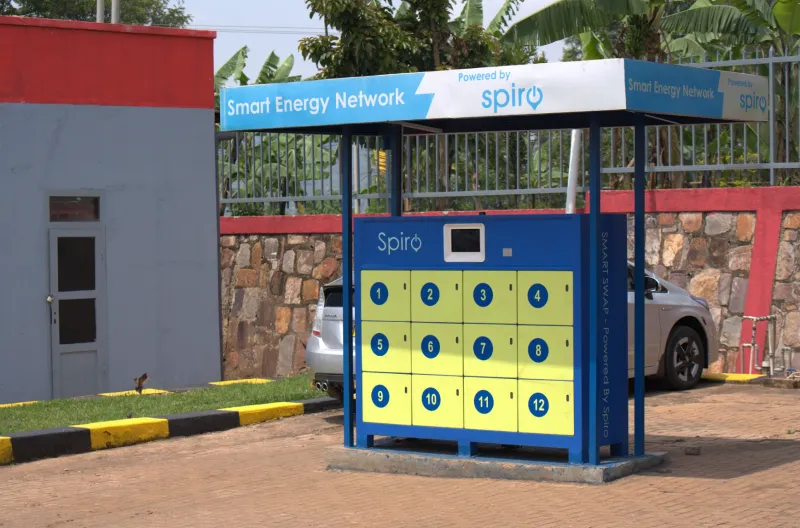
The roads, the riders and the need are unmistakably African; the ownership and the capital are largely not.
THE STRATEGIC BET
The bet is that the winning layer in African e-mobility is the energy network, not the vehicle. Anyone can import an electric bike; the moat is a dense grid of swap stations and the batteries that circulate through it. By owning the infrastructure and lowering the rider's daily operating cost, Spiro turns a hardware sale into a recurring energy relationship.
It is also a bet that patient, global capital — impact funds, an industrial holding company — is what a capital-intensive African infrastructure play needs. Battery networks are not built on venture-scale software economics; they need long money and manufacturing muscle, which is precisely what the $500m and the Equitane relationship supply.
THE CREATIVE MOVE
The move is to sell certainty to the rider. A commercial motorcyclist cannot afford hours plugged into a wall; the swap station reframes 'charging' as a two-minute pit stop, making the economics of going electric legible and attractive to the person whose livelihood depends on uptime.
Vertically, Spiro is building both ends — manufacturing the vehicles and operating the energy network — so it captures the margin on the bike, the battery and the swap. In a market where most players do one thing, owning the full stack is the differentiator.
THE EVIDENCE
Confirmed: Spiro raised $215 million in June 2026, led by Impact Fund Denmark and Equitane — the largest round for an African two-wheeled EV company — taking total funding past $500 million, corroborated across TechCabal, Bloomberg and Ecofin Agency.
Confirmed: Spiro reports 100,000 EVs deployed, roughly 2,500 battery-swap stations and 30 million+ swaps, operating in Kenya, Rwanda, Uganda, Togo, Benin, Nigeria and Cameroon, with expansion planned into Malawi, Mali and Ethiopia.
Reported independently: The deployment figures (100,000 vehicles, 2,500 stations, 30m swaps) are company-reported operating metrics.
Reported independently: Spiro is described as 'nearing unicorn value' (Bloomberg); a precise valuation was not disclosed.
Not claimed at this stage: The company's profitability and unit economics are not disclosed.
Not claimed at this stage: The ownership split between the international founder and backers and any African shareholders is not detailed here; the value-capture question is left open, not answered.
Whoever owns the swap network owns a toll on movement across the continent.
THE AFRICAN READ
This is the honest, complicated shape of a lot of African infrastructure right now: the roads, the riders and the need are unmistakably African; the ownership and the capital are largely not. Spiro's founder Gagan Gupta — also chairman of lead backer Equitane — is an international industrialist building for the continent, funded by Danish impact capital. That is not a criticism so much as a description, and it is why the authorship score sits in the middle.
The value question is who owns the energy grid of African mobility a decade from now. If the swap network becomes essential infrastructure — and it is being built to be — then the entity that owns it owns a toll on movement across the continent. The prize for African stakeholders is participation in that ownership, not only employment on the assembly line or a seat on the bike. The infrastructure is genuinely good for Africa; the open question is how much of it Africa will own.
LESSONS FOR BRAND BUILDERS
Own the network, not the vehicle. In African e-mobility the durable moat is the battery-swap grid and the energy relationship, not the bike anyone can import. Infrastructure compounds; hardware commoditises.
Some things need patient, heavy money. Battery networks and factories are not software. They need long-term, industrial capital — which shapes who ends up owning the infrastructure a continent runs on.
Good-for-Africa and owned-by-Africa are different questions. Spiro's network genuinely improves African mobility. Whether Africa owns a meaningful share of that essential infrastructure is a separate — and strategically decisive — question.
PUBLICATION VERIFICATION STATUS
The $215m raise, the lead investors, the total funding past $500m and the seven operating countries plus three expansion markets are confirmed across TechCabal, Bloomberg and Ecofin. The deployment metrics are company-reported; the valuation is 'nearing unicorn' rather than a disclosed figure; profitability and the ownership split are not disclosed.