THE MONOKROMATIK DECODE
Our editorial read across the four dimensions we use to assess creative work — an authorship-weighted Cultural-Signal Score, reflecting judgement, not a measured metric.
63 /100BBBCULTURAL-SIGNAL SCOREMixed — the idea outruns the ownershipConsequence is capped at 3 because every economic-impact figure in circulation is a pre-event projection by an interested party — R798m, ~R1bn, R245m provincial. If an audited or independently-verified post-event figure is published for the 2026 running, it would either evidence the claim or refute it, and we cannot predict which.
Assigned 2026-07-21. An outlook states at least a one-in-three likelihood of a change over the next twelve months. How outlooks work
The format is inherited — a 130-year-old race long since reformatted into a fashion platform. The 2026 edition runs the category's established play deliberately and well; it does not reframe what the category can attempt.
African designers took the headline slots at genuine scale, but the confirmed record shows almost every cheque in the marquees written by Diageo, LVMH, Pernod Ricard, AB InBev or Chery. Real African participation in the making; the money and the platform sit elsewhere.
Twenty-nine venues, 40,000-plus attendees, a record R10m purse and a fashion programme that produced real artefacts — strong and consistent across nine corroborating sources. Held off 5 by the publicly contested theme and the conflicting figures circulating around the awards and attendance.
The economic-impact numbers are pre-event projections issued by interested parties and they conflict with each other (R798m vs ~R1bn); the entry explicitly declines to claim any audited figure. Against that, one R70,000 student bursary and — stated outright — no evidence any African design house captured equity, royalties or revenue share. Exposure without demonstrated capture.
THE CONTEXT
On 4 July 2026, a horse called Note To Self came home late under Richard Fourie to win the 130th Hollywoodbets Durban July, giving trainer Justin Snaith his sixth victory in the race and taking the lion's share of a record R10 million prize fund — R6 million to the winning connections, with purses extended to the first twelve finishers. That is the last time the racing will be mentioned in this analysis, and that is the entire point. Ask anyone who was at Hollywoodbets Greyville that afternoon what happened and the horse is not the answer. The answer is a marquee, a dress, a beat drop, and a bar tab.
The scale is worth holding still for a moment, because it is the thing that turns a party into a market. eThekwini Municipality, presenting at the official media launch, projected R798 million in total economic contribution to the city, of which R230 million is direct spending, supporting roughly 1,105 jobs across the value chain. Organisers and much of the trade press pushed a bigger number — 'close to R1 billion', about US$61.5 million — citing a climb from R690 million in 2024 to R840 million in 2025. Both figures are projections, not audits, and the gap between them is itself instructive: nobody has an incentive to under-count this event. What is not in dispute is the physical footprint. More than 40,000 people. Twenty-nine independently operated hospitality venues and VIP marquees. Over 9,000 event staff and 1,000 security personnel, per Race Coast, the operator.
Read that sentence again: twenty-nine independently operated hospitality venues. That is not a racecourse. That is a temporary luxury district, built for one day, on a strip of Durban turf, and then dismantled. The horse race is the legal justification for the gathering — the pretext that makes the calendar entry, the broadcast rights and the licence work. The product is the room. And the rooms are sold accordingly: Saso's Marquee Experience listed at R30,000 for a four-seater café, R45,000 for a six-seater lounge and R75,000 for a ten-seater; the Makubenjalo marquee at R5,650 for a single pass rising to R45,000 for a VIP table of ten. At those prices, a marquee is not hospitality. It is a media buy with catering.
The 2026 theme, 'Country Allure', asked guests to interpret equestrian heritage, natural texture and rural elegance rather than reach for costume. It was, predictably, divisive — a theme that gestures at pastoral Anglo-colonial iconography in a country where the countryside means something else entirely to most of the people in the stands. What is interesting is not the argument but the resolution: the strongest interpretations of 'country' on the day were the ones that refused the brief's implied geography and answered it in Nguni, in beadwork, in coffee-stained cloth. The theme was set in one language and answered in another. That is the story of the 2026 Durban July in a single line.
At R75,000 for a ten-seater lounge, a marquee is not hospitality. It is a media buy with catering.
THE STRATEGIC BET
Every brand at Greyville was placing one of two bets, and telling them apart is the whole discipline. Bet one: rent the room. Buy visibility inside an audience you cannot otherwise assemble, hang your name on it, pour your product, leave. Bet two: build something inside the room that could not exist without you, and that people will still be describing a week later. The first bet buys reach. The second buys authorship. They cost roughly the same and they return wildly different things, which is why the second is so consistently under-taken.
Diageo made both bets simultaneously and was the most sophisticated operator on the grounds. Johnnie Walker returned as presenter of BOOMTOWN for a sixteenth consecutive year — a lineup spanning TKZee, DJ Tira, Sjava, Sphectacula & DJ Naves, Blxckie, Karyendasoul and Ciza that deliberately bridged the artists who built South African popular music and the ones currently inheriting it — while extending across Dukkah, Butcher Boys Umhlanga and Rockets Wonderland. Ifeoma Agu, Diageo's Group Head of Culture for South, West & Central Africa, framed it plainly: the Durban July is where music, fashion and culture intersect, and therefore a natural platform. Sixteen years is not sponsorship. Sixteen years is tenure. Nobody under thirty-five in KwaZulu-Natal can remember a Durban July night that was not, in some sense, Johnnie Walker's.
Then Diageo ran the opposite play with Don Julio, and it is the more interesting one. Rather than build a venue, the tequila brand commissioned a single object: a bespoke couture gown by Orapeleng Modutle, worn by actress Linda Mtoba, hat by Anita Ferreira Designs, accessories by Jimmy Choo. One dress. One woman. One walk. It generated a fraction of BOOMTOWN's footfall and, arguably, more concentrated cultural attention — because a gown can be photographed, argued about, and carried into the following week in a way a bar cannot. That is the entire modern luxury thesis compressed into one look: don't buy the crowd, buy the artefact the crowd photographs.
The most revealing bet on the grounds, though, was Colgate's. A mass-market oral-care FMCG brand — the least glamorous category imaginable — commissioned Mzukisi Mbane's Imprint ZA for a collaboration called 'Purple Allure' and put it on Zozibini Tunzi, a former Miss Universe. The design logic was literal to the point of audacity: purple, yellow and white prints referencing the brand's whitening technology, the purple 'cancelling out the yellow and bringing in the white'. Tunzi's look landed as one of the standout style moments of the day. Colgate did not buy a marquee, a stage or a bar. It bought a designer's imagination and got a national fashion conversation for it. Every FMCG marketer in South Africa should be studying that receipt.
THE CREATIVE MOVE
The headline structural move of 2026 was Saso's Marquee Experience — crowned Best Marquee at the 2025 Durban July — installing MaXhosa Africa as its official Culture and Fashion Partner, staging what organisers describe as MaXhosa's first dedicated fashion showcase at the Durban July, unveiling previously unseen bespoke and atelier pieces. Sixteen years into Laduma Ngxokolo's project, MaXhosa arrived at Greyville not as a label some celebrity chose to wear, but as the named cultural authority of the room. That is a promotion in kind, not degree. And the supporting cast in that marquee tells you exactly what it was worth: Stella Artois (AB InBev), Moët & Chandon and Hennessy (LVMH), Mercedes-Benz. A Xhosa knitwear house from Port Elizabeth was the reason those brands were in that tent, and not the other way around. Kabza De Small, K.O., DreamTeam and a deep local DJ bench supplied the sound; MaXhosa supplied the meaning. The concept — 'The African Frontier' — did what the official theme could not: it took 'country' and put it back on African land.
The Makubenjalo marquee ran a different and colder calculation, and it is the one with the longest tail. Martell and GH Mumm — both Pernod Ricard — poured the welcome drinks, alongside OMODA, the Chery-owned Chinese automotive brand. Boom Shaka, Kabza De Small, Boohle and DJ Stokie played. Look at what OMODA actually did here. Chery entered South Africa in 2021 and has become one of its fastest-growing automotive players, now running six brands locally — Chery, OMODA, JAECOO, Jetour, iCAUR and LEPAS. On 3 July 2026 it inaugurated a plant at Rosslyn, north of Pretoria — bought from Nissan, which had quit local manufacturing two months earlier — where no vehicle is scheduled to be built until mid-2027. The next day, its premium sub-brand was pouring cognac at the Durban July. That is not a coincidence and it is not a media buy. That is a Chinese challenger buying its way into the exact room where South African aspiration is priced, twenty-four hours after staging its claim on South African industrial legitimacy. Note what was actually exchanged on both days: a ceremony, not a car; a marquee, not a dealership. Chery's own language calls Rosslyn a transition from importer to local manufacturer. It is not one yet, and that is the point — the signal was booked a year ahead of the substance. European luxury spent a century earning the right to stand in that tent. OMODA rented it in five, before its first local car exists.
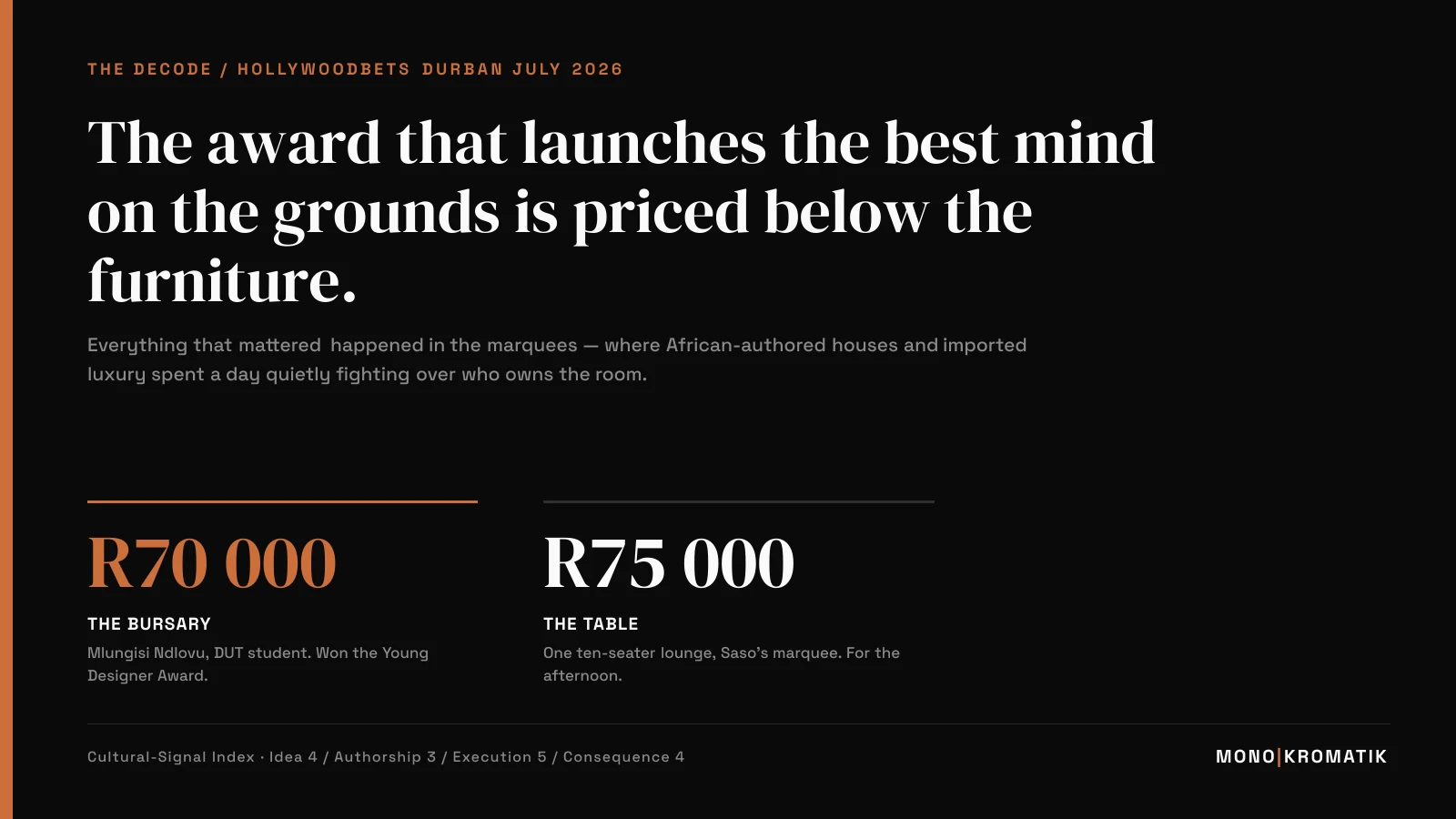
But the sharpest creative work of the day cost almost nothing and came from people with no marketing budget at all. Mlungisi Ndlovu, a Durban University of Technology fashion design student, won the Hollywoodbets Young Designer Award with a couture piece built on the markings of the Nguni cow, using coffee to stain the fabric for its finish. Consider what he did: handed a brief steeped in imported pastoral romance, he answered with the specific animal that constitutes wealth, lineage and standing across this region, and dyed it with a crop grown on this continent. He out-thought every agency on the grounds. His prize — a R70,000 bursary, R10,000 cash, a trip to South African Fashion Week 2026 and a R25,000 Kryolan voucher — is worth roughly what a single ten-seater lounge in Saso's marquee cost for the afternoon. The bursary itself, the part that actually builds the career, is R70,000. The table was R75,000. The award that launches the most original mind on the grounds is priced below the furniture next to the runway.
The rest of the fashion economy behaved like a functioning industry, which is new. Somizi Mhlongo arrived dressed by his own label, Sompire Femme, and also dressed Zola Mhlongo and DJ Tira — the latter in a navy coat carrying a reported 15,000-plus glass beads forming a portrait of the Afrotainment boss in the national colours. Jessica Nkosi-Dlamini wore a custom Ruberto Scholtz velvet gown embellished with a horse profile, conceived so that she arrived as the racecourse's own subject; she was widely named best-dressed female. In the Raceday Fashion Awards — roughly 150 public entrants, no celebrity budgets — Happiness Mkhwanazi took Classic Racewear Female, Mnotho Ngema took Classic Racewear Male, Nirvana Nolene won Exceptional Raceday Hat or Fascinator, and Pamela Shabane and Larnelle Maddocks successfully defended Most Striking Couple in bronze and ivory by Brenda Warring, a second consecutive win. First prize: R5,000 cash and a R2,500 gift card.
THE EVIDENCE
Confirmed: Note To Self won the 130th Hollywoodbets Durban July on 4 July 2026 at Hollywoodbets Greyville, trained by Justin Snaith (his sixth July win) and ridden by Richard Fourie; record R10m prize fund, R6m to the winner, purses to the first 12 finishers.
Confirmed: Saso's Marquee Experience, named Best Marquee at the 2025 Durban July, partnered MaXhosa Africa as official Culture and Fashion Partner; premium partners Stella Artois, Moët & Chandon, Hennessy and Mercedes-Benz; lineup led by Kabza De Small, with K.O. and DreamTeam.
Confirmed: Saso's Marquee packages listed at R30,000 (4-seater café), R45,000 (6-seater lounge) and R75,000 (10-seater lounge), open bar 12pm–4pm, including access to the MaXhosa Africa fashion show.
Confirmed: Makubenjalo marquee partnered Martell and GH Mumm (Pernod Ricard) and OMODA (Chery); tickets R5,650 single to R45,000 for a VIP table of 10, including entry to the Njalos July afterparty.
Confirmed: BOOMTOWN, presented by Johnnie Walker, returned for a 16th consecutive year, with TKZee, DJ Tira, Sjava, Sphectacula & DJ Naves, Blxckie, Karyendasoul and Ciza.
Confirmed: Diageo's Ifeoma Agu (Group Head of Culture, South, West & Central Africa) publicly framed the Durban July as a natural platform at the intersection of music, fashion and culture.
Confirmed: Raceday Fashion Award winners (official): Happiness Mkhwanazi (Classic Racewear Female), Mnotho Ngema (Classic Racewear Male), Nirvana Nolene (Exceptional Raceday Hat or Fascinator), Pamela Shabane and Larnelle Maddocks (Most Striking Couple, second consecutive win, outfits by Brenda Warring). First prize R5,000 cash plus a R2,500 gift card.
Confirmed: Mlungisi Ndlovu (Durban University of Technology) won the Hollywoodbets Young Designer Award with an Nguni-cow-inspired, coffee-stained couture piece; prize includes a R70,000 Hollywoodbets bursary, R10,000 cash, SA Fashion Week 2026 travel package and a R25,000 Kryolan voucher.
Confirmed: Linda Mtoba wore a bespoke Orapeleng Modutle couture gown in partnership with Don Julio, with a hat by Anita Ferreira Designs and Jimmy Choo accessories.
Confirmed: Zozibini Tunzi wore an Imprint ZA (Mzukisi Mbane) creation forming part of the designer's Colgate collaboration titled 'Purple Allure'.
Confirmed: eThekwini Municipality projected R798m total economic contribution and R230m direct spend, supporting c.1,105 jobs, with 40,000+ attendees; Race Coast cited 29 independently operated hospitality venues and VIP marquees, 9,000+ event staff and 1,000 security personnel.
Reported independently: MaXhosa Africa's Saso's showcase is described by organisers as its first dedicated fashion showcase at the Durban July — a landmark claim we report as organisers' framing rather than independently established fact.
Reported independently: Organisers and several outlets projected the 2026 edition would contribute 'close to R1 billion' (~US$61.5m) to the eThekwini economy, up from R690m (2024) and R840m (2025). This conflicts with the municipality's R798m projection; both are pre-event estimates.
Reported independently: Chery is reported to have inaugurated its Rosslyn plant on 3 July 2026, one day before the Durban July, having acquired it from Nissan after Nissan ended local manufacturing in May 2026. Production is scheduled to begin mid-2027 (initial ~15,000 units across Q3–Q4 2027; 50,000/year single-shift capacity at full ramp-up). Six brands now in its South African portfolio (Chery, OMODA, JAECOO, Jetour, iCAUR, LEPAS).
Reported independently: DJ Tira's Sompire Femme coat is reported to carry more than 15,000 glass beads forming a portrait of him in South African flag colours.
Reported independently: Jessica Nkosi-Dlamini's custom Ruberto Scholtz velvet gown with horse-profile embellishment was widely reported as best-dressed female; celebrity best-dressed recognition is media-conferred, not an official Raceday Fashion Award.
Reported independently: The 'Country Allure' theme was publicly contested, with designer Orapeleng Modutle responding that every theme is inherently open to interpretation.
Not claimed at this stage: We do not claim any audited economic-impact figure. Both R798m and ~R1bn are projections issued before or around the event by interested parties.
Not claimed at this stage: We do not claim any brand's spend, sponsorship fee, marquee cost, media value or return on investment — none of these were disclosed.
Not claimed at this stage: We do not claim that any African design house received equity, royalties or revenue share from any brand partnership at the 2026 Durban July. We found no evidence either way; the absence of disclosure is itself the point.
Not claimed at this stage: Two claims circulating about the Raceday Fashion Awards are not supported by the official results and are not made here: that Gistine Kifubula won Classic Racewear Female (the official winner is Happiness Mkhwanazi), and that Richard Tulinatbitu won Classic Racewear Male (the official winner is Mnotho Ngema).
Not claimed at this stage: We do not claim attendance above 40,000; a 45,000 figure appeared in pre-event previews but the reported turnout is 'more than 40,000'.
Not claimed at this stage: We do not claim betting turnover; no figure was published.
Not claimed at this stage: We do not claim Chery manufactures vehicles in South Africa. The Rosslyn plant was inaugurated on 3 July 2026 but is not scheduled to build a vehicle until mid-2027. Chery's own communications describe the inauguration as its 'transition from an importer to a local manufacturer'; we report the ceremony and its date, not that characterisation.
Not claimed at this stage: We do not claim the Young Designer prize is a fraction of a marquee table. Stated prize value (R70,000 bursary + R10,000 cash + R25,000 voucher + travel) exceeds one R75,000 ten-seater lounge; the like-for-like comparison we do draw is bursary (R70,000) against one ten-seater lounge (R75,000).
European luxury spent a century earning the right to stand in that tent. OMODA bought it in five years.
THE AFRICAN READ
So: who won? MaXhosa Africa won, unambiguously and by the widest margin — it converted from decoration to institution, became the reason a marquee had a proposition, and made LVMH and AB InBev its supporting acts for a day. Imprint ZA won, because Colgate paid it to think rather than to lend a name. Sompire Femme won, because Somizi has quietly built a house that dresses other people, which is the actual definition of a fashion business. Orapeleng Modutle and Ruberto Scholtz won on craft. Mlungisi Ndlovu won on ideas, at a scale of compensation that should embarrass everyone else on this list. Saso's won by understanding, before anyone else, that a marquee needs a curator and not just a cover charge. Johnnie Walker won on tenure — sixteen years of accumulated ownership no rival can now buy. Don Julio and Colgate won on efficiency. Hollywoodbets won by owning the name on the door.
Who lost? Nobody lost money — and that is the softest, most honest verdict available. But several brands lost the plot. Mercedes-Benz, Hennessy and Moët & Chandon appeared in the 2026 Durban July almost entirely as nouns: names on a partner list, product in a glass, no artefact, no idea, nothing that could not have been supplied by any other house in the same category. That is the definition of renting a room. Stella Artois at least attempted a proprietary format with its 'Stella Moment'. GH Mumm was a welcome drink. Jimmy Choo was an accessory credit on someone else's triumph. When an African knitwear atelier and a toothpaste brand are producing more culturally durable work than three of the most storied luxury houses on earth, the houses are not losing revenue — they are losing relevance, which arrives later and costs more.
Now the uncomfortable part, and it is the one this publication exists to say. Every African-authored win listed above is a win in exposure, not in equity. MaXhosa was a partner in a marquee it does not own, at an event it does not own, sponsored by companies it does not own a share of. Imprint ZA executed a brief for Colgate; Colgate keeps the brand equity that collaboration generated. Ndlovu received a bursary, not a royalty. The pattern is consistent and it is old: African creative labour supplies the meaning, foreign capital supplies the money, and the meaning is the appreciating asset. The value created at Greyville on 4 July flowed to Diageo, LVMH, Pernod Ricard, AB InBev, Chery, and to Race Coast and Hollywoodbets — all of whom hold assets — while the designers who made the day worth photographing hold, at best, a stronger negotiating position for next year. That is progress. It is not ownership.
The five-year read. The Durban July is not becoming South Africa's Met Gala; it is becoming something structurally more interesting, because the Met Gala is a fundraiser controlled by a museum, and the Durban July is a fashion platform pretending to be a sports fixture — which means the fashion economy is running free inside a shell nobody has formally claimed. That vacuum is the opportunity. Whoever moves first to constitute the fashion side properly — a designer council, a licensed marquee-partner tier that guarantees African houses revenue share rather than a stage, an artefact archive, prize money at parity with what a table costs — captures the next decade of it. And the racing? The racing will matter exactly as long as it keeps supplying the pretext, the date and the R10 million headline that justifies the broadcast. It is the shell, and shells are load-bearing. The question for African houses is not whether the horses matter. It is whether, by the 135th running, they are still guests in the room they are the reason for.
LESSONS FOR BRAND BUILDERS
A partnership tier is worth more than a logo tier — and costs about the same. MaXhosa Africa did not sponsor Saso's marquee; it authored it, as named Culture and Fashion Partner. That single structural difference is why a Xhosa knitwear house, not Mercedes-Benz or Hennessy, was the reason people talked about that tent. If your brand's role in an event can be described in a noun, you bought reach. If it takes a verb, you bought authorship.
The cheapest cultural capital on the continent is a designer's imagination. Colgate — a toothpaste brand — commissioned Imprint ZA and put the result on Zozibini Tunzi, and out-performed three global luxury houses that were physically present with bars, product and hospitality. Don Julio bought one gown and won the news cycle. Commissioning an artefact costs less than pouring a room and travels infinitely further, because artefacts get photographed and bars do not.
Tenure is the only sponsorship moat that compounds. Johnnie Walker has presented BOOMTOWN for sixteen consecutive years. No competitor can buy that back at any price, because what has accumulated is not exposure but memory — an entire generation in KwaZulu-Natal has no recollection of a Durban July night that was not Johnnie Walker's. One-year activations depreciate to zero on the Monday; sixteen-year ones become infrastructure.
Exposure is not equity, and African houses should stop accepting the swap. Every African-authored win at the 2026 Durban July — MaXhosa, Imprint ZA, Sompire Femme, a DUT student — was denominated in visibility. The foreign capital in the room holds the appreciating assets; the African creative labour holds a better negotiating position for next year. Until a Durban July partnership tier guarantees local houses revenue share rather than a stage, the meaning will keep being made here and banked elsewhere.
PUBLICATION VERIFICATION STATUS
Race result, prize fund, marquee partnerships, ticket pricing, fashion award winners and brand quotes are verified against official and primary sources. Economic-impact figures are contested and pre-event projections, not audited outcomes: eThekwini Municipality projected R798m total impact (R230m direct spend), while organisers and several outlets projected 'close to R1 billion' (~US$61.5m). We report both and endorse neither. Two widely circulated claims about the Raceday Fashion Award winners are incorrect and are corrected in the text. Chery's Rosslyn plant was INAUGURATED on 3 July 2026, not brought into production: vehicle production is scheduled for mid-2027. We report the ceremony's timing (one day before the Durban July) and decline Chery's framing of the event as a completed transition to local manufacturing.