THE MONOKROMATIK DECODE
Our editorial read across the four dimensions we use to assess creative work — an authorship-weighted Cultural-Signal Score, reflecting judgement, not a measured metric.
82 /100AACULTURAL-SIGNAL SCOREStrong — clear authorship, real consequenceNo one-in-three likelihood of movement identified in the next twelve months.
An outlook states at least a one-in-three likelihood of a change over the next twelve months. How outlooks work
Made-in-Africa as a hard production promise rather than a design credit is a thesis with teeth and rare in the market, but it is an adaptation of an established provenance play rather than a new category.
Confirmed Senegalese founder, Senegalese tailors, Dakar production and continent-sourced materials — origination, control and the labour value all sit in one place. Nothing material sits offshore.
A DTC label shipping worldwide out of Dakar, validated by confirmed Beyoncé placements in 'Spirit' and Black Is King and a Fast Company 50 listing — the craft is externally validated, with industrial capacity the visible gap.
Celebrity placement is visibility, not measured outcome: there is no disclosed revenue, no artisan headcount, and the piece itself calls the industrial-manufacturing story 'partly aspirational' with no ecosystem yet at scale. Plausible impact with no published evidence.
THE CONTEXT
For a generation, the phrase 'African fashion' described an aesthetic more than a supply chain. Prints, silhouettes, and references travelled the world on runways and in editorials, but the actual cutting, sewing, and finishing — the part where value is captured and jobs are made — happened somewhere else. A designer could be Lagos-born or Accra-raised and still route production through workshops in Europe or factories in Asia, because that was where the machinery, the financing, and the reliability were assumed to live. The continent supplied inspiration and, too often, exported the margin.
Tongoro was built to break that default. Launched in the spring of 2016 in Dakar by Sarah Diouf — a Senegalese-Congolese-Central African founder who had worked in media and creative direction before turning to fashion — the label carries a single, unusually specific promise on its own homepage: it is 'a 100% Made In Africa label, designed and produced in Dakar, Senegal.' That sentence is doing strategic work. It is not claiming African heritage or African motifs. It is claiming African manufacture. Every piece is cut and sewn by local Senegalese tailors, with materials sourced from the continent, and the stated ambition is to foster the economic and social development of artisanal workers across West Africa.
Diouf started without a fashion-industry pedigree and without a factory. She worked with self-taught Dakar tailors, built the brand as an online-first, direct-to-consumer operation, and priced it to be worn — 'affordable pieces available worldwide,' as she framed it to Nataal — rather than gatekept as luxury. That combination is unusual on the continent, where the two available templates have tended to be either handcrafted couture priced for a narrow elite, or mass-market imports with no local authorship at all. Tongoro planted a flag between them: designed and made in Africa, but built for everyday wear and global reach.
Then, in 2019, the world's most famous entertainer put the whole thesis on the largest possible screen. Beyonce wore Tongoro in the 'Spirit' video for Disney's Lion King, and again in the 2020 visual album Black Is King, where her BIRMA gown appeared in the 'Brown Skin Girl' sequence. What could have been a novelty became a proof point, because behind the placement sat a real operation — a catalogue, a storefront, a shippable product — ready to convert a moment of planetary attention into orders. The question the rest of this decode asks is not whether Tongoro is beautiful, but whether its structure — where it makes things, how it sells them, and who keeps the value — is the model African fashion has been waiting for.
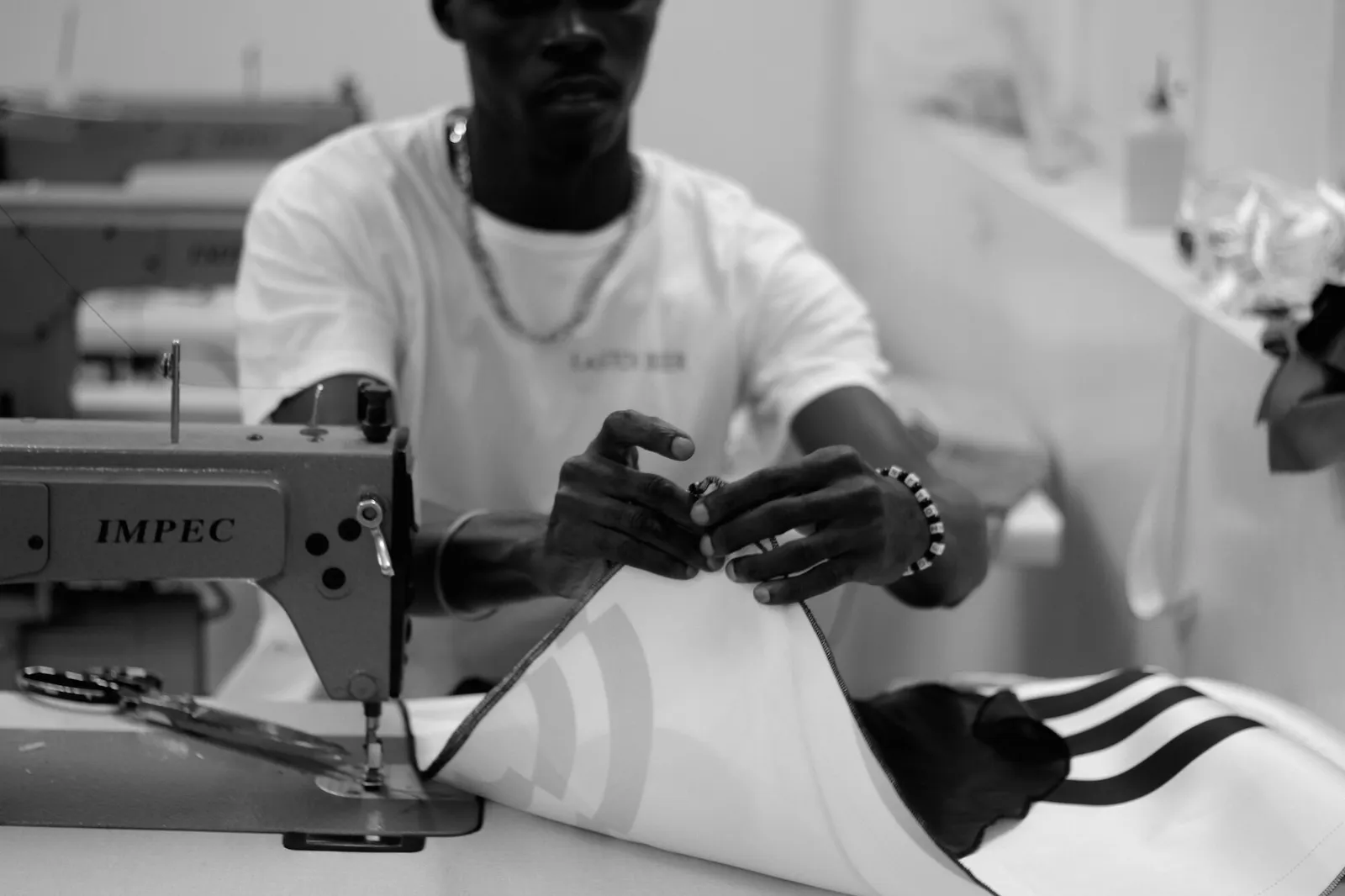
Anyone can license a print. Very few labels can honestly say the garment was made where the story is set.
THE STRATEGIC BET
The bet underneath Tongoro is that the scarce, defensible thing in African fashion is not design talent — the continent has that in abundance and always has — but production sovereignty. Anyone can license a print or borrow a silhouette. Very few labels can honestly say the garment was made where the story is set. By anchoring the entire operation in Dakar, Diouf chose the harder, slower path on purpose, because it is the path that keeps the money, the skills, and the credit on the continent. The 'Made in Africa' label is not decoration; it is the moat.
The second bet is on channel. Tongoro did not wait to be picked up by Western department stores or to earn a wholesale account that would take a cut and dictate terms. It went direct-to-consumer and global from the start — an online storefront shipping from Senegal to customers anywhere, at accessible price points. This matters more than it looks. Wholesale and consignment are the traditional mechanisms by which African-made goods are discounted, marginalised, and stripped of pricing power. Selling straight to the buyer means Tongoro sets its own price, owns its own customer relationship, and captures the full retail margin in Dakar rather than surrendering it to an intermediary in Paris or New York.
The third bet is that demand can pull production onto the continent rather than the other way around. The conventional development story asks Africa to build competitive factories first and hope buyers come — a chicken-and-egg trap that has stranded countless industrial-policy schemes, because capacity built on speculation sits idle and dies. Tongoro inverted it: create desire — through design, through diaspora resonance, through the gravitational pull of a Beyonce placement — and then use that demand to justify and finance local manufacturing capacity. Diouf has been explicit about the industrial endgame, describing the goal of contributing to African retail production in West Africa, with a factory in Dakar. Demand first, capacity second, value retained throughout. It is a riskier sequence for the founder, who has to satisfy real global orders with an artisan base rather than a finished factory, but it is the only sequence in which the demand is proven before the capital is sunk.
THE CREATIVE MOVE
The creative move that made Tongoro legible to the world was refusing to choose between 'African' and 'modern.' The clothes read as contemporary, globally wearable, unmistakably designed — bold cuts, statement accessories, a clean and confident visual language — and only then, on inspection, as products of Dakar. This is the opposite of ethnographic fashion that asks the buyer to consume Africanness as costume. Tongoro sells desirability first and provenance second, which is precisely why the provenance lands harder: the buyer wants the piece, and then learns it was made in Senegal, and the two facts reinforce rather than compete.
The Beyonce association was not a lucky break so much as the reward for having a coherent thing to be discovered. Stylist Zerina Akers built Black Is King around Black-owned and African labels, and Tongoro was ready — an existing catalogue, a working storefront, a shippable product — when that attention arrived. The 'Spirit' video and Black Is King put Tongoro in front of a planetary audience, and the direct-to-consumer machine meant that attention could convert immediately into orders from anywhere. The label kept compounding the relationship: it was cited as the only African brand featured on Beyonce's 2023 Renaissance tour, and in 2025 produced custom couture — reported as 444 golden cowries and 44 crystals — for the Cowboy Carter tour's opening. Iman, Naomi Campbell, Alicia Keys, Kelly Rowland, and Burna Boy have all been associated with the label, and Fast Company named Tongoro among its 50 Most Innovative Companies in 2020.
Underneath the celebrity gloss, the quieter creative decision was to treat tailors as the brand's core asset rather than a cost line to be squeezed. Tongoro's story centres the self-taught Senegalese artisans who make the clothes, positioning their skill as the source of value and their development as the point of the enterprise. In an industry that usually renders garment workers invisible — the fashion supply chain is built to hide exactly the people Tongoro puts forward — making them visible, and framing scale as more livelihoods rather than merely more units, is both a moral stance and a marketing one. It is what lets 'Made in Africa' function as a promise a buyer can feel good about, not just a stamp on a label.
That framing also solves a subtler positioning problem. A brand that leans only on celebrity endorsement is hostage to it: the moment the famous wearer moves on, the story deflates. By making the artisans and the provenance the durable narrative — the thing that is true whether or not Beyonce is wearing it this season — Tongoro built a story that compounds independently of any single placement. The Beyonce moments accelerate the brand; the Dakar workshop is what the brand actually is. That separation between accelerant and substance is what distinguishes a label with a business from a label with a viral moment.
THE EVIDENCE
Confirmed: Tongoro was launched in spring 2016 in Dakar, Senegal, by founder Sarah Diouf (Tongoro official site).
Confirmed: The brand describes itself as 'a 100% Made In Africa label, designed and produced in Dakar, Senegal,' working with local Senegalese tailors and sourcing materials from the continent (Tongoro official site; UN Africa Renewal).
Confirmed: Tongoro operates as an online, direct-to-consumer label shipping worldwide at accessible price points (Nataal).
Confirmed: Beyonce wore Tongoro in the 2019 'Spirit' video and in the 2020 visual album Black Is King, including the BIRMA gown in the 'Brown Skin Girl' sequence (BellaNaija Style; UN Africa Renewal).
Confirmed: Naomi Campbell and Alicia Keys are among the label's high-profile wearers (UN Africa Renewal; Tongoro official site).
Confirmed: Fast Company named Tongoro among its 50 Most Innovative Companies in 2020 (Tongoro official site).
Reported independently: Tongoro was cited as the only African brand featured on Beyonce's 2023 Renaissance tour, and produced custom couture (reported as 444 golden cowries and 44 crystals) for the Cowboy Carter tour opening in 2025 (UN Africa Renewal; BellaNaija).
Reported independently: Kelly Rowland, Burna Boy, and Iman have also been associated with the label (Tongoro official site; UN Africa Renewal).
Reported independently: Diouf has described an ambition to expand West African retail production with a factory in Dakar (Nataal).
Not claimed at this stage: Tongoro has not publicly disclosed a specific number of tailors or artisans employed, or annual revenue figures — the industrial-scale manufacturing story remains partly aspirational.
Not claimed at this stage: No claim is made that Tongoro alone has built a regional garment-manufacturing industry; the case is that it proved the demand and the model, not that the ecosystem yet exists at scale.
Beyonce did not just wear the clothes — she routed a slice of the world's attention back toward Dakar.
THE AFRICAN READ
Read from the continent, Tongoro is a rare example of Africa capturing the whole value chain of its own aesthetic — not just the design credit, but the manufacturing margin and the labour income. For decades the pattern has been extractive in a subtle way: African creativity flows out as inspiration, is monetised elsewhere, and returns as expensive imports. Tongoro reverses the flow. The idea, the ownership, the production, and the profit all sit in Dakar, and the demand comes from the diaspora and the global market inward. That is the difference between being a muse and being a manufacturer.
The diaspora is the engine here, and it is worth naming precisely. The people most primed to want Africa-made clothing — to pay for it, to wear it as identity, to amplify it — are the global Black diaspora and Africans on the continent with rising spending power. Tongoro's direct-to-consumer, ship-anywhere model is built exactly for that dispersed demand: a customer in London, Atlanta, or Johannesburg can buy a garment made in Senegal without a Western retailer standing in the middle taking a toll. Beyonce, herself the diaspora's most powerful cultural node, did not just wear the clothes; she routed a slice of the world's attention back toward Dakar. The value flows toward the continent, not away from it — which is the exact reversal of the century-old pattern in which African raw material and African creativity left cheap and returned expensive.
There is a deeper point about ownership hidden in the logistics. When a Western house 'draws inspiration from' African design, the African contribution is uncredited and unpaid, and the garment is made and sold abroad — the continent supplies the idea and captures none of the enterprise. Tongoro collapses that entire chain into Senegalese hands: the founder is Senegalese, the design is hers, the tailors are Senegalese, the materials are continental, and the profit is booked in Dakar. Authorship is not one variable among several here; it is the whole architecture. That is why, on an honest authorship-weighted read, Tongoro scores at the top of the AUTHORSHIP axis while most 'African-inspired' global fashion would score near the bottom despite looking similar on the runway.
The honest caveat is scale. Tongoro has proved the thesis at the level of a desirable independent label — that global demand will pay a premium for genuinely Africa-made fashion, and that a Dakar operation can serve it. What it has not yet proved, and what no single brand can prove alone, is that this becomes an industry: thousands of tailors, reliable factory capacity, a supplier ecosystem that lets other labels make the same promise without importing everything. Public figures on Tongoro's headcount and revenue are not disclosed, so the manufacturing story is still partly aspirational. But the direction is the point. Tongoro drew the map. The unfinished work — turning one label's proof into a regional production base that keeps the value on the continent at scale — is the most important brief in African fashion, and Diouf has been unusually clear that she intends to keep pushing on it.
LESSONS FOR BRAND BUILDERS
Provenance is a moat only if it is literal African-inspired is easy to copy; African-made is not. Tongoro's defensibility comes from the fact that the garment is actually produced where the story is set. The label made 'Made in Africa' a verifiable production fact rather than a marketing mood, and that is what competitors cannot cheaply replicate.
Go direct to keep the margin on the continent Wholesale and consignment are the mechanisms by which African goods get discounted and stripped of pricing power. By selling direct-to-consumer and shipping globally from Dakar, Tongoro set its own prices, owned its own customers, and captured the full retail margin locally instead of surrendering it to a foreign intermediary.
Let demand pull production home The usual development script asks Africa to build factories first and hope buyers appear. Tongoro inverted it — create desire through design and diaspora resonance, then use that demand to finance local capacity. Desirability first, manufacturing second, value retained throughout.
One proof point is not yet an industry Tongoro showed the world will pay for genuinely Africa-made fashion, which is the hard part. But turning a single celebrated label into thousands of livelihoods and reliable factory capacity is a different, unfinished task. The lesson is to bank the proof without mistaking it for the finished job.
PUBLICATION VERIFICATION STATUS
Founding, production model, and celebrity placements verified against Tongoro's official site, UN Africa Renewal, Nataal, and BellaNaija. Exact tailor headcount and revenue figures are not publicly disclosed and are treated as reported, not confirmed.