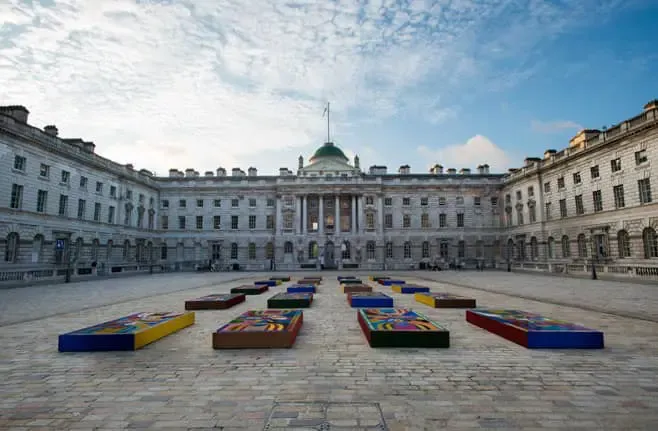
A market that had to build its own room
In October 2013, a new fair set up inside London's Somerset House with a deliberately arithmetic name: 1-54 — one continent, fifty-four countries. Its founder, the Moroccan-born Touria El Glaoui, was not opening a gallery so much as opening a category. Contemporary African art had artists, collectors, and centuries of authorship, but almost no dedicated infrastructure at the top of the global market. 1-54 gave it a stage, and it scaled fast: a New York edition followed in 2015 and a Marrakech edition in 2018, making it the first international fair devoted solely to art from Africa and its diaspora 1.
Four years after the fair, the continent got its cathedral. On 22 September 2017, Zeitz MOCAA opened at Cape Town's V&A Waterfront — carved by Heatherwick Studio out of a disused 1920s grain silo, 9,500 square metres across nine floors, billed as the world's largest museum dedicated to contemporary art from Africa and its diaspora 2. The building itself made an argument: that the definitive institution for this work should stand on the continent, not in a wing of a museum in London or New York.
The prices caught up — spectacularly
Institutions set the terms; the auction room set the numbers. And the numbers moved. Ghanaian sculptor El Anatsui, who transforms discarded liquor-bottle caps into shimmering metal tapestries, saw his Prophet (2012) sell for roughly $2.3 million at Christie's in New York in May 2023 3 — years after Venice had already handed him the Golden Lion for lifetime achievement in 2015 and Tate had given him the Turbine Hall.
The generational leap was even starker on canvas. Nigerian-born Njideka Akunyili Crosby, whose layered paintings splice Lagos and Los Angeles, went from a five-figure market to selling Bush Babies for nearly $3.4 million at Sotheby's in May 2018 4 — with her top results since climbing past $4.7 million. And Ghanaian painter Amoako Boafo, discovered barely a few years earlier, watched Hands Up sell for $3.42 million at Christie's Hong Kong in December 2021 5 — a 175% jump over his own record set twelve months before.
This is what "blue-chip" looks like as a verb. African aesthetic authorship, long discounted or filed under the flattening label of "tribal" or "emerging," was being repriced in real time as exactly what it always was: contemporary art at the center, not the margin.
The value question hiding inside the boom
Here is the tension the headline prices obscure. A record at Christie's New York or Sotheby's Hong Kong is a resale — the money changes hands between collectors and the auction house, and typically none of it returns to the artist, let alone to the continent. The primary market that first backed these artists, the galleries that took the early risk, and the institutions doing the slow work of scholarship are frequently not African. Boafo was championed out of Vienna and Los Angeles; Akunyili Crosby's market is anchored in New York and London. The authorship is African. The value capture, often, is not.
That is precisely the gap 1-54 and Zeitz MOCAA were built to close — by relocating the authority to grant value, not just the price. A museum on the continent decides which work enters the permanent record. A fair run by an African founder decides which galleries and narratives reach international buyers. Control of the canon is upstream of control of the market, and it is the more durable asset.
The honest read is that the machinery is still lopsided. Speculative "flipping" of young African painters — buy at the gallery, resell at auction within a year — has burned artists before, inflating and then chilling markets that the artists themselves never profited from. The blue-chip story is real, but so is the risk of a boom that extracts faster than it builds. The measure of maturity will not be the next auction record. It will be whether the collectors, galleries, endowments, and museums that keep the value are increasingly African-owned — and whether resale royalties, continental collecting, and institutions like Zeitz MOCAA turn a market moment into an ownership position.
What the last decade actually proved
What 1-54 and Zeitz MOCAA proved between 2013 and 2017 is that scarcity of infrastructure — not scarcity of talent — was the ceiling. Build the room, and the market fills it. The artists were always blue-chip; the world simply lacked the institutions to price them and the confidence to say so. The unfinished work is the harder half: converting global demand for African authorship into African ownership of the value that authorship creates.

