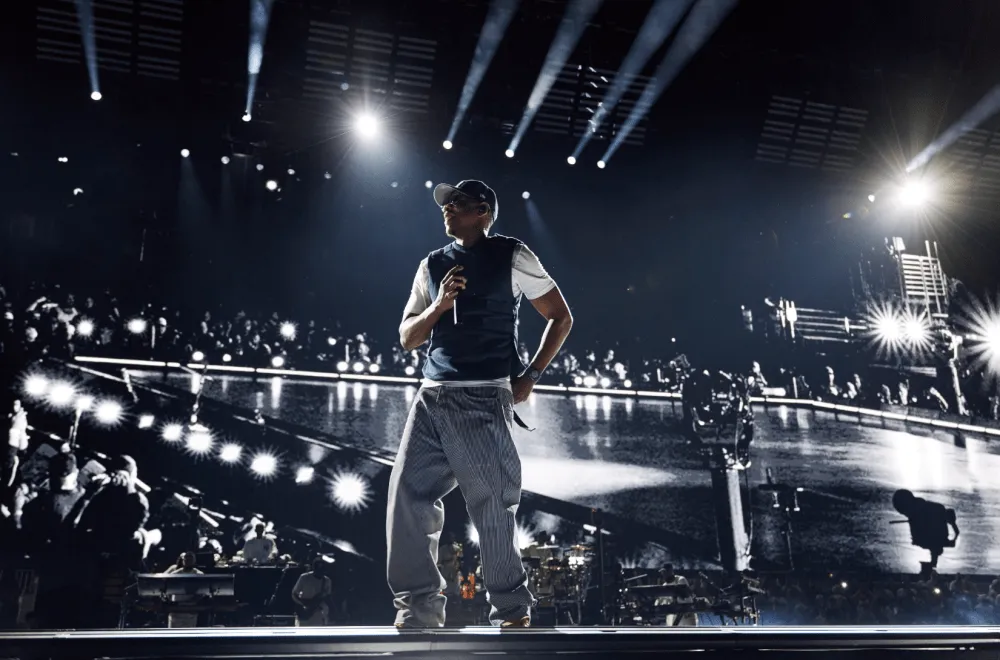
Three nights in the Bronx, thirty years in the making
Over three nights in July 2026, Jay-Z did something few artists in any genre can attempt: he sold out Yankee Stadium by staging his own history. The run opened with "JAY-Z 30," marking the 30th anniversary of his 1996 debut Reasonable Doubt, followed by "JAY-Z 25" for a quarter-century of The Blueprint, and closed with a chaotic "Extra Innings" show that took the stage after midnight following an hours-long delay and a security breach that left thousands outside the gates 1. Beyoncé, Nas, Rihanna, Usher and Blue Ivy Carter passed through. The Reasonable Doubt night alone reunited Jay-Z with Nas and his family on stage 2, collapsing a decades-old rivalry into a victory lap.
Read as a concert, it was a spectacle. Read as a business, it was something more instructive for the continent watching from across the Atlantic: a masterclass in what happens when an artist owns the thing everyone else only rents.
The asset underneath the spectacle
The reason Jay-Z can build a stadium event out of a 30-year-old album is that the album is his. He controls his masters and his publishing through the machinery he built himself — Roc-A-Fella, and later Roc Nation, the entertainment company he founded in 2008 after buying out his Def Jam contract 4. Reasonable Doubt is the one catalog exception, co-owned with former partners, and even that is set to revert fully to him in 2031 under a copyright reversion clause 3, 35 years after release. The direction of travel is one-way: everything flows back toward the artist.
That ownership is the whole game. Because he holds the recordings and the rights, every anniversary tour, sync licence, streaming play and re-release is an appreciating asset compounding into old age. The back catalog is not nostalgia — it is a self-owned monument that throws off cash and cultural power for as long as he chooses to activate it. He is not performing his songs so much as collecting rent on a legacy he refused to sell. That is the difference between a career and an estate: a career ends when the shows stop; an estate keeps paying because someone owns the paper underneath the music.
The mirror for the continent
Now hold that up against the standard African music story. Afrobeats won the world, but the question of who owns the win remains uncomfortably open. Across the industry, artists have historically signed away masters and publishing early, often without fully understanding what they were assigning 5, while the durable value of the catalog is captured by infrastructure — labels, distributors, streaming platforms — that African entities do not own. Cultural success without ownership, as one analysis put it, is celebration without wealth creation.
The economics make the stakes brutal. African streams frequently pay a fraction of global rates, so the long-tail royalty income that funds an American artist's forever-tour is thinner here even when the music travels further. An Afrobeats record can soundtrack the planet and still leave its maker with a shallow catalog position — a hit today, but no monument to activate in 2056. Worse, when a foreign major owns the masters, the continent exports its culture and re-imports it as someone else's asset, paying twice: once in creativity, again in licensing.
What the diaspora blueprint actually teaches
The lesson from Yankee Stadium is not "tour your old albums." It is that ownership is a multi-generational strategy disguised as a legal detail. Jay-Z spent decades fighting — through label presidencies, buyouts and litigation with former partners — to consolidate control of his own work. The stadium run is the dividend on that fight.
Encouragingly, the continent is already moving. A newer generation is more business-literate about masters, publishing and distribution, and African-owned labels like Mavin, Chocolate City, YBNL and DMW are structuring joint ventures that keep creative control and catalog on the continent rather than trading it away for an advance. Burna Boy, Wizkid and Davido increasingly negotiate as businesses, not just talent — a shift underscored by the IP-protection gap that African artists have long been urged to close 5.
This is where the continent-to-diaspora bridge stops being sentimental and becomes strategic. The diaspora has already run this experiment and shown the endgame: an artist who owns his catalog can turn thirty years of work into an appreciating, self-owned institution. The African artist who signs that away for a fast cheque is not just losing a royalty — they are forfeiting the stadium they could have filled in 2056. The music was always going to be world-class. The unfinished work is making sure Africans still own it when it becomes history.
