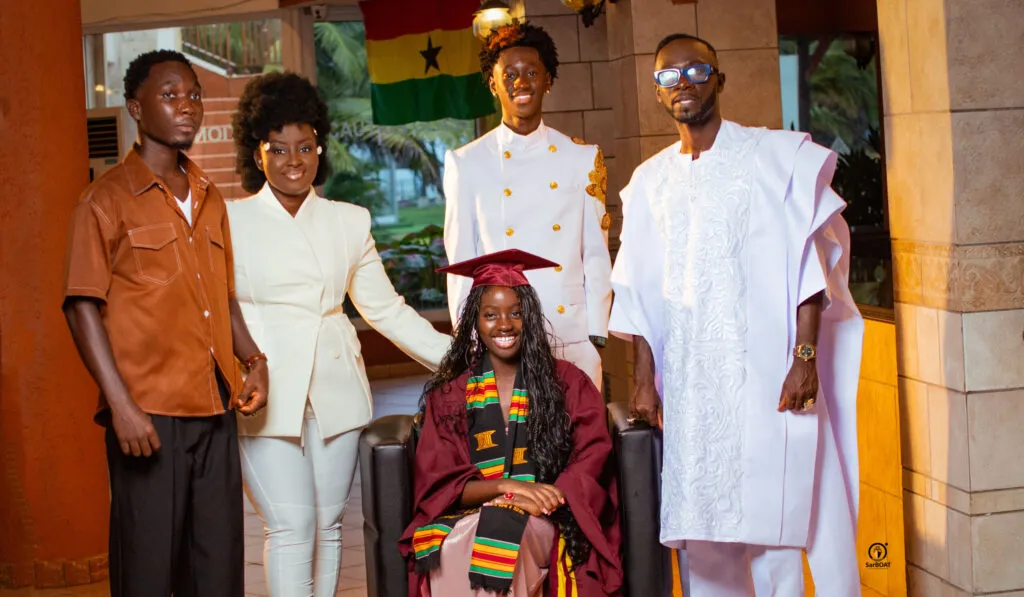
The Word That Did the Most Work
Okyeame Kwame didn't call Galaxy International School helpful. He didn't call it a good institution, or a strong academic environment, or whatever polished language the occasion usually demands. He called it a co-parent.
That word is the whole story.
When Ghana's rap icon posted to mark his daughter Sante Nsiah Apau's O-Level graduation, he didn't write the caption most people write. He named her teachers. He credited them specifically — for raising "an intelligent lady with good social skills." He gave the school a title that, in most families, is reserved for grandmothers and aunties and the neighbours who watched you when your mother was at work.
Co-parenting isn't a compliment. It's an acknowledgment. It means: you showed up, consistently, for my child. It means the relationship was real.
The comments section understood immediately.
What Actually Happened at Galaxy International
Sante Nsiah Apau — daughter of the man behind "Clap," one of the most durable and thoughtful voices in Ghanaian music — completed her O-Levels at Galaxy International School in Accra. A milestone any parent would mark. A photo, a caption, a family moment made public.
Okyeame Kwame went further. He went on Instagram and named the school, named the teachers, and made an argument in public that most parents only ever make in private: that the people who educate our children are not service providers. They are partners. They are, in the truest sense of the word, part of the raising.
One follower wrote: "This is the respect teachers deserve. Well done King Kwame for showing gratitude." Another put it plainly: "If more public figures did this, teachers would feel seen."
They're right. Which is exactly why this one landed the way it did.
The Teacher We Carried on the Plane
If you grew up in Accra or Lagos or Nairobi or Dakar, you know the relationship we have with teachers is not simple. We feared them. We respected them. A handful of them changed the entire direction of our lives. And almost none of us ever said that to their faces.
There was always one. The one who kept you in at lunch — not as punishment, but because they saw something in you that you were actively avoiding. The one who wouldn't let mediocrity settle in your chest even when you were trying your hardest to be mediocre. The one who pronounced your full name correctly, every time, because they had decided you deserved that small dignity.
We got on planes. We crossed time zones. We brought those teachers with us in the weight of how we work, how we expect, how we refuse to let our children be invisible in classrooms that weren't built with them in mind. We just never sent them the message.
Okyeame Kwame sent the message. With his full name attached.
For those of us raising children now in London, Toronto, Houston, Amsterdam — navigating parent-teacher evenings in accents that sometimes collect raised eyebrows, spelling out Ghanaian and Nigerian and Cameroonian names for teachers who stumble through them — this post described something we're quietly searching for. Not just academic rigour. The other thing. The thing where a teacher looks at your child and decides, before a single test result, that this child matters and I will act accordingly.
Where "I expect more from you" is delivered as an act of love.
When Okyeame Kwame says Galaxy International co-parented Sante, he's describing an institution that provided that. And he's reminding us, loudly, that when we find it — we should say so.
What the Post Is Actually Doing
Ghana has a teacher shortage. The continent has a teacher shortage. The people holding classrooms together are underpaid, under-resourced, and publicly thanked almost never — and only performatively when they are. When things go right, the child gets the praise. The parents get the credit. The teacher watches from the back of the room.
Okyeame Kwame's post disrupts that arrangement. It doesn't just thank a school — it models a different accounting of how children are built. It tells every teacher watching that their investment is visible to the people it shaped. It tells Sante herself that her success has authors, plural, and that naming them isn't a diminishment of her achievement. It's the full picture of it.
The diaspora group chats understand this. Not just because of who Okyeame Kwame is — though his legacy in Ghanaian music is its own conversation — but because of what the post reveals about how we understand the raising of children when we're being honest. Together. With intention. With a ledger that accounts for everyone who showed up.
Sante's Next Chapter
O-Levels done. What comes next — A-Levels, university, something no one has predicted yet — is hers to write. But she enters that next chapter knowing something that takes some people decades to understand: that achievement is never produced alone, and that the people who contributed to yours are worth the public acknowledgment.
Her father taught her that by doing it in front of everyone.
For Galaxy International and the teachers this post named: a thank-you from one of Ghana's most respected public voices, offered freely and without occasion, hits differently than a trophy. Recognition you didn't ask for, from someone who owed you nothing but chose to give it anyway — that's the kind that stays.
The Credit We Never Paid
Sante graduated. Ghana celebrated. But what Okyeame Kwame actually gave us was a debt made visible — the quiet, enormous, long-overdue credit we owe to the people who raised us in rooms our parents couldn't always be in.
We've always known it takes more than parents. The proverb exists because the truth existed first. Okyeame Kwame just said it publicly, attached his name to it, and reminded us that gratitude unexpressed is gratitude withheld.
Say it. While they can still hear you.


