When Nike Finally Listened
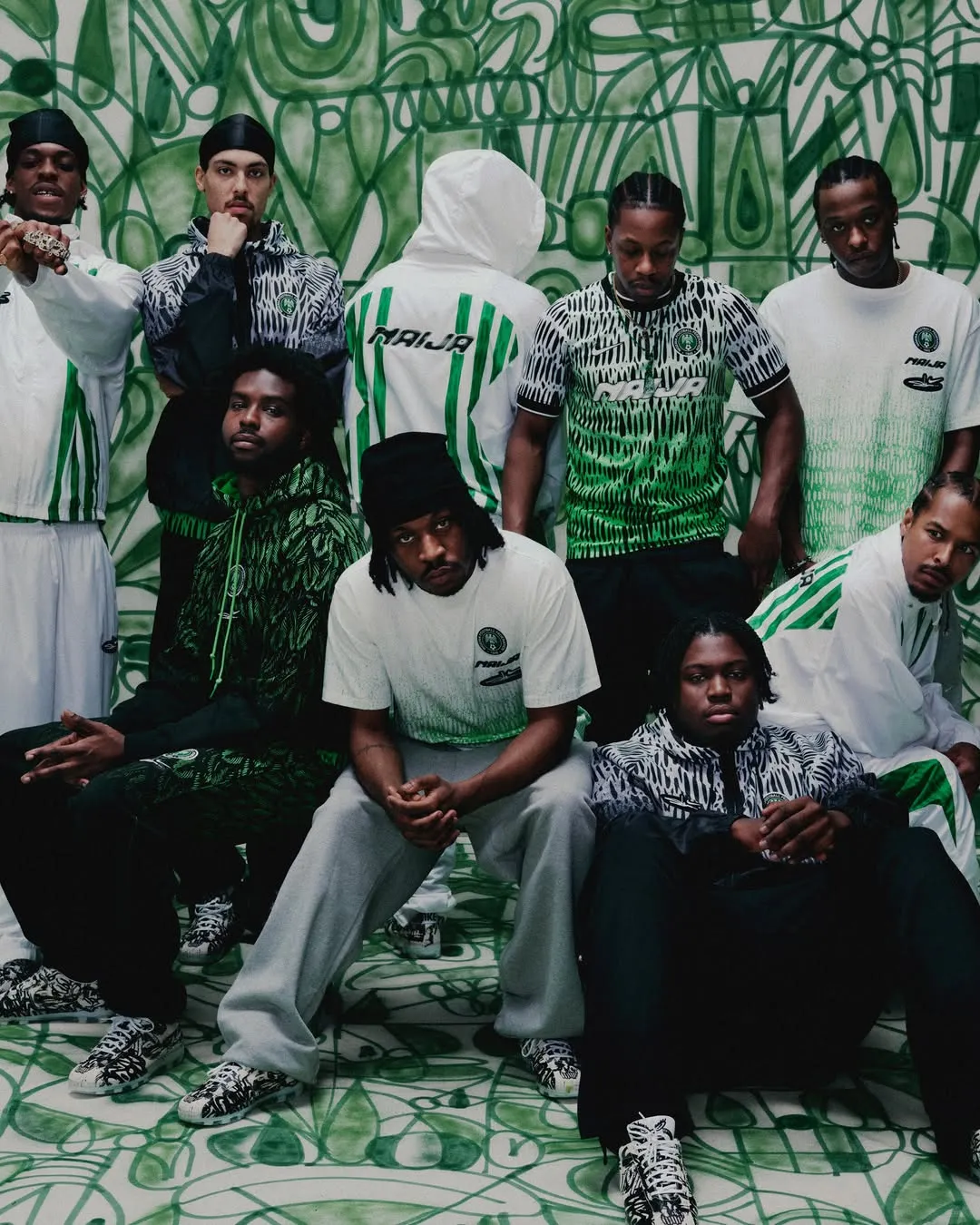
Nike called up London artist Slawn, Jay-Jay Okocha, and Patience Ozokwo for a campaign shoot. Yes, that Patience Ozokwo. Mama G herself, draped in Nike tracksuit glory, cowrie shells in her hair, looking like she's about to bless the entire streetwear industrial complex.
The Nike x Slawn 2026 collection drops this summer on SNKRS and at select retailers. This isn't another football kit release where someone in Portland decided what "African energy" looks like. This is what happens when a British-Nigerian visual artist who built his reputation bombing walls with monochrome doodles gets handed the keys to one of sport's biggest brands and says, "Let me show you how we really move."
Slawn took his signature graffiti aesthetic and screen-printed it straight onto athletic staples that'll work in Peckham and Port Harcourt equally. The centrepiece: a white relaxed-fit graphic tee with a spray-gradient lime green bottom that looks like someone took a can of Montana Gold to it mid-design. The chest carries the official Nigeria Football Federation crest and bold, puffy lettering spelling out "NAIJA" in unmistakable street-art script.
The matching white fleece drawstring shorts echo the same energy. Same gradient. Same script. Same unapologetic Nigerian pride.
But the real flex? The lightweight woven zip-up anthem jacket covered in a black-and-grey abstract pattern that feels like Slawn's brain spilled onto fabric in the best possible way. Nike styled it over a high-neck top with an oversized, deeply pleated black maxi skirt in the campaign shots, completely dissolving the line between pitch-side and fashion week.
When your sportswear works at Sunday service and the stadium, you've cracked the code.
The Campaign Squad Doesn't Miss
Jay-Jay Okocha modeling the white and lime green jersey is poetry. The man who made "so good they named him twice" an actual football phrase, wearing contemporary Nigerian design three decades after he first pulled on the green and white. If you grew up watching him torment defenders with ball control that looked like witchcraft, seeing him anchor this campaign hits somewhere deep.
He's joined by current Super Eagles forwards Tolu Arokodare and Samuel Chukwueze. Past glory, present excellence, future promise—all in one frame.
Then there's Patience Ozokwo, looking absolutely regal in a white Nike zip-up tracksuit jacket with vertical green stripes, the NFF crest sitting proud on her chest, those cowrie shells threaded through her hair. Mama G has played the stern Nigerian mother in so many Nollywood classics that seeing her in fresh Nike feels like your actual mum finally letting you dress her for once.
The culture is full circle.
Musicians Kida Kudz and DEELA round out the campaign, anchoring the streetwear aesthetic and reminding everyone this isn't just football apparel. It's a whole lifestyle ecosystem.
Why This Lands Different in Manchester, Toronto, Atlanta
You spot the green and white anywhere in the world and something in your chest expands. That's your people. That's home, walking toward you on a random Tuesday.
But for too long, the Nigerian jerseys we could actually buy looked like afterthoughts. Basic templates. Nothing that captured the energy of Lagos traffic, the chaos of Balogun Market, the creativity bubbling out of every corner of the culture.
Nothing that felt like us.
Slawn gets it because he lives it. Born in Nigeria, raised in London, building his reputation one wall at a time across the UK. His art already bridges the gap we navigate daily—that space between where we're from and where we are. His monochrome doodles carry that same frenetic energy as Lagos streets, that same density of information and life happening all at once.
Now that aesthetic is on official Nike sportswear, co-signed by the Nigeria Football Federation, modeled by actual Nigerian legends. This is representation that doesn't feel like a committee-approved diversity initiative.
This feels like your cousin who went to art school finally getting the budget he deserves.
For those of us who've spent years code-switching between home voice and work voice, seeing "NAIJA" in bold puffy letters on official Nike gear hits different. It's permission to take up space. It's confirmation that our aesthetic, our language, our vibe isn't something to code-switch away from.
It's something global brands are studying and celebrating.
The Blueprint Nobody's Naming
This collaboration also quietly showcases how the second-generation diaspora is reshaping culture on their own terms. Slawn didn't have to move back to Nigeria to validate his Nigerian-ness. He built his name in London's street art scene, stayed authentic to both sides of his identity, and now both Nike and the NFF are calling.
That's the blueprint for so many of us navigating dual identities.
You don't have to choose. You don't have to prove your authenticity by rejecting where you were raised. You can be fully Nigerian and fully British, fully Ghanaian and fully Canadian, fully Kenyan and fully American.
The culture is elastic enough to hold all of us.
And when Mama G shows up in your Nike campaign, you've officially achieved something special. Nollywood royalty meeting sportswear giant meeting street art sensation—that's the range of Nigerian excellence in one frame.
What Happens Next
The collection drops this summer on Nike's SNKRS app and at select retailers. No specific date yet, which means the culture vultures are already setting notifications and preparing their click fingers.
If previous Nigeria kit releases are any indication, the online drops will move fast. Super Eagles gear has been selling out within hours lately, especially designs that actually respect the culture instead of treating Africa like a monolithic aesthetic they can slap on anything.
Keep your eyes on Slawn's Instagram and Nike Sportswear's official channels for drop dates. When they announce, move quick—this isn't the kind of collection that sits on digital shelves.
And when you finally secure your piece and wear it to the African shop, the gym, or wherever your Saturday takes you, remember this: you're not just wearing a jersey.
You're wearing proof that Nigerian culture doesn't need permission anymore.


