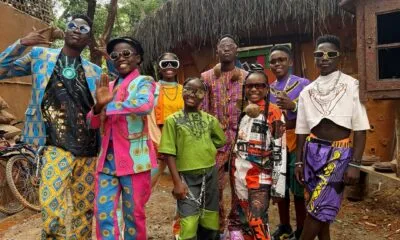
The World Cup invite isn't the story. What came before it is.
Uganda's Triplet Ghetto Kids are performing at the 2026 FIFA World Cup Final halftime show with Shakira. That sentence alone rewrites what "making it" means for African artists. Because these kids didn't leave Kampala to get here. They built in Kampala. And now the world's biggest sports stage is coming to them.
Let's be clear about what this is. This isn't a charity slot. This isn't a "diversity moment" tucked between the real headliners. Shakira announced the Ghetto Kids herself in a video message to fans—calling them part of what she's building as a "truly unique performance." The show is July 19 at the New York New Jersey Stadium. She's co-headlining with Madonna and BTS. The Ghetto Kids will be there, dancing to "Dai Dai"—the official World Cup anthem Shakira just released. The one featuring Burna Boy.
The culture is everywhere at this World Cup. And it didn't get there by accident.
What the timeline won't tell you
If you've been following the Ghetto Kids since French Montana's "Unforgettable" video in 2017, you know this moment didn't come overnight. That video put them in front of millions—kids from Kampala moving with precision and joy that the algorithm couldn't look away from. They performed at the 2022 World Cup festivities in Qatar. They made it to the finals of Britain's Got Talent, bringing their choreography to Simon Cowell's stage and refusing to water it down.
Every step was deliberate. Every stage was earned. And now? The World Cup Final halftime show. The one event where billions of eyes are watching at the same time.
For those of us in the diaspora—scrolling in London on the Tube to work, grabbing coffee in Toronto, heading to a shift in Brooklyn—this hits differently. We grew up being told to be realistic. That dancing, music, art were hobbies, not careers. That the real opportunities were elsewhere, in "serious" professions, preferably abroad.
The Ghetto Kids stayed. They built something from nothing. And they didn't need to leave Africa to make it matter. They made Africa the launchpad. That's the part your aunt who never messages is suddenly sending voice notes about. Because it confirms what we've always known but were taught not to say out loud: we're not waiting for permission anymore.
The lineup is the proof
Look at the full World Cup 2026 slate. Burna Boy on the official anthem with Shakira. Rema and Tyla performing at the opening ceremony June 12 at SoFi Stadium in Los Angeles. The Ghetto Kids at the final.
African artists aren't being squeezed into token slots. They're headliners. They're the draw. They're the reason people are marking calendars in May for events in July.
This is what winning looks like. Not when someone gives us a seat at the table—when we build our own table and everyone else asks to sit down.
For diaspora kids growing up right now, this is their baseline. They're watching Tyla win Grammys before she turns 23. Burna Boy sell out Madison Square Garden. The Ghetto Kids land World Cup stages. They won't spend their twenties explaining why African music and dance matter. They'll spend them watching it dominate. That's the generational shift happening in real time.
For those of us who are older? We remember when African acts at global events were feel-good stories, not main events. We remember when "making it" meant leaving home and maybe—if you were lucky—coming back successful once you'd proven yourself elsewhere. The Ghetto Kids flipped that script entirely. They proved themselves at home first. Then the world showed up.
What Dauda Kavuma started
The Ghetto Kids were founded over a decade ago by Dauda Kavuma in Kampala. The vision: take kids from difficult circumstances and give them purpose through dance. Build something that showcases Ugandan and East African talent without apology, without explanation, without waiting for validation.
That vision has resulted in viral videos, international tours, and now a World Cup Final performance that puts Uganda on a stage most countries would pay millions to access. The ripple effects are already visible. Dance academies across Nairobi, Dar es Salaam, and Kigali are seeing increased enrollment. Kids are forming their own crews, uploading their own videos, dreaming their own dreams—because they saw what's possible when someone from home does it first.
That's what representation actually does. It doesn't just make us feel good. It expands the boundary of what we think we can build.
For the diaspora specifically, this gives us something concrete to point to when we're explaining where we're from and what we're about. Not statistics about GDP growth. Not defensive arguments about poverty rates. Just this: our kids from Kampala are performing at the World Cup Final with Shakira. That's the sentence. That's the answer.
What's on the calendar
June 12: Opening ceremony at SoFi Stadium in Los Angeles. Rema and Tyla. If you're anywhere near LA, you know what to do.
July 19: World Cup Final at the New York New Jersey Stadium. Shakira, Madonna, BTS, and the Ghetto Kids bringing Kampala choreography to the world's biggest sports stage.
In between, the Ghetto Kids will be sharing behind-the-scenes preparation. Follow @ghettokids_tfug on Instagram. Watch what it looks like when African excellence gets the platform it always deserved.
And when July 19 rolls around—whether you're watching from a pub in Manchester, a viewing party in Atlanta, or your cousin's flat in Montreal—make noise. Post about it. Let the world see how we celebrate our own. Because this isn't just the Ghetto Kids' moment. This is ours.
They didn't wait for the world to come to them
From Kampala streets to the World Cup Final stage. From YouTube videos to performing alongside Shakira in front of billions. The Ghetto Kids didn't wait for permission. They didn't leave home to prove they were good enough. They stayed, they built, and they made the world pay attention.
On July 19, they're bringing Uganda, East Africa, and the entire continent with them to that stage. Not as guests. As headliners.
We're not just watching anymore. We're center stage. And the world is taking notes.


