THE MONOKROMATIK DECODE
Our editorial read across the four dimensions we use to assess creative work — an authorship-weighted Cultural-Signal Score, reflecting judgement, not a measured metric.
70 /100ACULTURAL-SIGNAL SCORESound — good work, incomplete captureNo one-in-three likelihood of movement identified in the next twelve months.
An outlook states at least a one-in-three likelihood of a change over the next twelve months. How outlooks work
Downgraded from 5. Sape and the 1974 Zaire squad carried as design language rather than costume is a strong, well-adapted idea with real specificity — but the designer arrival look is now a standard tournament format that many federations run. New to this nation, not new to the category.
Downgraded from 5. A Congolese designer working under his own label authoring his nation's most-watched cultural act is genuine African origination with a real ownership layer — but the platform, the moment and the commission belong to the federation, and no IP, contract or ownership term is evidenced anywhere in the file. A material layer sits elsewhere.
Arrival, garment and narrative move in lockstep on the reported record. Held at 4 — the single confirming source covers the look and its reception, not the craft in detail.
Downgraded from 4. One BellaNaija report of an arrival look and its public reception, and nothing else. 'Diaspora recognition was immediate' is unmeasured sentiment, not outcome; commercial results, federation strategy and any continuing programme are all explicitly notClaimed. A moment occurred and passed with no evidenced downstream.
THE CONTEXT
DR Congo's Léopards arrived at the 2026 World Cup not in standard team travel-wear but in leopard-print tailoring by the Congolese designer JMAKxPARIS — a look that referenced more than fifty years of Congolese sartorial memory, from la Sape to the 1974 squad that made Zaire the first Black African nation at a World Cup.
As reported by BellaNaija, the arrival itself became the story before a ball was kicked. MonoKromatik's reading treats that sequencing as the decision worth studying: a national team's most-watched moment in a generation was handed to an author who carried the inheritance, not a vendor asked to approximate it.
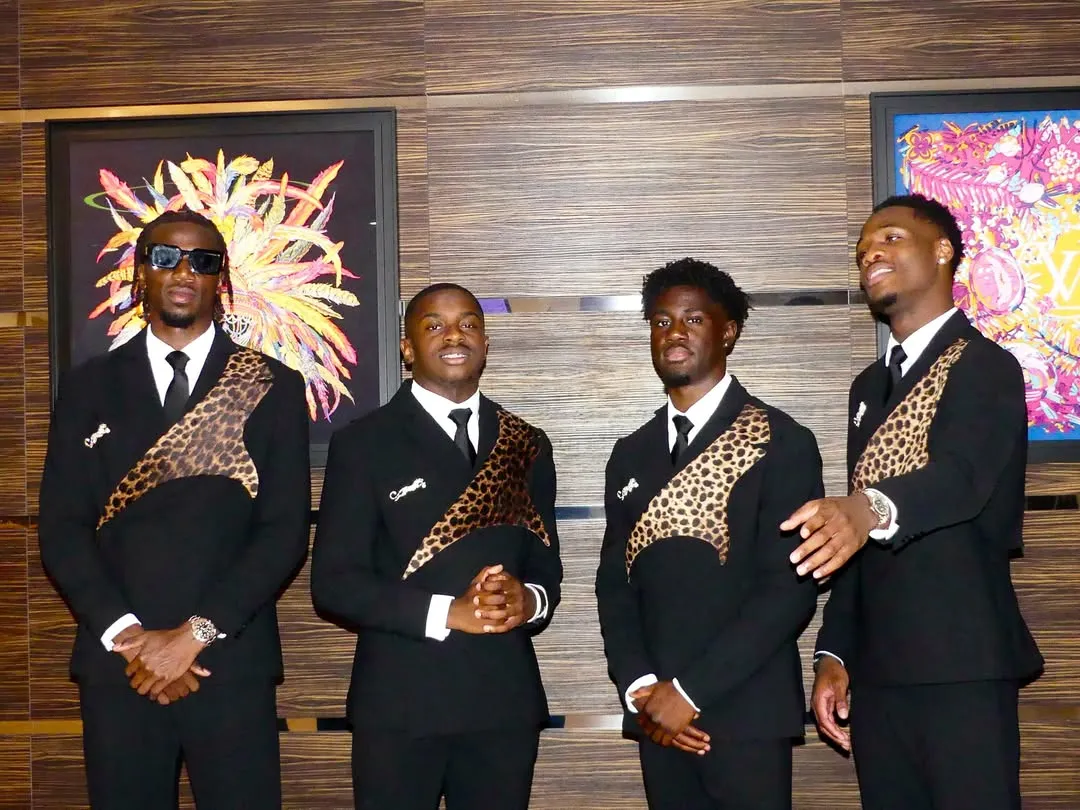
The arrival look turns Congolese sartorial memory into the nation’s most-watched cultural act in over fifty years.
Authorship beats casting — JMAKxPARIS didn't interpret Congolese identity for a global audience; he carried it there.
THE STRATEGIC BET
The bet is authorship over casting. A nation's identity at a global event is usually styled — outsourced to a sponsor's template or a European house briefed to render 'African' from a distance. Here the most visible cultural act was authored from inside a felt inheritance.
It also treats the arrival as the statement rather than a pre-match formality. The terminal walk was used as the canvas — a decision that says the cultural frame around the football is part of the product, not its packaging.
THE CREATIVE MOVE
The Sape reference was not a mood-board decision; it was lineage. The 1974 nod was not retro; it was memory. The work is strongest because the heritage shows up in both the garment detail and the behaviour of the arrival.
That is the difference between borrowed cool and owned meaning: one reads as costume, the other as reckoning. A global broadcast audience felt the gap even where it could not name it.
THE EVIDENCE
Confirmed: The Léopards' JMAKxPARIS arrival look and its public reception — reported by BellaNaija.
Reported independently: The cultural references the look draws on — Congolese Sape and the 1974 Zaire squad — are widely documented in football and fashion coverage.
Not claimed at this stage: Commercial or sponsorship outcomes, federation strategy, or any continuing authored-identity programme. A single arrival can signal intent; only repetition would prove strategy.
The difference between borrowed cool and owned meaning is the difference between costume and reckoning.
THE AFRICAN READ
The diaspora — London, Brussels, Paris, Montréal — recognised themselves in it immediately, in the body, before the mind caught up. That recognition is the asset, and it cannot be manufactured at rate card.
For brands working across African and diaspora audiences, this is the correction: authorship by someone who already carries the inheritance is the route to legitimacy. Casting buys presence; authorship earns belonging.
LESSONS FOR BRAND BUILDERS
Authorship beats casting. Hand the cultural act to someone who carries the inheritance, not a vendor asked to approximate it.
Treat the ritual as the canvas. Arrivals, walk-ons and ceremonies are brand surfaces — the meaning can live there, not only in the match.
Heritage must show in behaviour, not only imagery. The reference landed because it appeared in both the garment and the way the moment was staged.
Judge the system, not the single moment. The lasting mark is whether this becomes a repeatable authored-identity practice or a one-off.
PUBLICATION VERIFICATION STATUS
Editorial decode. The arrival look and designer are reported by BellaNaija; the cultural references (Congolese Sape, the 1974 squad) are widely documented. The strategic and commercial reading is MonoKromatik interpretation, not a claim sourced from the federation or designer.