This Isn't a Fashion Story
DR Congo didn't arrive at the 2026 FIFA World Cup. They made a reckoning.
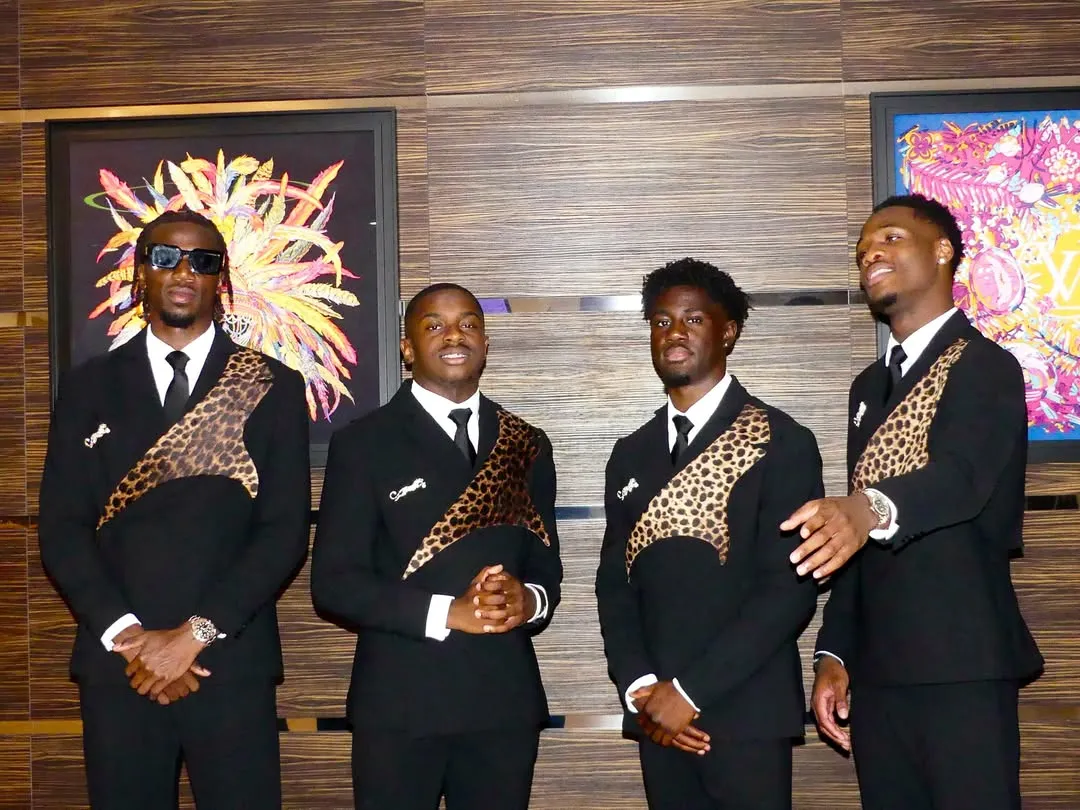
Before a whistle, before a lineup, before a single minute of group-stage football, the Léopards walked through the arrivals terminal in black single-breasted blazers — each one cut with an asymmetric leopard-print panel sweeping across the left shoulder and chest. Gold lapel pins. Dark shades. Matching tote bags. Slim black ties. Polished leather shoes.
Every piece was intentional. None of it was decoration.
The suits were designed by Alvin Junior Mak of JMAKxPARIS — a Congolese designer working in his own creative language, dressing his nation's team on the largest football stage the sport has ever staged. He wrote about the commission in French, and his words deserve to be read slowly:
"Elegance is a way of wearing one's history. Conceived as a homage to the Léopards of 1974 and the spirit of the Congolese Sape, this creation celebrates those who dare to dream bigger and carry high the colours of a nation. A nation behind them, a dream ahead of them."
That is not a fashion brief. That is a love letter to a people.
What's Actually Layered Inside the Look
The leopard-print panel is not an appliqué. Not an accessory added after construction. It is built directly into the suit — integrated at the pattern stage, woven into the garment's architecture. The distinction matters. A patch says: we added something. A built-in panel says: this was always part of the structure.
So was the history.
In 1974, Zaire — the country now known as DR Congo — became the first sub-Saharan African nation to qualify for the FIFA World Cup. That squad walked onto a global stage that had never made space for them. They did it anyway. They carried an entire continent's ambitions in their boots, and the world watched. Then 52 years passed.
The 2026 Léopards are only the second Congolese squad to reach a World Cup. The first since that 1974 generation. Mak's decision to honour those men — not in a documentary, not in a museum installation, but in the clothes the current squad wore through the airport — is an act of lineage. Not nostalgia. Lineage is different. Nostalgia looks backward. Lineage carries something forward.
The second thread is the Sape. La Société des Ambianceurs et des Personnes Élégantes. Born in the Congo — Kinshasa and Brazzaville both claim it — the Sape is a philosophy that says elegance is resistance. That a working-class man who steps out in a precisely tailored suit and a pocket square is making an argument about his own worth in a world that keeps trying to undervalue him. The Sapeurs built a movement out of fabric and intention. They turned dressing into a form of power long before the rest of the world started writing thinkpieces about it.
Mak pulled both threads — the 1974 squad and the Sape — and wove them into something a billion people would see on a global broadcast. That's curation at a level most designers never get near.
Where the Diaspora Feels This
In London, Brussels, Paris, Montréal, Washington D.C. — the cities where Congolese communities built entire worlds away from Kinshasa — the group chats did not stay quiet.
We know what this looks like from the inside. The uncle who came to visit a decade ago and stayed, suddenly watching the coverage a little differently. The auntie showing her colleagues the photos and saying: that's us. The kid born in Croydon or Laval who's still working out what it means to be Congolese, and then watching those suits come through arrivals and understanding it immediately, in the body, before the mind catches up.
This is what it looks like when a culture refuses to be invisible. When a squad shows up not only as footballers but as ambassadors for something ancient, alive, and worth the ceremony.
And it was done by a Congolese designer. Not a European house commissioned to interpret African identity for a global audience. Alvin Junior Mak, working from his own inheritance, dressing his own nation. That is a full-circle moment that deserves its own paragraph.
Now the Football Has to Speak
DR Congo are among ten African nations at an expanded 48-team World Cup — more seats at the table than any previous tournament. For the Léopards, the arithmetic is different. This is 52 years of waiting. This is a new generation carrying the 1974 squad's weight alongside the expectations of millions in Kinshasa, Lubumbashi, Goma, and every city the Congolese diaspora has made its own.
Watch the group stage for energy, not only results. Share the arrival photos with everyone in your circle who hasn't seen them yet. When the Léopards play, find a screen and find your people.
The suits made the first statement. The football makes the second.
But understand what already happened in that terminal: a Congolese designer dressed his nation's team in 52 years of memory, and the world watched them walk through like they owned the floor.
The Sape does not ask for the room. It commands it.


