THE MONOKROMATIK DECODE
Our editorial read across the four dimensions we use to assess creative work — an authorship-weighted Cultural-Signal Score, reflecting judgement, not a measured metric.
61 /100BBBCULTURAL-SIGNAL SCOREMixed — the idea outruns the ownershipThe league runs an annual season and the NBA publishes attendance and broadcast metrics against it. Consequence is capped at 3 because the league is not shown to be self-sustaining; a further season of published figures is a scheduled disclosure point that could evidence one.
Assigned 2026-07-21. An outlook states at least a one-in-three likelihood of a change over the next twelve months. How outlooks work
Converting existing national-champion clubs into a single continental competition — the NBA's first operated league outside North America — is sharp category design, well adapted to African club football's existing structure. Not a new format invention.
Clubs, players, arenas and operating executives are African, and diaspora capital holds a reported ~8% of NBA Africa. But the league IP, the format, the trademark, the media-rights pipe and the franchise-sale windfall belong to a joint venture the NBA controls and consolidates. African institutions supply the product; authorship and ownership sit in New York.
Confirmed and strong: 48 games in 2025, record cumulative attendance over 140,000, YouTube views up 69% to 2.7m+, NBA-grade broadcast, a purpose-fit Kigali hub. Minor gaps around cost base do not undercut the craft.
Downgraded from 4. The compounding-stakes claim rests on the ~37,000 jobs and $250m+ GDP figures, which originate with the league and its partners and which we explicitly decline to verify, plus a permanent-franchise model that is prospective and phased from 2027 — a stated intention, capped by the announcement rule. What is confirmed — attendance, views, one player drafted 10th — is real but modest, and the franchise windfall it feeds accrues to the NBA-controlled venture.
THE CONTEXT
The Basketball Africa League was announced in February 2019 as a joint venture between the NBA and FIBA, and tipped off its inaugural season in May 2021. It is, by the NBA's own framing, the first league the NBA has operated outside of North America — a structural first that matters more than any single game result. Where the NBA had run camps, academies and exhibition games in Africa for two decades, the BAL is the moment the league stopped visiting and started building a permanent competitive product on the continent.
The format borrows from continental football rather than from American franchise sport. Twelve clubs — most of them reigning or near-champions of their own national leagues — are drawn into three conferences (Sahara, Nile, Kalahari), play a group phase across host cities, and converge on a single-elimination playoff. Seven teams qualify directly; the rest fight through a 'Road to BAL' qualifier run with FIBA Africa. The clubs are the real thing: Egypt's Al Ahly and Zamalek, Angola's Petro de Luanda, Tunisia's US Monastir, Rwanda's APR, Nigeria's Rivers Hoopers, Senegal's AS Douanes. These are not expansion shells; they are institutions with their own histories and fan bases.
The commercial architecture sits inside NBA Africa, a business entity the NBA spun up in May 2021 and — in Commissioner Adam Silver's words — valued at roughly $1 billion. A group of strategic investors, including the Nigerian Folawiyo family's Yinka Folawiyo Group, Africa-focused Helios Fairfax Partners, former U.S. president Barack Obama as a minority partner and strategic advisor, and a bench of NBA figures (Dikembe Mutombo, Grant Hill, Luol Deng, Joakim Noah, Junior Bridgeman), took a combined stake reported at around eight percent. The kit is outfitted by Nike and Jordan Brand, with a sponsor roster that has run through Hennessy, Wilson, Flutterwave, New Fortress Energy, the French Development Agency and Rwanda's tourism and airline brands. That sponsor list is itself the tell: this is a property blue-chip global and pan-African brands now want to be seen inside.
Five seasons in, the record of results is not a marketing gloss — it is a real competition with a widening map. Egypt's Zamalek took the inaugural 2021 title; US Monastir of Tunisia won in 2022; Al Ahly returned Egypt to the top in 2023; Angola's Petro de Luanda broke through in 2024; and Al Ahli Tripoli made Libya a first-time champion in 2025. Kigali's BK Arena has served as the league's spiritual home and, by the NBA's own assessment, the best basketball arena on the continent, while the 2025 decision to stage the playoffs and final in Pretoria was the clearest statement yet that the BAL intends to be a property of the whole continent rather than a single host nation's showcase. The competition is neither rigged toward a superpower nor stuck in one city — which is exactly what a credible league needs before it can be sold.
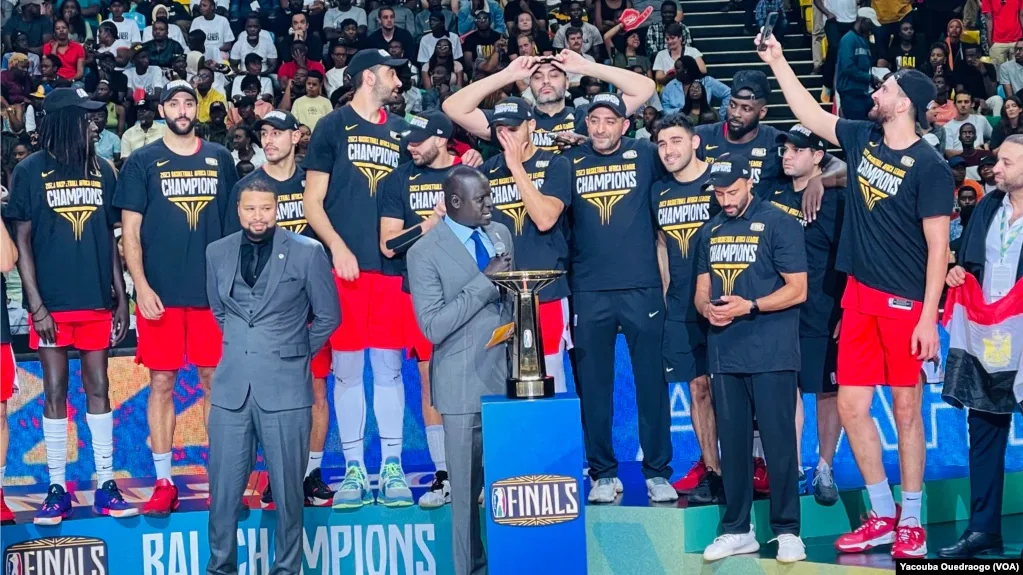
Al Ahly lifts the 2023 BAL title — an African institution winning a league whose enterprise value consolidates through NBA Africa.
PREMIUM CASE STUDY
The full strategic decode — the bet, the creative move, the evidence ledger and the lessons — is part of the Intelligence membership.