The Framework Was Never Neutral
The problem was never that Africa lacked evidence. The problem was who got to decide which evidence counted.
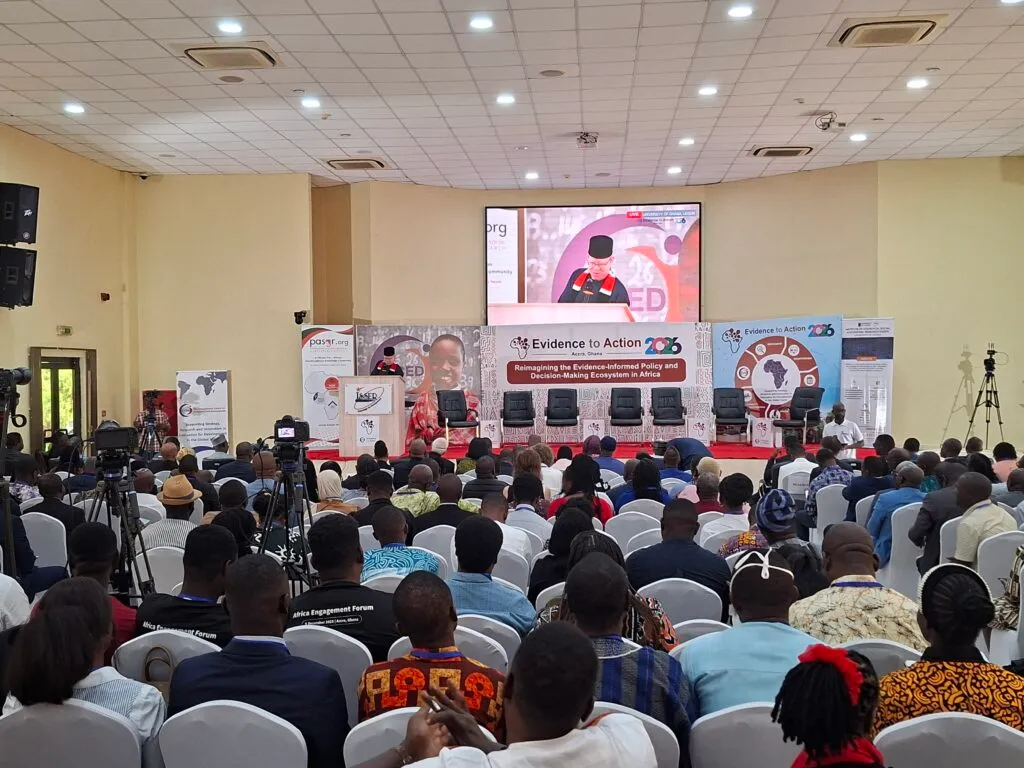
In June 2026, the University of Ghana's Legon campus hosted the closing plenary of the Evidence to Action (E2A) Conference — three days, hundreds of researchers and policymakers, one question underneath everything: whose knowledge is actually shaping policy on this continent?
Kenya answered it directly.
What Was Said, and Why It Matters That It Was Said Aloud
Dr. Isaac Mwaura, Kenya's Government Spokesperson, stepped to the podium at the final session and made the kind of statement that usually gets softened into a think-piece recommendation.
"We cannot use evidence that outsiders are producing alone. We must rely on evidence produced within our own context and environment."
No hedge. No "arguably." Just the structural reality, stated clean.
Before him, Prof. Peter Anyang' Nyong'o — Governor of Kisumu County and one of the continent's most rigorous political voices — set the stakes without comfort.
"We are not going to change Africa without action. What matters is what we do from here."
Not a slogan. A challenge with a deadline attached.
The conference was organised by ISSER — the Institute of Statistical, Social and Economic Research at the University of Ghana — alongside the International Centre for Evaluation and Development (ICED). The stated focus was evidence-informed policymaking. What emerged was something sharper: a reckoning with whose evidence, gathered by whose hands, run through whose frameworks, has been driving decisions about Kisumu's healthcare, Lagos's housing, Accra's credit markets.
Prof. Nyong'o was explicit. Much of the research currently informing policy across the continent is derived from external sources. Those sources, he argued, do not fully capture the social and cultural dynamics at play — not because the researchers are incompetent, but because a market woman's decision-making in Kumasi, the logic of communal land tenure in the Rift Valley, the reasons why healthcare uptake in rural Kisumu does not respond to the same behavioural nudges that work in rural Denmark — these are not edge cases. They are the whole case. And they require researchers who already know the weight of them.
This is a structural argument, not a sentimental one. The framework isn't broken. It was built for someone else.
The AI Problem Is the Same Problem, Arriving Faster
Prof. Nyong'o extended the argument into territory that the conference's more cautious voices left untouched: artificial intelligence.
AI systems trained on datasets that exclude Twi, Dholuo, and Zulu. Models built without the social architectures of communal decision-making. Diagnostic tools calibrated on demographics that do not include sub-Saharan populations. These systems are already being deployed — in credit scoring, in healthcare diagnostics, in how governments model resource allocation.
The argument at Legon was not that African institutions should resist these technologies. It was that African values must be integrated into how they are built, or the systems of the next twenty years will make decisions about this continent the same way the last century's frameworks did: at a distance, with confidence, and without full sight of who is actually there.
That is not abstract. That is a procurement decision. That is a dataset. That is a funding line.
The Diaspora Is Not Separate From This Conversation
For the researchers, data scientists, public health professionals, and economists in the diaspora — the ones who built careers in Toronto, London, Houston, Amsterdam — this conversation does not arrive from outside. It arrives from underneath.
We know the version of this problem that lives in the body. We wrote essays that required Western citations even when the subject was our own countries. We learned to call our grandmothers' knowledge "anecdotal" and our professors' frameworks "rigorous." We became the bridge between communities we grew up in and institutions that funded the research about those communities. And somewhere in that translation, the question got buried: what if the framework itself is what needs to change?
The scholars at Legon were drawing the line that answers that question. African institutions need to own data generation. African researchers need to own the analysis. Policymakers need evidence that is not just technically sound but culturally grounded — which means the people producing the evidence need to know the ground.
For diaspora professionals working on Africa-facing research, tech, or public policy: the contribution isn't charity. It's correction. Partner with institutions on the continent. Push back when your team's Africa work runs entirely through external frameworks. Put ISSER in the room when your institution is deciding who to fund.
The conference is over. The infrastructure question is open.
What ISSER and ICED Build Next
The E2A Conference was not a conclusion. The collaboration between ISSER and ICED is designed to build lasting architecture for evidence-informed decision-making across the continent — more institutional partnerships, more locally-funded research programmes, more pressure on governments to commission knowledge from scholars who live inside the systems they study.
Ghana's ISSER has been doing serious work for decades. The Kenyan voices at Legon signal something broader: a growing continental alignment around the idea that external validation is not a prerequisite for knowledge to count. The next test is whether governments shift their research procurement — whether they fund local scholars when the high-stakes decisions arrive, or default again to international consultants who will fly in, file the report, and fly out.
Watch that procurement. It is where the rhetoric either holds or folds.
Knowledge Is Not Imported. It Never Was.
What happened at the University of Ghana in June 2026 was deceptively quiet. No declaration. No treaty. Just Africa's sharpest institutional voices standing up and saying: the knowledge exists. The context exists. The values exist. The only thing missing is the confidence to build systems from here instead of waiting for permission from elsewhere.
That confidence is not soft. It is the infrastructure everything else runs on.


