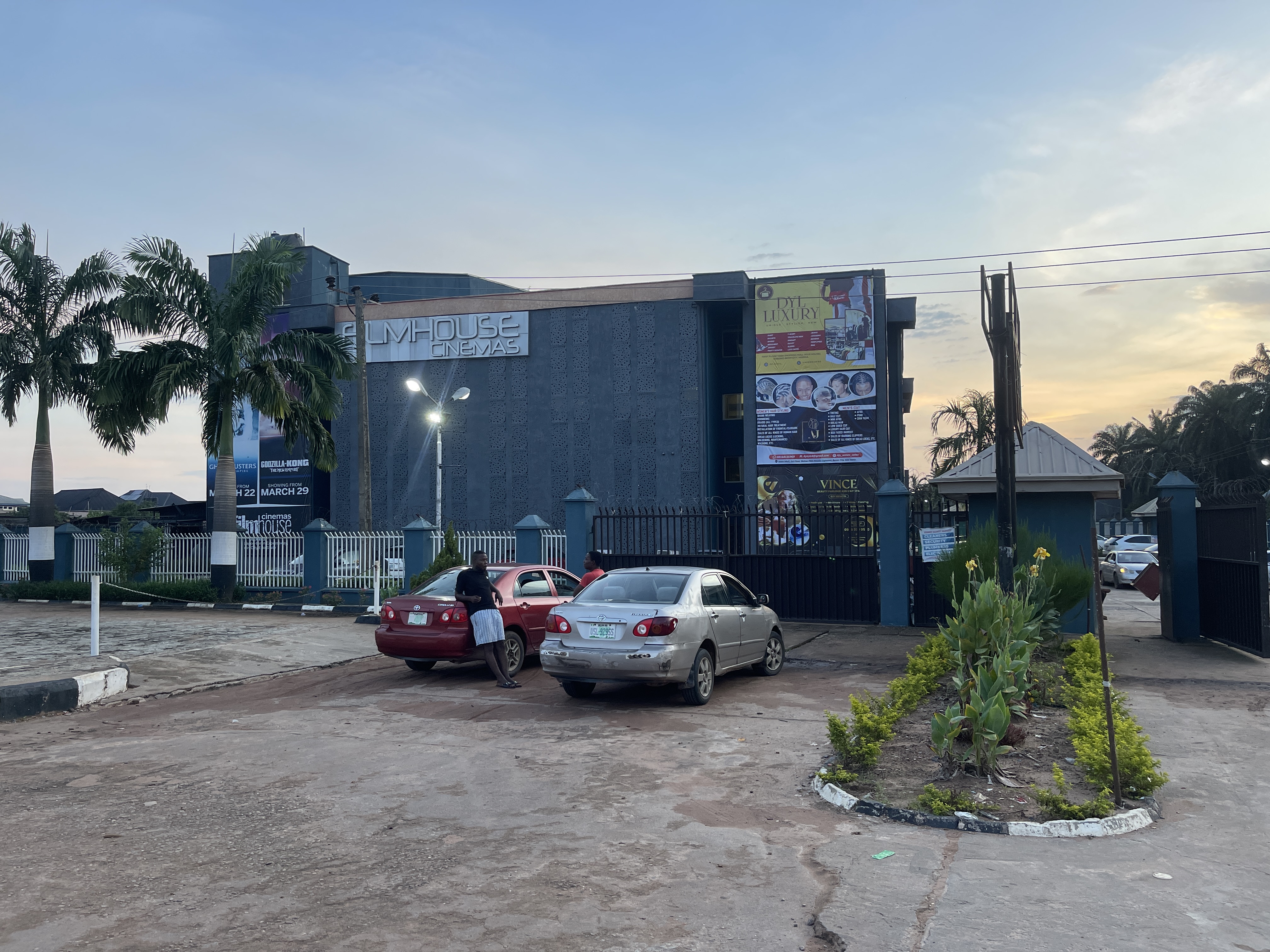
The story everyone is telling about Nollywood right now is a growth story. Box office up. Records falling. Nigerian films outgrossing Hollywood on their own soil. All true. All the wrong frame.
Because a boom is what happens when new money arrives. This is the opposite. Nigeria's theatrical market is surging precisely because the money left — and the more interesting question is not how big the numbers got, but who owns them now.
Here is the surge, in figures. Nollywood's top ten theatrical releases in the first half of 2026 grossed a combined ₦2.26bn, a cume that has more than doubled in two years (ShockNG).1 The total Nigerian gross box office for the same six months landed at roughly ₦8.8bn (Nollywire).2 And for the first time, Nollywood pulled ahead of Hollywood in its home market — local films out-earning the imports in the country that used to be a reliable export destination for American studios (Businessday).3 Funke Akindele's "Behind the Scene" became the first Nigerian film ever to cross ₦2bn (allAfrica).4 Read those numbers as a scoreboard and it looks like triumph. Read them as a map of ownership and it looks like a recovery — a value chain being rebuilt by the people who lost it.
To understand why, you have to go back to the cheque.
For about five years, the streaming platforms treated Nigeria as a content frontier. Netflix commissioned Nigerian originals, paid filmmakers upfront, and slapped the "Netflix" logo on Lagos stories. It felt, at the time, like arrival. Kunle Afolayan — one of the directors whose work Netflix bankrolled — has since confirmed the reversal: Netflix stopped commissioning Nigerian originals around November 2024, pivoting from funding new work to merely licensing finished films (Businessday; Pulse Nigeria).56 The upfront support, the thing that made the model feel generous, is the thing that got cut. Amazon's Prime Video moved the same direction on a shorter timeline, laying off its Africa staff and halting original funding in 2024, pushing filmmakers back toward cinemas and local platforms like Showmax and IrokoTV (Pulse).6
The industry narrative calls this abandonment. Our read is that it was always a lease, and the lease simply expired.
Look at what the upfront cheque actually bought — not for the filmmaker, for the platform. It bought the master. It bought the global distribution rights. It bought the audience relationship: the viewer who watched a Nigerian film did so inside Netflix's interface, on Netflix's terms, generating Netflix's data. The filmmaker got paid once. The platform got an appreciating asset and a first-party relationship with every person who pressed play. That is not a partnership. That is a sale, dressed as a break.
And the extraction was sharper than most of the coverage admitted. A large share of the Nigerian titles Netflix acquired were geo-locked to Africa — available to viewers on the continent but never surfaced to the platform's global audience (Tech Labari).7 Sit with what that means. Nigerian filmmakers were told they had gone global, while their films were quietly fenced inside the same continent they were made in. The "global audience" everyone signed up for was, for many titles, a Lagos-to-Nairobi audience wearing a Silicon Valley badge. The promise was reach. The delivery was a logo.
Of the three, the data is the one nobody mourns, and it is the one that mattered most. A master is a film; you can, in theory, make another. A global audience is reach; you can rebuild it. But the data — who watched, for how long, what they watched next, which thumbnail made them press play, which Lagos story travelled to which foreign living room — is the compounding asset, because it is the thing that decides what gets made next and who it gets shown to. The platform did not just license Nigerian films. It learned the Nigerian viewer, and the diaspora viewer, better than any Nigerian company was allowed to. When the money left, that intelligence left with it, and it was never on the invoice. You cannot re-domicile a dataset you were never given a copy of.
So when the platforms retreated, they took three things with them: the IP, the global audience, and the data. What they could not take was the domestic cinema-goer — because that relationship was never theirs to own. And that is exactly where the growth reappeared.
The 2026 leaderboard tells the ownership story better than any think-piece. The top film of the year so far is "Call of My Life," which grossed ₦719.84m, distributed by FilmOne Entertainment, released 15 May (ShockNG).1 "Love and New Notes" took ₦400m through FilmOne in February. "The Return of Arinzo" cleared ₦351m in April (ShockNG).1 Notice what these have in common. They are not streaming acquisitions. They are theatrically distributed films moving through Nigerian and Africa-facing distribution houses — FilmOne among them — that keep the rights, the release strategy and the box-office relationship on the continent. The revenue is not an advance against a surrendered master. It is a ticket sold to a person in a seat, counted by a distributor who answers to Lagos, not Los Gatos.
This is the part worth saying plainly. Nollywood is not booming despite the streaming pullback. It is booming into the space the streaming pullback opened. The cheque came with a claim on the future; the cinema ticket does not. When you own the release, every naira that comes back is yours to reinvest in the next film, the next screen, the next distributor — instead of flowing offshore as a licensing line on someone else's balance sheet. The theatrical surge is the sound of a value chain being re-domiciled.
There is a temptation to make this a villain story, and we should resist it. Netflix did not single Nigeria out. The company's 2026 posture — fewer films, higher budgets, a "fewer, better" strategy across its entire slate — swept up Nigeria as collateral, not as a target (OtakuKart).8 The retreat was a global capital-allocation decision made in California about California's margins. Nigeria was a line item in a spreadsheet that got trimmed. That is almost the whole point. The most valuable creative market in Africa had its funding switched off by a decision it had no seat in, no vote on, and no warning of. When your industry's growth depends on a foreign platform's slate strategy, you are not an author of your future. You are an input to someone else's.
Which forces the honest question, the one the celebration is trying to skip. Is the box-office boom a healthier, self-owned model — or a forced retreat to a smaller pond because the global door was shut from the outside?
Both, and pretending otherwise is how you get the analysis wrong.
The retreat is real. A cinema ticket in Lagos is denominated in naira, sold to a domestic audience, in a currency that has lost ground and a market that is a fraction of the global streaming base Nigerian filmmakers were briefly promised. ₦2.26bn1 across a top ten is a serious number at home and a rounding error against a single mid-budget Hollywood release. The geo-locked years mean many of these films never got to find out how big their global audience could have been. The door did shut. Nobody chose this from a position of strength. To call it liberation without naming the loss is its own kind of poverty-porn-in-reverse — a triumphalism that flatters the survivor and ignores the theft.
But here is why the self-owned reading still holds, and holds harder. Ownership is the only growth that compounds. The streaming years produced a spike in filmmaker income and a collapse in filmmaker equity — you got paid, and you got nothing that appreciates. The theatrical years are producing the reverse: slimmer, harder-won revenue that stays inside structures Nigerians control, that funds the distributor's next slate, that builds the muscle of running your own release rather than renting it out. One model made individual filmmakers briefly richer and the industry permanently dependent. The other is making the industry slowly sovereign. A smaller pond you own beats an ocean you're leased into — because the pond is yours to widen.
There is a diaspora dimension here that the domestic figures hide. The audience the streaming platforms were supposedly delivering — Nigerians in London, Houston, Toronto, the people who grew up on Nollywood VCDs and now stream everything — is precisely the audience the geo-locked years fenced off. That diaspora is not a nice-to-have market. It is the highest-value route on the map: a viewership that earns in pounds and dollars, that carries Nigerian stories into rooms where global taste gets set, and that will pay a premium to stay connected to home. The tragedy of the lease years is that a foreign platform sat between Lagos and its own diaspora and monetised the connection without ever fully opening it. The prize for whoever builds the continent-owned pipe is not just the local cinema-goer. It is the re-domiciling of that entire diaspora relationship — earned abroad, owned at the source.
And widening it is the actual work now. The theatrical rebound proves the domestic value chain functions; it does not yet prove it can scale globally on its own rails. That is the unfinished project: African-owned distribution that reaches the diaspora and the world without handing back the master to do it. Showmax, IrokoTV and the local distributors are the early architecture of that. The pan-African cinema footprint is the physical layer. What is missing is the global-facing, continent-owned pipe — the thing that lets a Nigerian film reach London and Atlanta and São Paulo while the rights, the audience data and the upside stay in Lagos. Build that, and the box-office boom stops being a recovery and becomes a foundation. Fail to build it, and the next well-funded foreign platform will offer the cheque again, and a generation that remembers only the payday and not the price will take it.
Because that is the trap, and it will come back. The extraction did not happen because Nigerian filmmakers were naive. It happened because the upfront cheque solves a real, immediate problem — production is expensive, capital is scarce, and a bird in the hand pays the crew today. The self-owned model asks filmmakers to trade certain money now for owned upside later, which is the hardest trade in any creative economy and the one the whole global music industry has spent a century getting wrong. Nollywood is currently getting it right, but by circumstance more than by choice. The task is to convert an accident of retreat into a doctrine of ownership — to make "we keep the master" the default even when the next Silicon Valley cheque is fat and the naira is weak and the temptation to sell the future for a solvent present is overwhelming.
Our take is that the H1 2026 numbers are not a box-office story at all. They are an ownership story wearing a box-office costume. The headline figure — Nollywood outgrossing Hollywood at home — matters far less than the sentence underneath it: the growth is flowing through structures Nigerians own, into a value chain Nigerians control, counted in a market Nigerians can actually reach without an intermediary's permission. That is worth more than the streaming years produced, even though the streaming years produced bigger cheques. Bigger cheque, smaller future. Slimmer ticket, owned future. The industry has, almost by accident, chosen correctly.
The streaming era paid Nigeria for its stories and kept the ending. The theatrical era pays less and keeps everything. If Nollywood remembers which of those is the actual asset — not the money that came in, but the rights that stayed — then the gold rush leaving town will read, a decade from now, as the best thing that ever happened to it. The prospectors have packed up. The ones who owned the land are still here.
