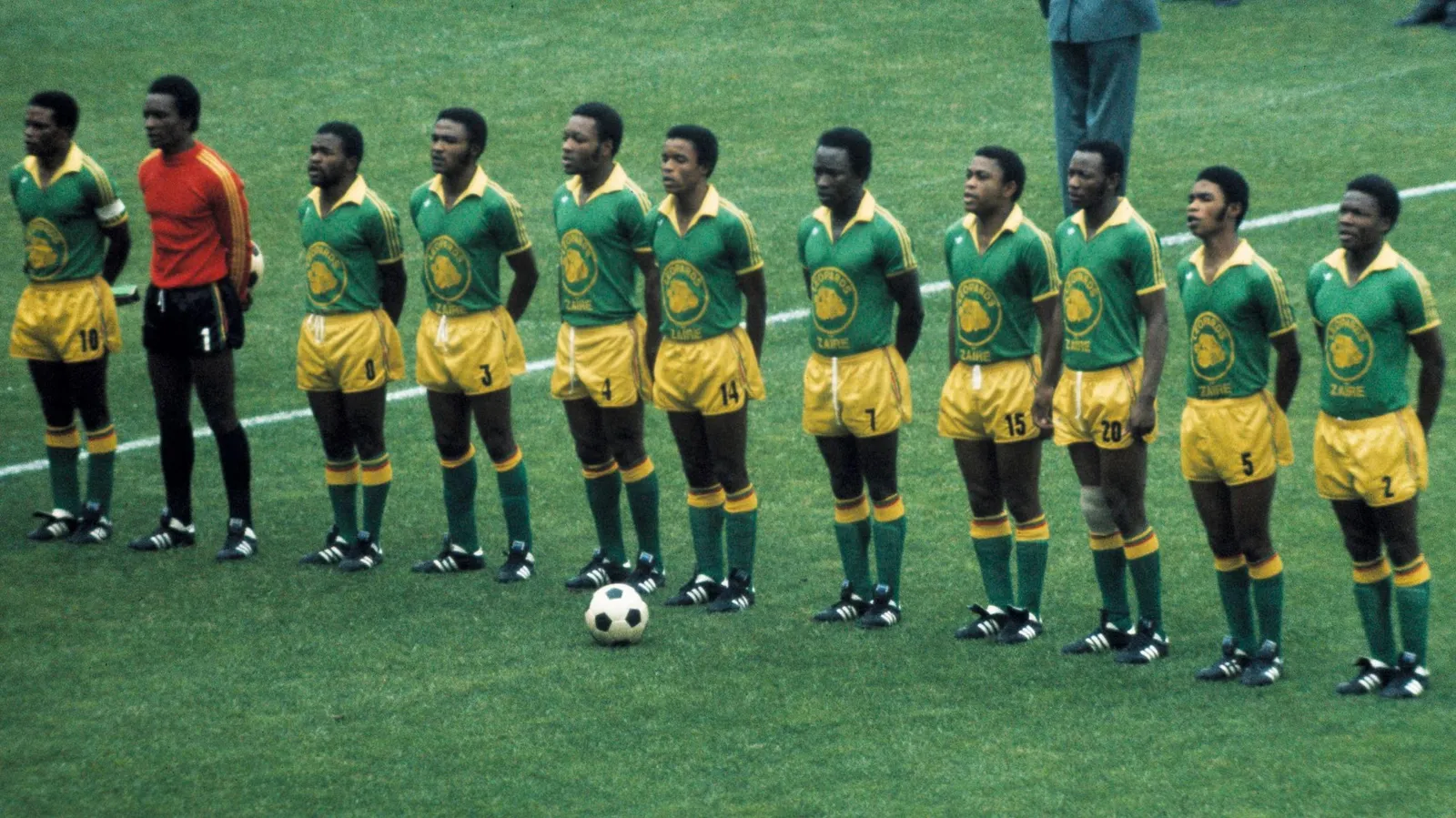
The Wound and the Rumble
DR Congo are not returning to the World Cup. They're returning to a conversation that was cut off mid-sentence in 1974 — and every Congolese person alive, whether in Kinshasa or Croydon or the Bronx, has been waiting to finish it.
Wednesday. Atlanta. England. 17:00 BST.
That fixture is not a football match. It's a verdict.
What Zaire Carried Into Those Three Games
June 1974. Zaire — DR Congo's name at the time — became the first sub-Saharan African nation to qualify for a FIFA World Cup. Read that again: the first. A country that had won its independence from Belgium in 1960. A country that had lifted the Africa Cup of Nations twice, whose clubs had claimed three continental titles between 1967 and 1973. The Leopards weren't grateful guests. They were continental royalty, and they had earned every minute of the tournament.
Then came the scorelines.
Three games. Three defeats. Fourteen goals conceded. Zero scored. Yugoslavia put nine past them. The 9-0 is still one of the worst results in World Cup history. But the moment the world kept — the one that followed Zaire like a shadow for fifty years — came against Brazil.
Trailing 2-0 in the dying minutes, defender Mwepu Ilunga broke from the defensive wall as Brazil lined up a free-kick and drove the ball downfield. The stadium laughed. Commentators questioned whether Zaire's players understood the rules of the game. The mockery was swift, global, and wrong.
Because Ilunga knew exactly what he was doing.
"I was aware of football regulations. I did it on purpose," he told the BBC in 2010. The players had been robbed. FIFA bonuses paid to the federation had never reached them. They had threatened to boycott the Yugoslavia match over unpaid allowances. The talent was there. The morale had been stolen from them. Reserve goalkeeper Mohamed Kalambay said it plainly: "You don't have the morale to play. And that's what happened to us."
Ilunga wanted a red card so he could walk off the pitch. "Why should I play for the benefit of officials of our country's football association who took the players' money?" The referee didn't give it. He stayed on. And that image — stripped clean of its context — became the story the world told about African football for a generation.
Not incompetence. Protest. The world just chose the cheaper read.
Four Months Later, Kinshasa Was the Centre of the Universe
Here is what happens when you put 1974 in full: after the World Cup humiliation, DR Congo came home. And four months later, President Mobutu Sese Seko spent $5 million each — yes, each — to bring Muhammad Ali and George Foreman to Stade du 20 Mai.
30 October 1974. Kinshasa. Ali absorbed everything Foreman threw across eight rounds, then dropped him with a combination that silenced one of the most dangerous punchers in the sport's history.
The Rumble in the Jungle. Staged not in Las Vegas, not in Madison Square Garden — in Kinshasa.
Journalist Justin Kabala Mwana was there that night. "People partied right through the night. Beer was flowing freely for up to 48 hours after the fight," he told BBC Sport Africa. Every headline in the world pointed at the Congolese capital. Every front page. Their home had hosted the greatest.
Mobutu had his political calculations — he always did. But what settled into the hearts of ordinary Congolese people was something the politics couldn't manufacture: the world had come to them. And it had witnessed something unforgettable.
Same year. Same country. The worst moment in World Cup history. The greatest moment in boxing history. That is the contradiction DR Congo has been carrying.
What Wednesday Means If You Already Know
If you're Congolese and reading this from Brixton, from Laeken, from the Bronx, from Montreal — you don't need this explained to you. You've spent your life explaining where you're from. You've watched faces recalibrate when you say Congo. You've code-switched in offices and stayed silent at dinner tables when the headlines were bad and the questions were worse. You've carried the weight of how the world reads your country.
Now your Leopards are back on the biggest stage in football.
Kabala — the man who watched Ali knock Foreman down fifty-two years ago — sees Wednesday the same way he saw that fight. A chance, he says, for a country "hit hard by conflict and corruption over decades to regain its unity and dignity."
Not perform it. Regain it.
That distinction is everything. Because when the Leopards line up against England, every Congolese person in every timezone stops being a statistic, an expat, an immigrant, a case study. They're just Congolese. Loud and together and watching the same screen.
The group chats are already running. Congolese aunties who never ask about football are suddenly asking what time kickoff is. The guys who swore off tournaments after the last heartbreak are checking stream links. Qualification alone — ending forty-six years of absence — was already a declaration. What comes next in Atlanta is the punctuation.
Who These Leopards Are
This is not a squad that parks buses. DR Congo came to this tournament with pace in the final third and the confidence of a generation that didn't inherit the 1974 wound — they inherited the survivors. Watch the energy. Watch the press. Watch what happens when this team smells space.
Beyond Wednesday's match against England, they have the depth to go further in this tournament than the draw suggests. Atlanta is not the ceiling. It's the door.
Atlanta Is Where the New Sentence Begins
From Mwepu Ilunga's deliberate free-kick in Gelsenkirchen to the Stade du 20 Mai the night Ali made history to a squad of Leopards running out in Atlanta in 2026 — this was never a story about shame.
It was always about what survives when everything is taken from you.
The Leopards are back. And the sentence that was cut off in 1974 is finally getting its full stop.


