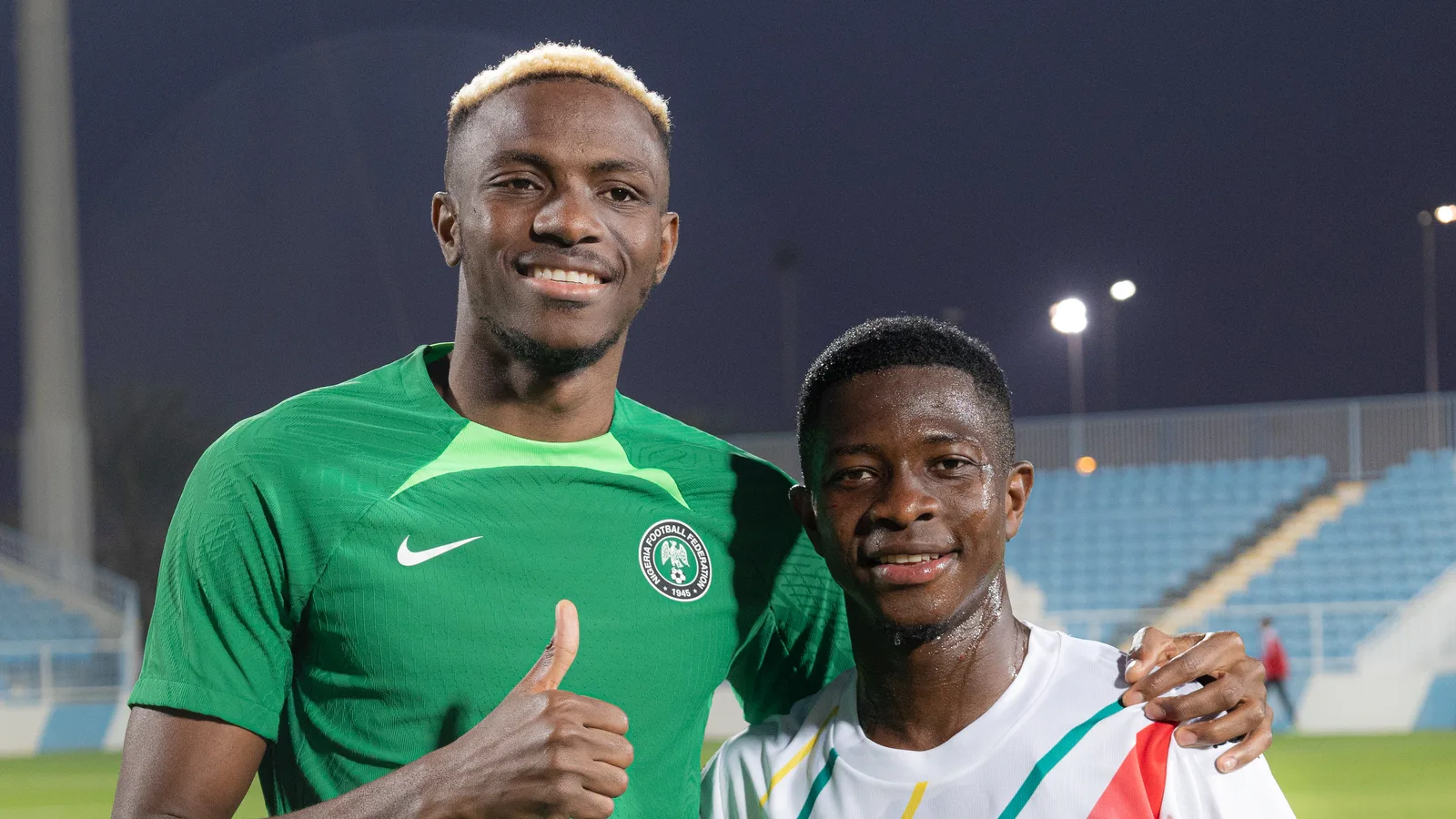
A striker you can identify from the silhouette
Most footballers are recognisable by their faces. Victor Osimhen is recognisable by the thing that hides half of it. The black protective face mask the Nigerian striker wears has become one of the most legible pieces of personal iconography in world football — a shape you can draw in three strokes and everyone knows who it is. For a sport that turns athletes into logos, Osimhen accidentally engineered the rarest asset of all: a visual signature no rival can copy without looking like a tribute act.
The origin is not a marketing story. In November 2021, playing for Napoli against Inter Milan, Osimhen clashed heads with defender Milan Skriniar and shattered multiple bones in his face, requiring surgery that inserted titanium plates and screws 2. He returned in a carbon-fibre mask, and — unusually — never took it off. Years later he still cites screws passing through his jaw and the need for protection when he jumps to head the ball. What began as medical necessity hardened into permanent identity.
The performance that made the mask worth branding
Iconography only works if there is a champion underneath it. Osimhen supplied that in 2022–23, the season he dragged Napoli to their first Serie A title since the Diego Maradona era of 1990. He scored 26 league goals to win the Capocannoniere as the division's top scorer, becoming the first African player to net 26 in a single Serie A campaign 3. The Scudetto was a city-wide catharsis; Osimhen, mask and all, was its face.
The individual honours followed the collective one. In December 2023 he was crowned CAF African Footballer of the Year in Marrakech, beating Mohamed Salah 4, becoming the first Nigerian man to win the prize since Nwankwo Kanu in 1999. That is the sequence that converts a quirk into a brand: elite output first, distinctive symbol second. The mask did not make Osimhen famous. His goals gave the mask something to stand for.
Iconography goes commercial
What happened next is the part brand strategists should study. When Osimhen moved to Galatasaray, the mask travelled from personal kit to cultural merchandise. Fans turned up in stadiums wearing replica masks; the club's official GSStore began selling them, and the imagery became so ubiquitous that Turkish authorities eventually banned fans from bringing the masks into stadiums on safety grounds 5 — the rare case of a personal-brand symbol becoming popular enough to require regulation. Teammates borrowed it to celebrate. It became a meme, a costume, a signal of allegiance.
The commercial logic underneath is real. Galatasaray made Osimhen a permanent signing in 2025 for a reported €75 million fee, the most expensive incoming transfer in Turkish football history 1. Clubs do not smash national records only for goals; they pay for the ecosystem an athlete drags with him — the shirt sales, the sponsor appeal, the social reach, the reason a neutral tunes in. Osimhen arrives pre-loaded with a face you can merchandise before he scores.
The African read
Strip away the football and this is a lesson in how an African star builds durable equity in a global market that usually flattens them into 'talent'. Osimhen owns something most exported African athletes never secure: a distinctive, portable, instantly-monetisable visual identity that is his, not the club's. Kits change, badges change, leagues change — the mask is constant. It is a brand asset he carries across borders, and it means his cultural value does not fully reset every time he transfers.
That matters because African footballers have long generated enormous commercial value abroad while capturing little of the iconography that outlives their contracts. Weah, Drogba, Eto'o, Salah, Mané — each a giant, few with a symbol you can render as a sticker. Osimhen has one, and it happens to be rooted in a specifically un-glamorous truth: resilience made visible. A near career-ending injury became the most recognisable thing about him. There is a pan-African narrative in that — turning damage into signature — that no sponsor could have scripted.
The caution is honest too. A brand built on a mask is a brand built on a body that is still healing; the symbol carries the risk it protects against. But as a case in athlete branding, Osimhen is close to a textbook: elite, repeatable performance; a single unmistakable visual; organic fan adoption; and cross-border portability. African stars are told to chase reach. Osimhen quietly proved the harder, more valuable thing is to be identifiable — to own a shape the world can draw from memory.

