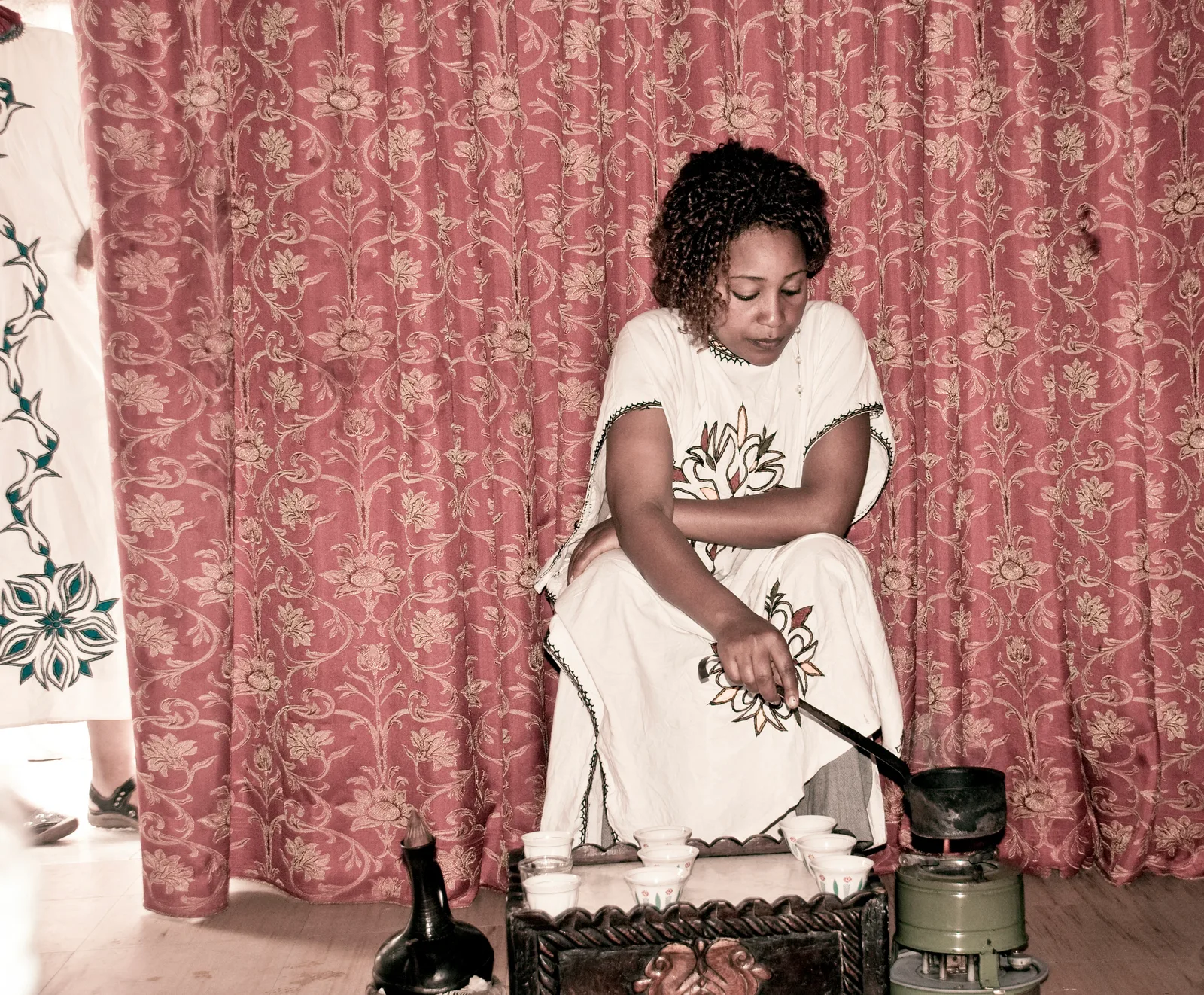
The record that hides the loss
In July 2026, Ethiopia announced its coffee sector had crossed a threshold it had chased for a generation: a record US$3 billion in export earnings for the 2025/26 fiscal year, more than 30% of everything the country sold abroad 1. Revenue had climbed from roughly $1.4 billion in 2023 to $2.65 billion the year before 2. Minister of Agriculture Addisu Arega and ECTA Director General Adugna Debela framed it as proof of reform working, and set a new marker: $6 billion by 2031 1.
Read the fine print and a harder story appears. Nearly all of that $3 billion left the country as green, unroasted beans. Roasted coffee — the version a person actually drinks — remains less than 5% of exports 3. Ethiopia is the birthplace of Arabica, home to more than six million smallholder farmers 1 working Sidamo, Yirgacheffe, Limu and Harrar. And yet the moment the bean becomes a brand happens somewhere else — usually a roastery in Hamburg, Seattle or, increasingly, Shanghai.
This is the origin-versus-brand question, and it is the defining economic argument of African coffee right now.
Where the money actually is
The global coffee industry is worth over $200 billion a year 4, yet Africa — coffee's ancestral home — captures a sliver of it. Africa grows roughly 12% of the world's coffee 4, but the steps that multiply value — roasting, blending, packaging, branding, retail — mostly happen on other continents. An African farmer earns less than $2 per kilo for exported beans; that same kilo retails at $20–30 once someone else has roasted and named it 4. The grower's share of a cappuccino sold in a European café is 5 to 10% 4.
The scale of the imbalance is easiest to see in a single comparison: in 2022, all of Ethiopia's coffee exports earned about $1.4 billion, while Starbucks alone booked over $36 billion in revenue 4. One country's entire harvest against one chain's cash register.
The reason is structural. Value in coffee compounds after the farm gate. Industry estimates put the multiplier from raw bean to roasted, packaged product at five to ten times 4. Even Ethiopia's own historical data shows roasted coffee fetching roughly double the per-kilo price of green 5 — and that is before you add the intangible premium of a name people trust. "The only way to ensure sustainable development in coffee is through value addition," Moyee Coffee's Ahadu Woubshet put it 5. The slogan is universally agreed. The execution is where it breaks.
Why it breaks is worth naming. Roasted coffee is perishable in a way green beans are not — it stales within weeks, which means exporting it demands fast, reliable logistics, cold-chain-grade freight and consumer demand waiting at the other end. Consuming markets have spent a century building exactly that infrastructure, plus the brand relationships, retail shelf space and trademark protections that keep it theirs. A green bean is a commodity anyone can buy on a screen; a roasted, named product is a promise that has to be marketed, distributed and defended. Origin countries have the beans. They have historically lacked the ships, the shelves and, above all, the brands.
Ethiopia's self-inflicted wound
Ethiopia's push to roast at home ran into a policy own-goal. In June 2021 the Ethiopian Coffee and Tea Board banned the export of raw coffee to other producing countries 6, reasoning that its beans should travel branded rather than as anonymous blending stock. The intent was sovereignty. The effect was lost markets — India among them — and a deeper problem at home: local roasters were barred from sourcing export-quality beans, left to roast lower grades and produce an inferior domestic product. The country was trying to build a brand economy while starving its own roasters of the good beans.
That particular ban has since been lifted for local roasters who export, and the government now talks the language of traceability, agro-processing and value addition. But the roasted-export number — under 5% — tells you the machine has not yet been built. As Sani Redi of the coffee authority conceded, "Every stage of the coffee production in Ethiopia and its value chain has to be reformed for the country to be competitive." 5
Rwanda's answer: build the brand, keep the profit
Rwanda is smaller and has run the experiment differently — by building companies, not just policies. Rwanda Farmers Coffee Company's Gorilla's Coffee opened a roasting plant in 2014 that it calls the largest roaster in East Africa, with a daily capacity of nine tons. It roasts Arabica Bourbon from cooperatives around Lake Kivu, and it is Rwanda's only instant-coffee producer — a category that is unglamorous but branded, shelf-stable and sold under a Rwandan name rather than a foreign one.
The more radical model is Question Coffee, the Kigali café and small-batch roastery run by the non-profit Sustainable Growers. It grew out of a 2013 initiative backed by Bloomberg Philanthropies and Sustainable Harvest, reinvests its proceeds into training, and now works with tens of thousands of predominantly women farmers organised through cooperatives across Rwanda, the DRC and Tanzania. Question Coffee's insight is that the café itself — the point where a customer pays retail — is a value-capture machine, and there is no law of nature saying that machine has to sit in Brooklyn.
What both Rwandan ventures share is a refusal to treat the country as merely a supplier. Gorilla's exports instant coffee under its own label; Question Coffee sells cups to Kigali's professionals and tourists at retail prices, then trains the growers who supply it. Neither is large by global standards. But together they sketch the alternative to the green-bean trap: keep the roasting, the packaging and at least some of the retail on Rwandan soil, and let the margin compound at home instead of abroad.
Kenya: the underdeveloped opportunity
Kenya earns real money from coffee — Sh43.36 billion between January and September 2025 7 — off a bean prized globally for its bright, complex profile. But Java House CEO Priscilla Gathungu named the gap plainly: "Most of our coffee is exported as raw or semi-processed, leaving the higher-margin work of roasting, blending and branding to importing countries 7."
The counter-movement exists. Spring Valley Coffee has roasted at origin since 2009, arguing that roasting in Kenya keeps more value — and more jobs — in Kenya. African Coffee Roasters runs private-label and toll roasting out of Athi River, shipping whole bean, ground and capsule to global markets. State-backed KCCE roasts and packages under its own Kencaffee and Shiriki labels. These are proofs of concept, not yet a sector. And Kenya carries a demographic clock: a 2020 report found most of its coffee farmers are men aged 60 and above 7, which is why programmes like the Java House Foundation's NexGen scholarship at Dedan Kimathi University's Coffee Technology Centre are betting on training a generation that treats coffee as a brand business, not just farming. That framing matters. If the next cohort of Kenyan operators learns quality management, roast profiling and traceability rather than only agronomy, the country's celebrated bean stops being someone else's raw material and starts becoming its own finished product — one that consumers, from Nairobi to the diaspora, can ask for by name. Customer taste is already moving that way, tilting toward specialty and single-origin coffee with farm-to-cup traceability. The demand exists; the question is who supplies the brand behind it.
The so-what
Here is the uncomfortable pattern. Africa authored the culture of coffee — the ceremony, the origin names buyers pay extra to print on a bag, the terroir romance of Yirgacheffe and Nyeri. But authoring the culture and capturing the value are two different acts, and for a century the continent has done the first and outsourced the second. Record green-bean earnings are real progress for farmers. They are also a ceiling dressed up as a milestone: you cannot green-bean your way to $6 billion of durable, brand-protected income when the drinker never sees your name. A commodity price is set by markets you don't control; a brand price is set by loyalty you build. Only one of those is defensible over a decade.
The origin-versus-brand debate is a false binary. Origin is the moat — nobody else can grow Ethiopian heirloom in the Ethiopian highlands. Brand is the toll booth built on top of it. The winners of the next decade won't choose one; they'll fuse them, the way Rwanda's roasters and cafés are quietly doing. The question for Addis, Kigali and Nairobi is not whether they own the best coffee on earth. They do. It's whether they'll let someone else keep naming it.
