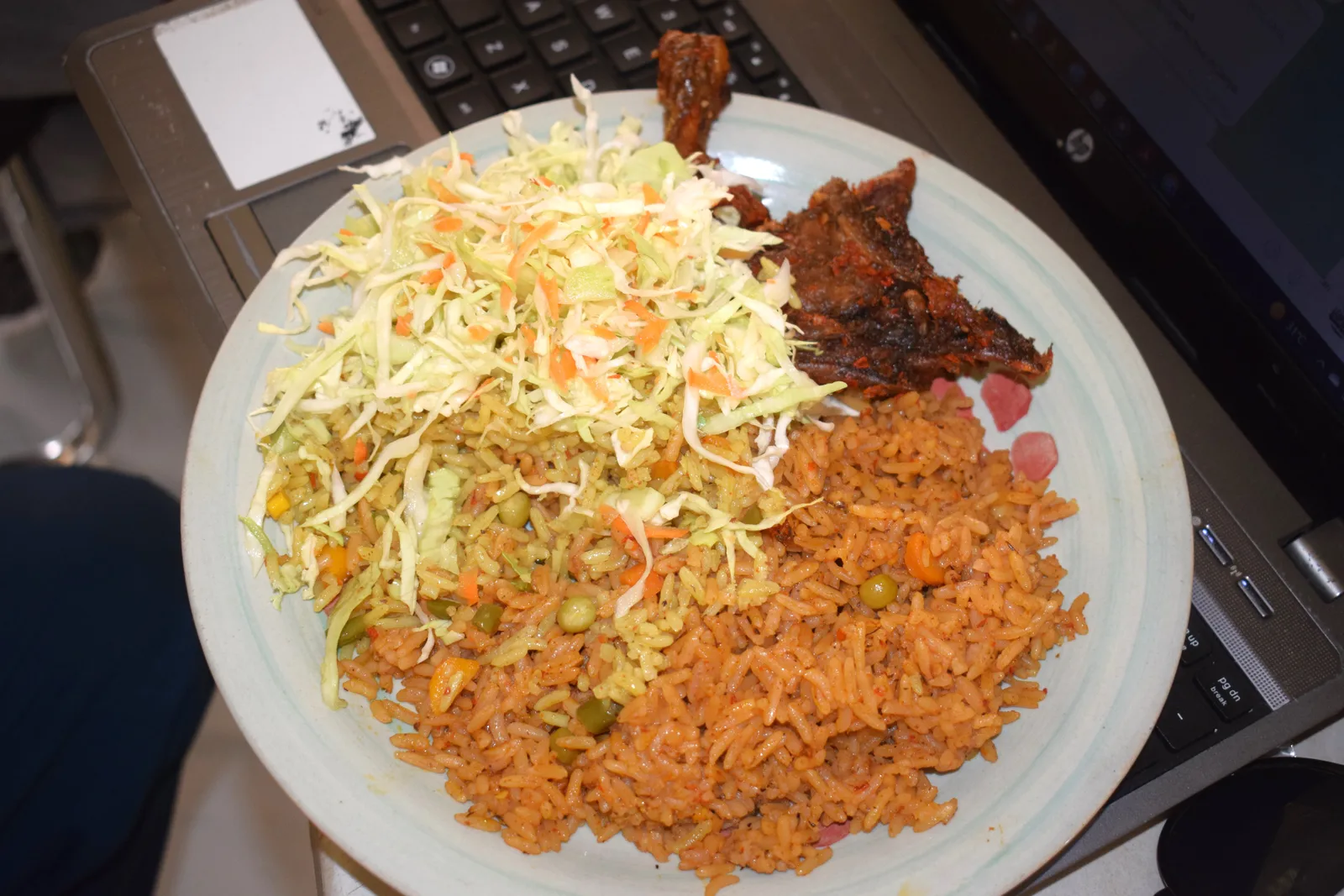
The war nobody wanted to win, everybody wanted to fight
In February 2023, UNESCO settled a decade of online combat — sort of. The UN's cultural body inscribed Senegal's thieboudienne, the tomato-and-fish rice dish widely understood as jollof's ancestor, onto its list of the intangible cultural heritage of humanity. 5 Nigeria and Ghana, the two loudest combatants in the so-called "jollof wars", were left to argue over the crown while Senegal quietly walked off with the deed.
That is the joke and the lesson of the last decade of West African food. The rivalry over whose jollof is best — a friendly flame-war that has burned across Twitter, YouTube and diaspora WhatsApp groups since the 2010s — turned out to be one of the most effective unpaid marketing campaigns the region has ever run. It projected culinary soft power without a single ministry of culture lifting a finger. The debate travelled; the recipe travelled with it; and by the time the argument reached the West's supermarket shelves, a very different question had replaced whose jollof is best. The new question is: who captures the value when West African food finally scales?
From meme to market
The numbers now do what the memes started. West African cuisine saw a 72% rise in popularity worldwide in 2023, per Mintel, making it the fastest-growing segment inside the "world foods" category — a category surging faster than grocery as a whole. 27 On the eating-out side, the West Africa food services market reached USD 6.2 billion in 2024 and is forecast to hit USD 11.4 billion by 2033. 3 And the prestige signal arrived in February 2024, when two London West African restaurants, Chishuru and Akoko, took Michelin stars in the same cycle — Chishuru's Adejoké Bakare becoming the first Black female chef in the UK to earn one. 4 The chefs themselves called it a "West African movement".
But restaurants and Michelin stars are the shop window. The real scaling is happening on retail shelves, in freezer cases and spice aisles — and it is being built, overwhelmingly, by a specific kind of founder: the diaspora operator with a Western MBA and a grandmother's recipe.
The diaspora CPG playbook
Consider the roster. Ayo Foods, founded by former General Mills executive Perteet Spencer — daughter of a Liberian immigrant who ran an import business — launched its frozen West African meals in 2020 and now calls itself the only nationally distributed frozen West African meal solution in the US. It went from cold-calling 200 retail doors to landing in Target and Sprouts, and Spencer is blunt that hiring a broker team was "a game changing decision." 1 Its freezer line — jollof rice, chicken yassa, groundnut stew — is the trend made microwaveable.
Iya Foods, built by Nigerian-born, Kellogg-trained ex-Bain analyst Toyin Kolawole, went the ingredients route: African pepper soup seasoning, plantain flour, fonio flour. Kolawole's founding insight was a gap, not a dish — "there wasn't adequate representation for African-inspired foods" on US shelves — and she pitched it through Walmart's open-call machinery. Egunsi Foods, 'Yemisi Awosan's line of West African soups and sauces, made scratch-cooked egusi and pepper soup shelf-stable and landed a berth in the Harlem Whole Foods and MOM's Organic Market. And Nuli, from former African Development Bank investor Ada Osakwe, is attacking the fast-casual lane — fonio bowls, suya skewers, egusi and baobab in Washington, DC, with a stated ambition of 1,000 US locations over 15 years.
Back home, the incumbents are older and quieter. Ayoola Foods, incorporated in Lagos in 1991, has spent three decades exporting plantain, yam and poundo-yam flours to the diaspora — the original scaled West African food business, built on nostalgia freight rather than trend cycles. The new wave didn't invent the export; it repackaged it for the American middle aisle.
The pattern is unmistakable, and it matters. The founders capturing the retail margin are, for the most part, dual-citizens of Lagos-Accra-Monrovia and of Kellogg, Northwestern and General Mills. They speak buyer. They understand slotting fees, brokers and Whole Foods category reviews. That is a genuine competence — and it is also where the value tends to pool.
Fonio, and the value question made concrete
No product makes the ownership question sharper than fonio, the ancient West African grain that has become the trend's poster crop. Chef Pierre Thiam has spent years evangelising it — his 2017 TED talk arguing fonio could help Africa prosper has passed a million views — and his company Yolélé now sells fonio pilaf and fonio chips in more than 2,000 US stores, including Whole Foods, Target and Erewhon. 6
What separates Yolélé from a pure branding play is where it chose to build the hard part. Its USD 1.98 million grant, funded through USAID's West Africa Trade & Investment Hub and Prosper Africa, went toward a processing centre in Mali — not a co-packer in New Jersey. The projected impact is denominated in African terms: roughly 13,714 agricultural jobs, USD 4.5 million in smallholder sales, and an estimated 85% lift in cash income for families in the grower network. 6 Ayo Foods, similarly, has said it wants to source 30–40% from small-scale West African farms. 1
This is the fault line. When a jar of West African seasoning sells in Austin, the value can be split many ways: to the diaspora founder who built the brand, to the American retailer taking margin, to the co-packer, and — sometimes, but not always — back to the West African farmer who grew the input. The seasoning and spice category is being reshaped precisely by standardising "home-cooked" artisanal blends into mass-market SKUs. Standardisation is what makes shelf-space possible. It is also what makes it easy to strip the origin out of the value chain, leaving the continent as a flavour reference rather than an economic participant.
The MonoKromatik read: culture is authored on the continent, value is captured off it
Here is the uncomfortable arithmetic. West Africa authored this culture — the recipe, the grain, the argument that made it go viral. But the scaled, investable, margin-rich version of it is being built predominantly in American freezer cases and British dining rooms, by founders who are of the diaspora but operating inside Western retail economics. That is not a scandal; the diaspora is doing exactly what diasporas do, and doing it well. It is, however, a strategic warning.
The jollof wars were free soft power that no West African nation monetised. The risk is that the retail moment goes the same way — that the region supplies the story and the smallholder inputs while the durable equity, the brand IP and the exit multiples accrue offshore. Senegal got the UNESCO deed to thieboudienne; it did not get the CPG company. The founders who will matter over the next decade are the ones, like Yolélé and Ayo, deliberately routing processing, sourcing and value back onto the continent — not as CSR, but as competitive moat and provenance premium. In a world-foods aisle crowded with lookalike jollof jars, verifiable origin is the one thing an American co-packer cannot fake.
Whoever owns the farm, the processing line and the story — not just the shelf — owns the jollof economy.
