Momma, He Made It
This isn't Afrobeats arriving. It's Afrobeats collecting what it's owed.
Rema posted two words after his World Cup performance. "Momma hope you proud." A white heart. A Nigerian flag. That's it. No long caption. No hype. Just a son from Benin City, Edo State, telling his mother he delivered on a stage that doesn't get bigger than this. That caption hit harder than any press release ever could — because it wasn't written for the culture writers. It was written for one person.
What Went Down at SoFi Stadium
Los Angeles, June 2026. SoFi Stadium, one of the most expensive arenas ever built, packed to capacity ahead of the United States vs Paraguay match. The FIFA World Cup opening ceremony. The biggest recurring sporting event on the planet. Rema was co-headlining.
He shared the stage with BLACKPINK's Lisa — the K-pop architect who sells out arenas from Seoul to São Paulo — and Anitta, the Brazilian superstar who has owned Latin pop for the better part of a decade. Three artists. Three continents. One song. "Goals," the official FIFA World Cup 2026 collaborative single, got its first live performance that night. Rema closed it out.
Lisa opened the track. Anitta followed. Then Rema stepped to the mic and took the final stretch — the Afrobeats-infused rap section — and held it. The crowd didn't dip. They stayed locked in, singing every word back. In Los Angeles. At a football match. Singing Rema's verse.
Let that settle.
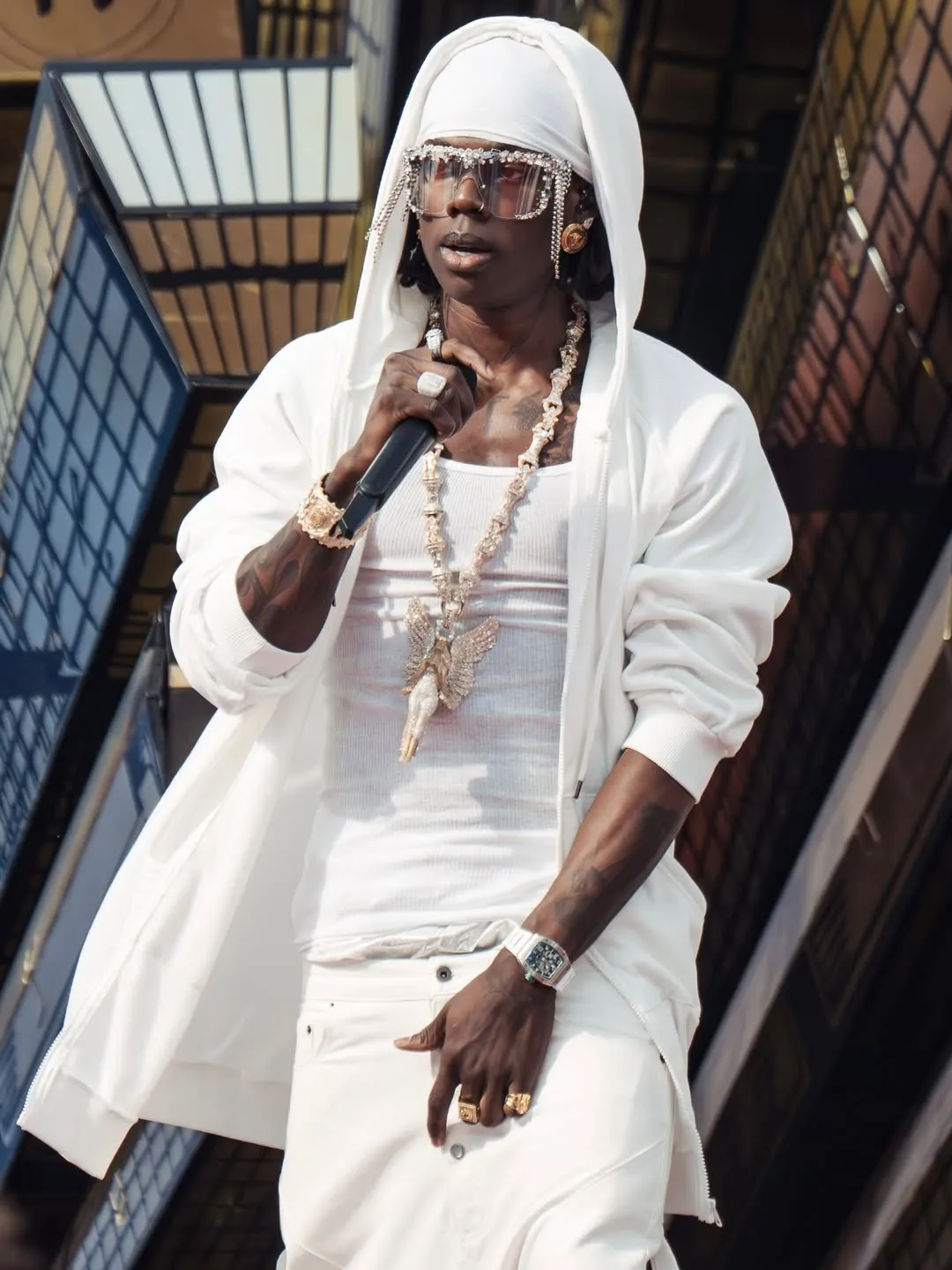
The fit deserves its own paragraph, because the visual language was doing serious work. Rema walked out in all-white: a loose hooded jacket over a ribbed vest, wide-leg trousers, a crystal-covered angel pendant at his chest, a luxury watch, futuristic sunglasses laced with crystal fringes. A white head wrap, tucked neatly under the hood. Lisa and Anitta came coordinated in white too, but nobody was a background character. Each artist kept their own identity intact. The styling was clean, intentional, and sharp — three distinct aesthetics speaking the same visual sentence.
This happened one day after Burna Boy and Shakira performed together at a World Cup event in Mexico City. Two days. Two Nigerian artists. Two of the largest stages football has ever constructed.
That's not a coincidence. That's a pattern.
Why This Moment Is Ours
If you're reading this from London, Toronto, Houston, or anywhere else far from home — you already know what this means. You don't need it explained. But some feelings deserve to be named out loud.
Growing up in the diaspora means carrying two versions of yourself at the same time. There's the version that fits wherever you live — the accent you adjust, the music you switch off when certain people get in the car. And then there's the version that comes alive in the group chat, at the cookout, at the Nigerian restaurant on a Saturday when the jollof is right and someone turns on Afrobeats at the right volume.
For a long time, that second version had to fight for space. You'd try to explain Afrobeats to a coworker and watch their eyes glaze over. You'd play a song and hear "oh, is this African music?" — like it was a genre of one. You'd see Nigeria mentioned in the news and brace for what kind of story was coming.
Now look at where we are.
Rema — a kid from Benin City — is standing in the middle of SoFi Stadium, backed by dancers in matching white, performing in front of a giant gold World Cup trophy, singing a song written for a global audience of billions. Not as a feature. Not as a surprise guest. As a co-headliner. As an equal. The group chats are going crazy, and rightfully so — because this isn't only Rema's win. It belongs to every person who played Afrobeats in a dormitory room and got questioned for it. Every parent who packed mixtapes in their luggage when they moved abroad. Every Nigerian kid who sat in a classroom somewhere in Europe or North America feeling like their culture was invisible.
Nigerian music doesn't need a Western co-sign to be taken seriously anymore. It doesn't need a translator. It shows up at the World Cup and runs its section like it's always belonged there.
Because it has.
25 Years Old and Already Confirmed
Rema has been doing this professionally since he was a teenager. He signed to Mavin Records at 18, released "Dumebi," and watched it go viral before most people his age had figured out what they wanted to study. Then came "Calm Down" — a song that crossed every border, topped charts in markets Afrobeats hadn't cracked before, and turned Rema into a genuine global name. The World Cup performance isn't his breakthrough. It's a confirmation of what's already been in motion for years.
He is 25. He has been building this since he was a child in Edo State. SoFi Stadium is just the latest room he's walked into and owned.
What Comes Next
The FIFA World Cup 2026 is still in its early stages. Matches are being played across the United States, Canada, and Mexico — a tournament footprint unlike any World Cup before it. More cities. More matches. More moments. "Goals" is streaming everywhere now, and it deserves the numbers that match the performance.
Burna Boy in Mexico City. Rema in Los Angeles. Two nights. Two stages. Two Nigerian artists running their sections in front of the world.
Somewhere in Benin City, a mother is watching her son perform in front of billions.
She already knows the answer.


