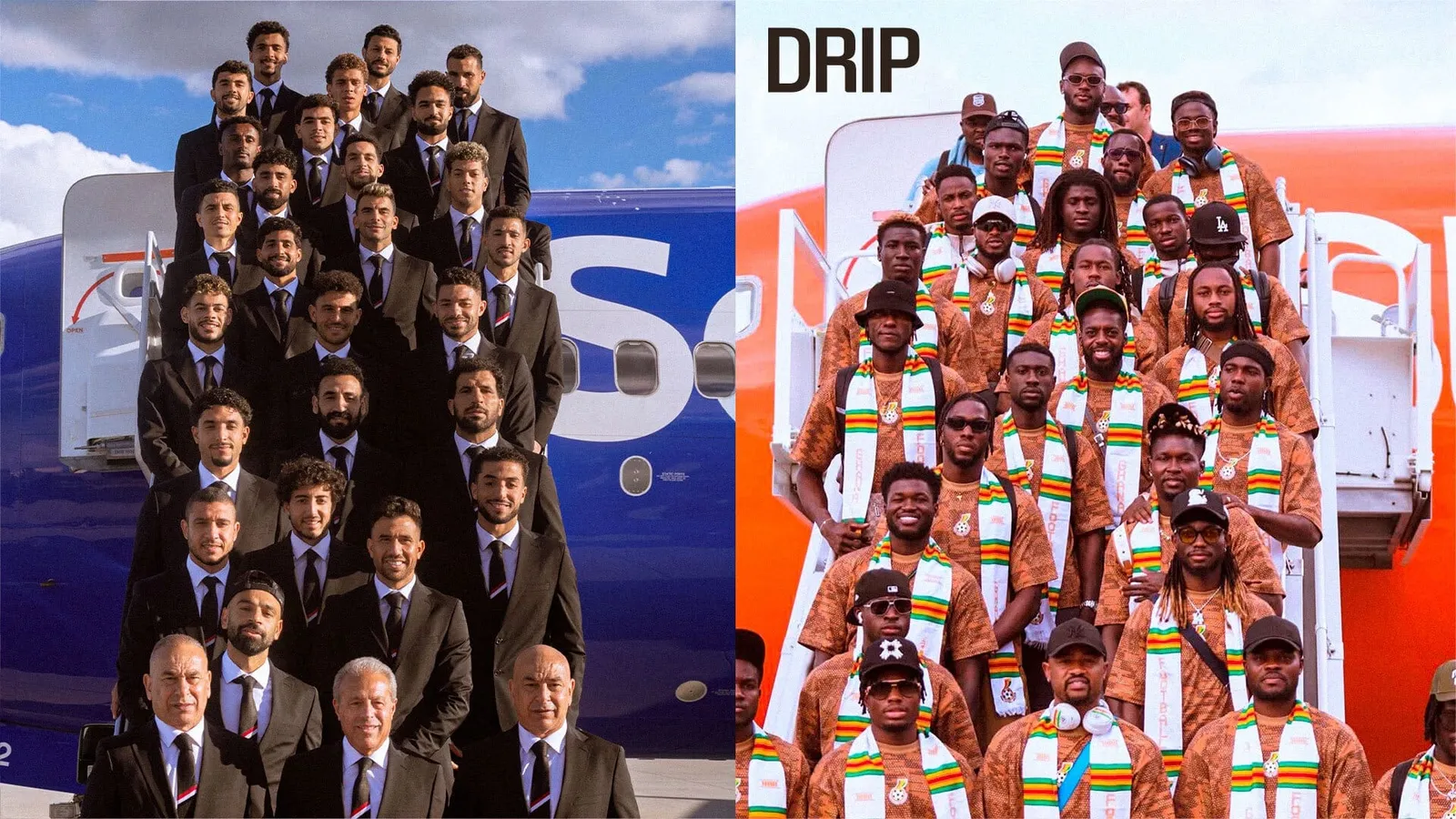
Before a single ball was kicked at the 2026 World Cup, the tournament had already produced its first genre of highlight: the arrival. Ten African nations qualified for the expanded finals — a record — and several of them treated the walk off the plane as the first fixture of the campaign. The jet bridge became a runway, and the clothes were not an afterthought. They were the statement.
That is worth taking seriously, and not as a style aside. When a national team decides what to wear off the aircraft, it is deciding who authors its image on the largest stage sport offers, and who gets paid to do it. The teams that got this right did two things at once: they controlled their own narrative, and they routed the value of that narrative back into their own creative economies. The team best placed to do exactly that, and did not, is the story worth telling.
The hits: Africa arrived with its own designers
Start with the moment everyone reported. The Democratic Republic of Congo, back at a World Cup for the first time in more than half a century, landed in custom black suiting with leopard-print detailing and crystal brooches, matched with travel bags — a deliberate nod to La Sape, the Congolese subculture that turned dandyism into a form of dignity and resistance. The looks were credited to a Congolese designer, and the coverage was unambiguous: African squads, DRC first among them, stole the spotlight at arrivals 1. (One note of caution we will honour: the designer's name appears with two spellings across outlets, so we hold it until a primary source settles it.)
Côte d'Ivoire arrived in sunset tie-dye jackets carrying an embroidered elephant motif, over tailored white trousers, by the Ivorian designer Ibrahim Fernandez, drawing on traditional Dida cloth 2. Senegal continued the styling language it had built at the Africa Cup of Nations, in coordinated ensembles by a Dakar label 1. It was not only these three. The arrival roundups that circulated across the tournament featured a spread of African teams — Ghana, Egypt, Tunisia and Morocco among them — enough that the coverage settled on a single frame: the African squads had stolen the show 1. In each of the strongest cases the pattern is the same, and it is the important part: the garment was specific to the nation, and the person who made it was from that nation. The arrival was not outsourced.
This is cultural authorship in its most legible form. A leopard sash is not a neutral choice; it is a citation. Dida cloth is not decoration; it is provenance. These teams used the most-photographed thirty seconds of their tournament to say something only they could say, in a visual language they own, made by people they pay. That is the whole game.
The diaspora tension: African bodies, European houses
The picture complicates the moment you turn to the diaspora squads, and it is a complication worth naming precisely rather than smoothing over.
France arrived as one of the most heavily African-heritage squads in the tournament, and its players turned the airport into a luxury-handbag parade — Michael Olise with a black Hermes Birkin 4, Ousmane Dembele with two 5, Marcus Thuram carrying a Chanel flap from the house collaboration with Pharrell Williams 3, Rayan Cherki with an Hermes Kelly 3. As personal style, it was immaculate. As a question of authorship, it points the other way. These are footballers of African descent, at the summit of the global game, carrying European luxury houses. Nobody was obliged to wear an African label. But it is a fair observation, and ours to make, that the continent's designers were not in the frame while the continent's talent was — the bodies were African, the brands were not.
We state that as a reading, not a verdict. Personal taste is nobody's to police. The point is narrower and structural: value flows to whoever's name is on the garment, and at the diaspora arrivals that name was almost never African.
What a done-right partnership looks like
For contrast, look at how the European federations that took arrivals seriously did it. Spain arrived in tailored looks from a Spanish luxury house, in what was reported as that house's first national-team partnership — a formal deal between a federation and a designer, not a one-off 5. Japan, as it has for years, arrived in three-piece suiting from a British heritage tailor 5. These are not cultural-diplomacy statements in the way DRC's was, but they are instructive as a template: a federation can enter a proper partnership with a design house and make the arrival a repeatable, owned asset rather than a scramble. The Spanish arrangement was reported as a first-of-its-kind national-team deal for the house involved; the Japanese one is years old. Either way the point holds: this is a normal thing for a federation to arrange, and the machinery is neither exotic nor expensive. Even a host nation played — Canada arrived in a Nike sub-label paired with a Montreal tailoring house 6, treating the walk-off as a styled moment rather than a logistics exercise. If Canada can turn an arrival into an outfit, the bar is not high.
That template matters for the argument that follows, because it shows the mechanism is available and ordinary. Federations do this. It is a normal thing to arrange.
The miss: South Africa had the houses and stayed in the terminal
Which brings us to the team this publication watches most closely, and the clearest miss of the tournament.
South Africa qualified, and arrived in Mexico City ahead of its campaign. But it does not appear in any of the arrival-fashion roundups that named DRC, Senegal, Côte d'Ivoire and the rest. There is no documented designer arrival moment for Bafana Bafana — no named house, no cited garment, no cultural citation. We are careful here about what we can and cannot say: we cannot describe what the squad actually wore off the plane, because no outlet did. What we can say, and it is the point, is that South Africa was absent from the story its peers wrote.
That absence is striking specifically because of who South Africa is. This is the country of Thebe Magugu, the first African winner of the LVMH Prize 7, and of Laduma Ngxokolo, whose MaXhosa turned Xhosa beadwork heritage into globally recognised knitwear. No nation at the tournament had a deeper bench of world-class fashion authorship to draw on. And the counterfactual is not a fantasy, because the model already exists on the record: in 2023, Thebe Magugu designed an Orlando Pirates kit in collaboration with adidas 7 — the same adidas that is now South Africa's national-team technical partner. Magugu, adidas and South African football have already been in a room together and made something the world noticed.
So the pieces were all present. A globally decorated local designer. A national sponsor with a proven appetite for exactly that collaboration. And a stage — the opening match of a home-continent World Cup era — on which a South African arrival look, authored by a South African house, would have travelled across every fashion desk that instead wrote about Kinshasa and Abidjan. It did not happen. Whatever the reason, the country with the strongest hand played it face down.
Why arrivals are a value-capture story, not a style story
It would be easy to file all of this under fun tournament trivia, and it would be a mistake. Arrival fashion is soft power with a supply chain attached. When DRC wears a Congolese designer, three things happen at once: the nation controls its own image, a local creative economy gets paid and gets seen, and the story that circulates is one the nation authored. When a squad of African-heritage players wears European houses, the image is still magnificent, but the authorship and the money both leave. And when a team with the deepest design bench on the continent arrives with no fashion story at all, it forfeits a moment that cannot be bought back — the arrival happens once.
The teams that understood this treated the jet bridge as what it now is: the most valuable unpaid media the tournament gives you, and a chance to put your own creative economy on the world's screen at no cost but intention. Several African nations understood it perfectly, and turned thirty seconds on a jet bridge into a week of coverage authored in their own visual language, by their own people. The one best equipped to lead simply did not show up to the runway. In a contest about who authors African culture on the global stage — and who gets paid when the world is watching — not showing up is its own kind of result, and not the kind a country with this much talent should be content to post.
