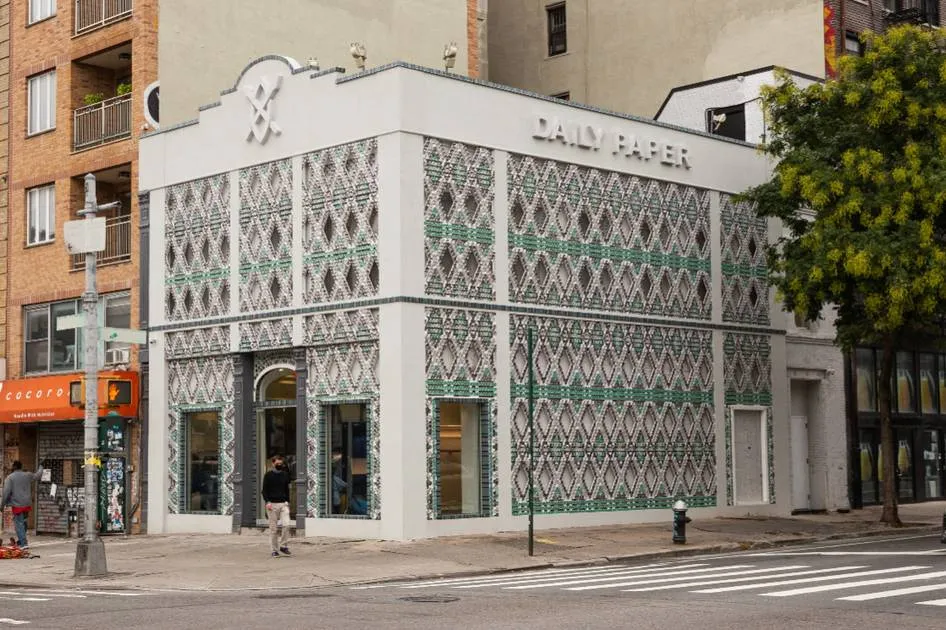
Who Owns the Aesthetic? Daily Paper, the Diaspora Streetwear Wave, and the Gap Between Authorship and Value
In January 2025, Daily Paper — the Amsterdam label three childhood friends built out of a blog — quietly put its downtown New York flagship up for sale. The two-storey space had opened in 2020 with mosaic floors, arches and a juice bar; it was the brand's first store outside the Netherlands and a statement of intent. Selling it was the opposite: a retreat, disclosed in an annual report that admitted turnover had fallen to just over 14 million euros and that the company no longer met the financial ratios required by its agreement with the bank 1.
That single filing is the whole story of African-diaspora streetwear in miniature. The aesthetic these founders authored is now everywhere — on runways, in sneaker rotations, in the visual grammar of global fashion. The value it generates is a different question, and it does not always land where the culture was written.
From a blog to a €30 million brand
Daily Paper began in 2008 as a blog run by Jefferson Osei, Hussein Suleiman and Abderrahmane Trabsini — of Ghanaian, Somali and Moroccan heritage respectively — interviewing figures in the streetwear and sneaker scenes 2. Their first five branded T-shirts, made as merch, sold out. By 2012 the blog had become a brand, built on a deliberate refusal of the era's monochrome minimalism. As one retrospective put it, the trend was all black and white, so the founders went for colour — African prints and patterns spliced into European menswear staples.
The commercial arc was real. Under chief executive Rodney Lam, revenue reportedly grew from roughly €500,000 to €30 million in five years, with wholesale placement in Selfridges and Galeries Lafayette, a drop-based release calendar and a devoted global following 3. Daily Paper wasn't a niche cult label; it was one of the fastest-growing young fashion brands in Europe, and it did it by exporting a diaspora sensibility to the mainstream.
Then the streetwear cycle turned. The 2023/24 accounts show profit ticking up slightly even as turnover dropped, but the numbers still breached the brand's banking covenants — enough that the report flagged "uncertainty that could have a material impact on the company's ability to continue operating." The response was textbook survival: restructure the head-office team, consolidate all e-commerce into the European distribution centre, and sell the New York store. The brand insisted its gross margin was healthy and its realignment would restore profitability. Recent collaborations with Eastpak in April 2025 and Oakley in July 2025 show it is still very much in motion. But the direction of travel is telling: an independent label that authored a look now has to fight the brutal economics of owning its own retail and distribution.
The wave is bigger than one brand
Daily Paper is a node in a much larger network. Diaspora designers have spent a decade turning the fusion of African heritage and Western streetwear from a subculture into a category. Hypebeast's 2024 survey of diaspora brands maps the geography: Maison Château Rouge in Paris, founded by the Senegalese-French Youssouf Fofana and named for its neighbourhood, which has collaborated with Jordan Brand; MIZIZI in the US, by Ghanaian-American Paakow Essandoh, with Marvel and Disney tie-ins; brands in Vienna, São Paulo, Singapore, Tokyo and Barcelona, each translating African cloth into local streetwear vernaculars 4.
In London, Labrum — founded by Sierra Leonean-born Foday Dumbuya — weaves West African stories into British tailoring and won the Queen Elizabeth II Award for British Design in 2023. Alongside Grace Wales Bonner, Priya Ahluwalia and Nicholas Daley, Dumbuya is part of a generation that made "designed with a diaspora point of view" a credential rather than a caveat. Collectively, these founders did the authorship work: they built the references, the silhouettes, the print languages and the cultural authority that the rest of fashion now borrows freely.
Where the value actually pools
Here is the uncomfortable arithmetic. The clearest evidence of how much money the diaspora aesthetic can generate is not on an independent designer's balance sheet — it is on a German sportswear giant's. Since her debut adidas Samba in 2020, Grace Wales Bonner has designed around 25 sneakers with the brand, almost all selling out instantly 5. The collaboration helped push the Samba to a 60% jump in popularity and adidas's highest-ever Samba sales — a single silhouette that became one of the defining shoes of the decade 6.
Who captured that? A $300 Wales Bonner Samba, up from the original's roughly $100 retail, resells north of $400 on StockX 7. Wales Bonner supplies the taste, the cultural credibility and the design; adidas owns the mould, the manufacturing, the global distribution and — crucially — the durable revenue. The designer licenses her authorship one collection at a time. The platform banks the compounding franchise. Resellers skim the top. That is not a criticism of the partnership, which has been genuinely elevating for both. It is a description of where structural value settles: with whoever owns the distribution and the balance sheet, not whoever originated the idea.
Daily Paper sits on the harder side of the same equation. It chose independence — it owns its IP, its stores, its distribution centre, its risk. That ownership is exactly why a soft year threatens covenant breaches and forces asset sales, in a way it never would for a licensor collecting royalties on someone else's inventory. The reward for authoring a culture and also trying to capture its value is that you carry all of the downside too.
The MonoKromatik read
African-diaspora designers have decisively won the authorship war. The visual language of contemporary streetwear — its prints, its heritage references, its storytelling — was substantially written by founders whose surnames trace back to Accra, Mogadishu, Freetown, Dakar and Rabat. What remains unresolved is the capture war. When the aesthetic scales, the money tends to flow to the layer that owns distribution: the sportswear conglomerate, the department store, the resale platform. The originators are left choosing between licensing their credibility for a fee or shouldering the full weight of ownership alone.
The strategic lesson from Daily Paper's retreat and Wales Bonner's success is the same one, read from two ends. Authorship without ownership of distribution is influence you rent out. Ownership without the scale to survive a down cycle is fragility. The prize for the next generation is not another sold-out drop — it is control of the layer that keeps earning after the hype cools: the platform, the licensing structure, the IP that others must pay to use. Culture is the input the diaspora already supplies for free. The task now is to own the machine that meters it.


