The paradox on the start line
Kenya produces the greatest distance runners the sport has ever seen. It does not, for the most part, produce the shoes they race in. For decades the podiums at Eldoret, Iten and beyond have been a rolling advertisement for Nike and adidas — global brands harvesting the marketing value of African feet while the design, the tooling and the margin stayed abroad. That gap is exactly the business Enda Sportswear set out to close when it launched Kenya's first home-grown performance running shoe.
Enda's pitch is deceptively simple: build a running brand in the land of runners. The harder part is industrial. As the company has been candid about, its shoes started life only around 52 percent Kenyan-made, with midsoles and technical components still imported, assembled at a factory in Kilifi on the coast. 2 The ambition — stated repeatedly since the brand raised money on Kickstarter and beyond 3 — is to push that number toward 100 percent, turning a heritage of winning into a manufacturing base. It is a useful lens on the whole category: African sneaker culture is loud, but the value quietly leaves the continent.
A market that is real, and mostly imported
The demand is not in question. Africa's sneaker segment is a multi-billion-dollar business, with revenue projected around $2.17 billion and volumes heading toward roughly 39 million pairs later this decade. 1 South Africa alone accounts for something like $232 million of that. 1 Those are the numbers global brands saw years ago: adidas planted a Johannesburg flagship, and Nike moved into Lagos through retail partners, precisely because the continent's young, style-literate cities are among the last high-growth sneaker markets on earth.
But a market being big and a market being owned are different things. Most of those pairs are designed elsewhere, manufactured in Asia and imported. Nigeria imports well over a billion dollars of footwear a year, with Lagos absorbing a huge share of the country's retail footwear sales. Balogun Market on Lagos Island moves imported sneakers by the container. The culture is African; the supply chain is not. That is the value question in one sentence — the continent is a demand centre for other people's factories.
Bathu and the township-to-mainstream playbook
The most instructive counter-example is South African. Bathu — the word is township slang for shoes — was founded by Theo Baloyi in Alexandra in 2015. 4 The origin story is now well-worn but telling: Baloyi, a chartered accountant, conceived the brand in a Dubai airport duty-free shop, watching a European label sell its story, and asked why South Africans were not selling theirs. "I thought about what we as South Africans are doing to tell our stories," he recalled.
What makes Bathu a case study rather than a feel-good anecdote is that it kept the hard parts at home. Baloyi has been open that local manufacturing is slower and costlier — he has said a new shoe can take eight months to develop in South Africa versus four weeks in the East. He built anyway. Today Bathu runs close to 40 retail stores and employs around 500 people 4, the overwhelming majority inside its own value chain, and reported digital sales growth approaching 100 percent year-on-year into 2024. The signature mesh silhouette is unmistakably local, and the brand has become a symbol of ekasi ambition as much as a product. That is what owning the value looks like: jobs, stores, IP and margin retained inside the country where the culture lives.
Lagos, Joburg and the resale economy
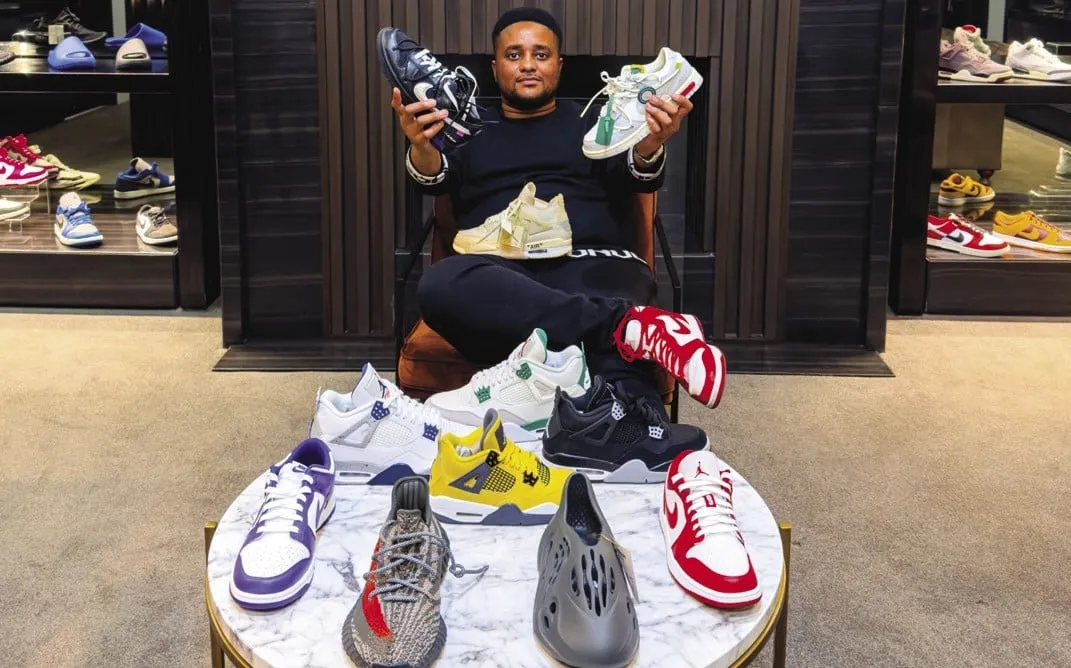
Not all of the value sits with the makers. A parallel economy has grown up around scarcity — the resale and consignment scene that turns limited Nike and adidas drops into tradable assets. In South Africa, marketplaces like Court Order and a cluster of premium streetwear stores have built real businesses on the rarest imported pairs, cleaning, authenticating and reselling them to a community that treats sneakers as currency. The demand outstrips the tiny quantities the global brands allocate locally, and resellers arbitrage the difference.
This is genuine entrepreneurship, and it is culturally central — the flex, the drop, the aftermarket are as much a part of Lagos and Joburg sneaker life as anything on a shelf. But it is worth naming what it is: a value layer built on top of foreign product. The reseller captures a margin; the brand equity, the design royalties and the manufacturing profit still accrue to Beaverton and Herzogenaurach. A thriving resale scene is a sign of cultural heat, not of ownership. It proves the appetite that local makers are trying to convert.
The designers rewriting the silhouette
The more interesting frontier is where African labels stop competing on price and start competing on point of view. A generation of designers is treating the sneaker as a canvas for a specifically African aesthetic rather than a cheaper copy of a Western one. Lagos names have pushed sculptural, architectural silhouettes; Nigerian label KEEXS built an Afrocentric identity around pattern and storytelling; Ethiopia's soleRebels made recycled materials and heritage craft its whole proposition years before it was fashionable. Publications tracking the category now list a deep bench of footwear brands from Senegal to Cameroon 5, and Business of Fashion has documented African sneaker labels reaching for global distribution. 6
Design is where the defensible value is, because it cannot be sourced from a container. A bogolan-wrapped upper, a tabi-toe silhouette or a Kilifi-assembled racer is not a commodity — it is authorship. And authorship is the thing global brands have historically extracted for free, borrowing the coolness of African culture without paying for it. The bet these labels are making is that the same consumer who once flexed an imported swoosh will increasingly flex something made where the story is true.
The so-what: culture versus capture
Here is the uncomfortable read. African sneaker culture is unambiguously authored on the continent — by the runners, the resellers, the stylists, the crews who decide what is hot in Lagos and Joburg. Value capture is a different scoreboard, and on that scoreboard the global brands are still winning by a wide margin, because they own the two things that compound: manufacturing and intellectual property.
The brands that will actually shift the balance are the ones absorbing the boring, capital-intensive parts of the business — Enda pushing its local-content percentage up shoe by shoe, Bathu running its own stores and factory network, designers building IP that a container cannot replicate. Cultural relevance is necessary but not sufficient. You own the value when you own the tooling, the brand and the shelf — not when you merely supply the cool.

