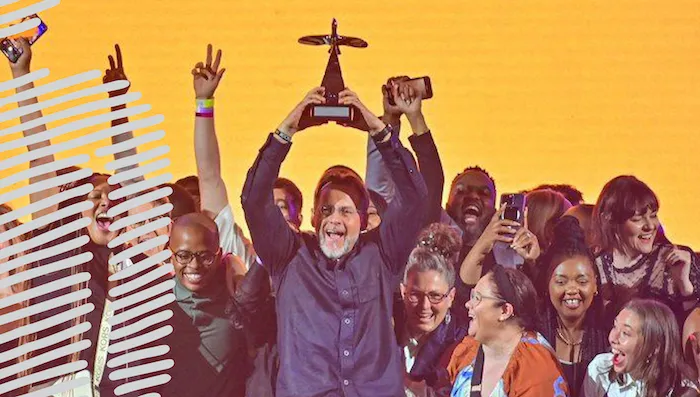
In October 2025, the most valuable individual award at South Africa's biggest creative show did not go to a product, a package or a price. It went to an actor.
At the 2025 Loerie Awards, the Grand Prix for Performance Craft was won by Phila Mazibuko, playing Coach Mazibuko in Chicken Licken's "Piki Piki Mabelane" — a spot built around football coaches, directed by Karien Cherry and produced by Giant Films 13. The brand behind it, Chicken Licken, was named Brand of the Year and took twenty Loeries in total 12. Its agency of twenty-plus years, Joe Public, was named Agency of the Year and ranked first across Africa and the Middle East 12.
For a publication that rates who ends up owning the value in creative work, that Grand Prix is the whole argument compressed into one line. The single most decorated thing a family-owned South African chicken chain produced last year was a performance — a piece of craft it commissioned, owns and can build on — not a discount or a media weight that a larger competitor could simply out-buy.
Why a performance award is the right prize to notice
It would be easy to treat a craft trophy as inside-baseball, the sort of thing that matters to the industry and no one else. It is worth resisting that, because the category itself makes a point that sits exactly on this publication's beat.
A Grand Prix for Performance Craft rewards the human being in front of the camera, and by extension the writing, direction and casting that made the performance land. It is not a media award — it says nothing about how many people saw the ad or how much was spent to put it there. It is not a results award — it makes no claim about sales. It is a judgement, by the industry's own jury, about the quality of a made thing.
That distinction is the reason it belongs in a discussion about ownership. Media reach is rented; the day the budget stops, the reach stops with it. A performance, a character, a piece of writing good enough to win the top craft award in the country — those are made once and owned thereafter. They can be extended, referenced, built into a running world. Coach Mazibuko can come back. The media schedule that carried him cannot.
So when a brand a fraction of its main rival's size wins the craft award and not the media one, it is not a consolation. It is a description of the only game that brand can actually win.
The comeback is the story, not the streak
Be precise about what happened in 2025, because the brand's own history invites a lazier telling.
Chicken Licken has been Loeries Brand of the Year before. Around 2023 the framing was a multi-year run — seven consecutive titles alongside Joe Public, a partnership that has become one of the most awarded in South African advertising. But 2025 was not simply more of the same. The year before, the brand had slipped to thirteenth 2. The 2025 result was a climb back to the top: a comeback, not a continuation.
That difference matters to the argument. A brand that wins every year on reputation is, at some point, coasting on a reputation. A brand that falls to thirteenth and then reclaims the top spot has had to make something that year good enough to earn its way back. What it made was Piki Piki Mabelane, and the industry's verdict was to hand it the highest craft award on the board.
Forty-four years of competing on craft because it could not compete on capital
None of this is new behaviour. It is the founding behaviour, and the record goes back to the beginning.
Chicken Licken was started in 1981 by George Sombonos, on the site of his father's Dairy Den roadhouse in Ridgeway, Johannesburg 4. The recipe at the centre of it had been bought a decade earlier, in 1972, from a fried-chicken outlet owner in Waco, Texas, for a thousand US dollars 4. From the outset this was a business assembling an American format and making it local, rather than importing one wholesale.
The defiance was there early, too. In 1982, KFC sued Chicken Licken for trademark infringement 4, arguing the name echoed its own "finger-lickin' good". The court disagreed, and the smaller company kept its name. A year into trading, the South African upstart had already been to court with the global giant and won the right to exist on its own terms.
The distribution strategy was as unconventional as the marketing would later become. Early franchises were seeded in Soweto and Alexandra in 1982 4 and, by contemporary accounts, given away with no royalties in their opening months — a decision that read less like a franchising model than a bet that the brand belonged in the townships first and would be repaid in loyalty later. Whatever the motive, the effect was a brand rooted where its audience actually was, at a time when the multinational competition was not.
By 2013 — the last year for which firm, chain-wide figures exist — Chicken Licken reported 259 outlets, 247 of them in South Africa and twelve in Botswana, around R1.3 billion in revenue, and monthly sales of more than 400,000 chickens and roughly five million hot wings 4. Those numbers are now more than a decade old, and no comparable company-disclosed set has replaced them, which is a limitation this piece returns to below. But they establish the shape of the thing: a substantial national chain, built without a foreign parent, that reached scale on its own balance sheet.
The advertising is where the ownership compounds
If the founding explains why Chicken Licken competes on craft, the advertising explains how the craft became an asset rather than an expense.
The Joe Public partnership has produced a run of work that is, by the industry's own scoring, among the most consistently awarded in the country. It has also produced the brand's sharpest public controversy. The 2018 "Legend of Big John" ad — a piece of counter-mythology that reframed the arrival of European settlers around a fictional local hero — was banned by the Advertising Regulatory Board on 18 December 2018, on the grounds that it trivialised colonialism 5. It is a reminder that authored work carries authored risk: a brand that says something specific can be told it went too far, in a way that a brand saying nothing generic never will.
But the through-line from Big John in 2018 to Piki Piki Mabelane in 2025 is the same one. This is a brand that treats its advertising as a body of owned creative property — characters, myths, performances, a recognisable voice — rather than as a series of disposable promotions. Each piece adds to a stock the brand keeps. That is why the craft awards accumulate, and it is why the accumulation is worth more than any single campaign's reach: the reach is spent, the body of work is banked.
The scale contest, in current terms
The reason craft is the strategy and not merely a flourish is the arithmetic of the market it plays in.
Chicken Licken cannot win on store count. It runs somewhere between roughly 268 and 287 outlets in South Africa 6. The precise figure is a reported estimate, the sources disagree, and there is no company-disclosed 2026 total to settle it — so it should be read as an estimate, not a fact. KFC, by contrast, operates about 1,200 outlets in South Africa, which is its fifth-largest market in the world, and announced plans in 2026 to add a hundred more and around 3,500 jobs 7. Globally, KFC's parent runs close to 32,000 restaurants. On store count in South Africa alone the contest is roughly four to one, and the larger brand is the one expanding.
Against that, the smaller company competes on the asset that does not scale with capital: authored craft. A media budget is a lever that a better-funded rival will always be able to pull harder. A performance that wins the country's top craft award is not something money alone can reliably buy — and once won, it stays with the brand that made it.
There is a second asset the brand has kept, and it is the one this publication weighs most heavily. Chicken Licken remains privately held and South African, led by chief executive Chantal Sombonos-Van Tonder, a daughter of the founder 6. There is no multinational stake and no sale on record. So the craft is owned, and the company that owns it is owned too. A wholly South African brand out-authoring a United States multinational on its home ground, and retaining both the creative property and the equity, is about as clean an illustration of the value-capture thesis as the market provides.
What this does not prove
The honest limits matter, because the temptation is to let a trophy stand in for a result it does not measure.
Awards measure craft, not market share. The last real market-share figure for Chicken Licken is somewhere around five per cent, from roughly 2010 4, and nothing newer has been disclosed. KFC is far larger and still growing. The Grand Prix establishes that the smaller brand makes the better work; it does not establish that the better work has narrowed the gap in stores or in sales, and there is no current figure that would let anyone claim it has.
A new campaign is not a business outcome either. "General Raj", the brand's March 2026 push for the Soulman Load Up, is recent and real, but a campaign is an input. Whether it moved anything is not a question an award ceremony can answer.
What the 2025 Loeries do establish is narrow, and worth stating without inflation: in a head-to-head on craft, judged at the industry's own scoreboard, the family-owned local brand beat the field — and the single most valuable thing it produced was a piece of authorship it owns outright, made by a company that its founding family still owns outright. For a business that cannot out-spend its rival, that is not a soft second prize. It is the entire plan, working exactly as designed.
