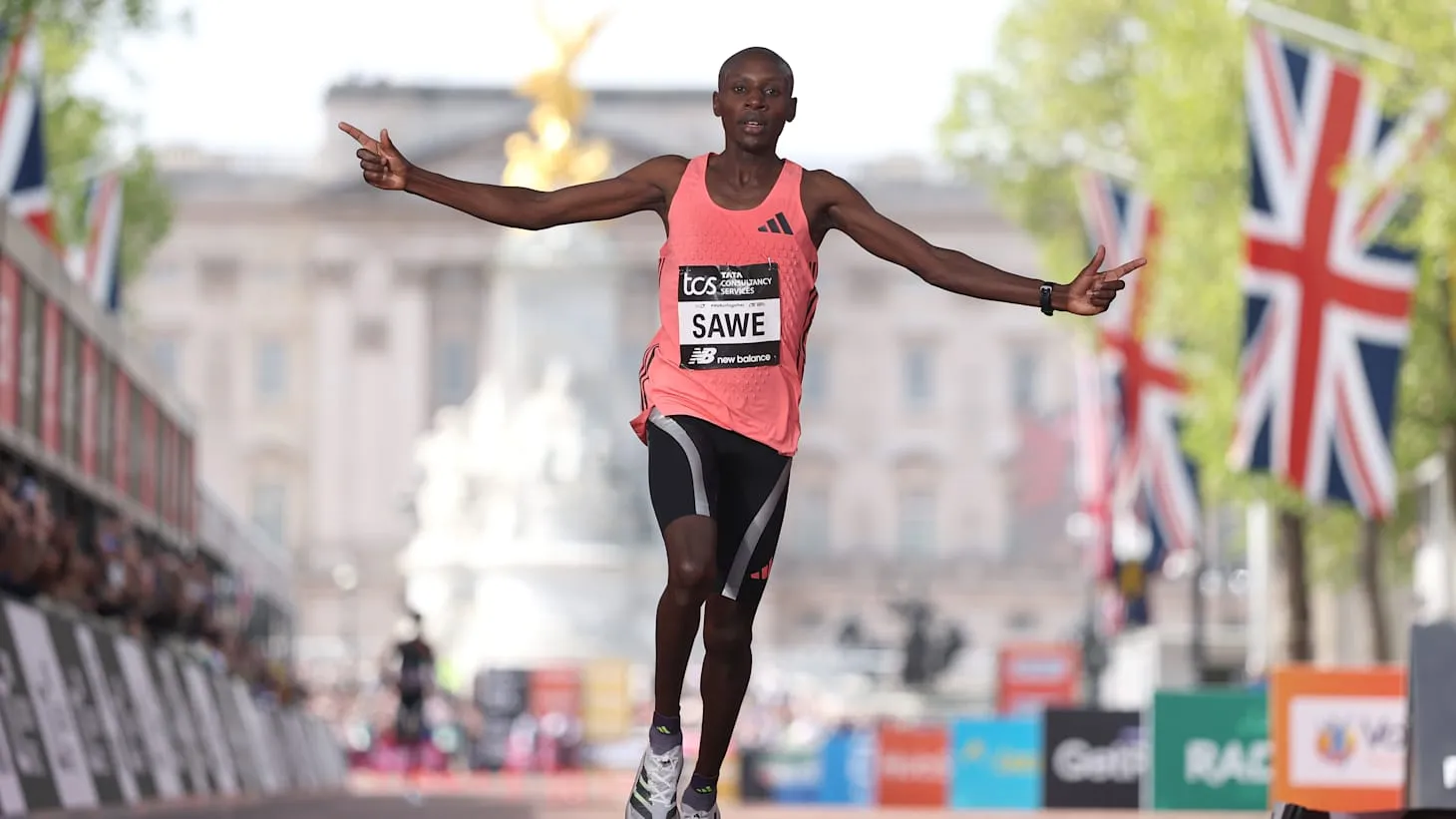
On April 26, 2026, sport crossed a line that had been treated as a physiological limit for decades. Sabastian Sawe became the first athlete ever to run a sub-two-hour marathon in legal race conditions, crossing the finish line at the 2026 London Marathon in one hour, 59 minutes and 30 seconds.
He took 65 seconds off Kelvin Kiptum's 2023 world record, and became the first man to break two hours in an open, record-eligible marathon.
The record is a Kenyan achievement, and it is an African one. The fastest men's marathon has been whittled down gradually over the last 24 years by a succession of Kenyan and Ethiopian runners, including Haile Gebrselassie, Wilson Kipsang, Kipchoge and, most recently, Kiptum. Sawe's London run continues that unbroken lineage.
Kejelcha was full of praise for Sawe's mission to prove his races are clean, which included taking 25 extra voluntary drug tests before winning the Berlin Marathon — a detail that speaks to the integrity pressures East African athletes still face in a sport that has not always extended them equal institutional trust. Sawe was the first of two men to finish the April 26 race under two hours; Yomif Kejelcha of Ethiopia crossed the finish line 11 seconds later, with a total time of 1:59:41.
A sub-two-hour marathon had long been compared to the four-minute mile. Eliud Kipchoge became the first man recorded to run a marathon in under two hours in 2019, but his time did not count as a record because the race was held under controlled conditions. Sawe did it on an open course, under regulation, in competition.
The 24th Africa Athletics Championships ran at the University of Ghana Stadium in Legon, Accra, from May 12–17, and came after 12 African teams qualified for the next World Championships at the World Relays in Botswana. Team South Africa retained the continental title at the Accra championships, securing 22 medals.
African football is writing its own chapter at the 2026 FIFA World Cup. Ghana and Ivory Coast won their opening matches against Panama and Ecuador, respectively. Morocco staved off five-time champion Brazil, Congo escaped with a draw against Portugal, and Cape Verde stunned tournament favourite Spain in a scoreless draw. Egypt's 1-1 draw against Belgium gave the Pharaohs their first World Cup point since 1990. The expanded 48-team pool at this year's tournament gave African teams more representation and a chance to show they belong at the top level of international soccer.
The two-hour marathon and Africa's World Cup group-stage performances are different disciplines, but they encode the same story: East African runners have, for two decades, quietly held the entire men's marathon record progression — now they own its most symbolic milestone. The four-minute mile analogy is useful only up to a point. When Bannister broke four minutes, the feat was absorbed into a specifically British national mythology. Sawe's 1:59:30 has no such national container ready to claim it. It sits, properly, inside a continental inheritance — one that stretches from Keino to Kiptum to Sawe, with no gaps.

