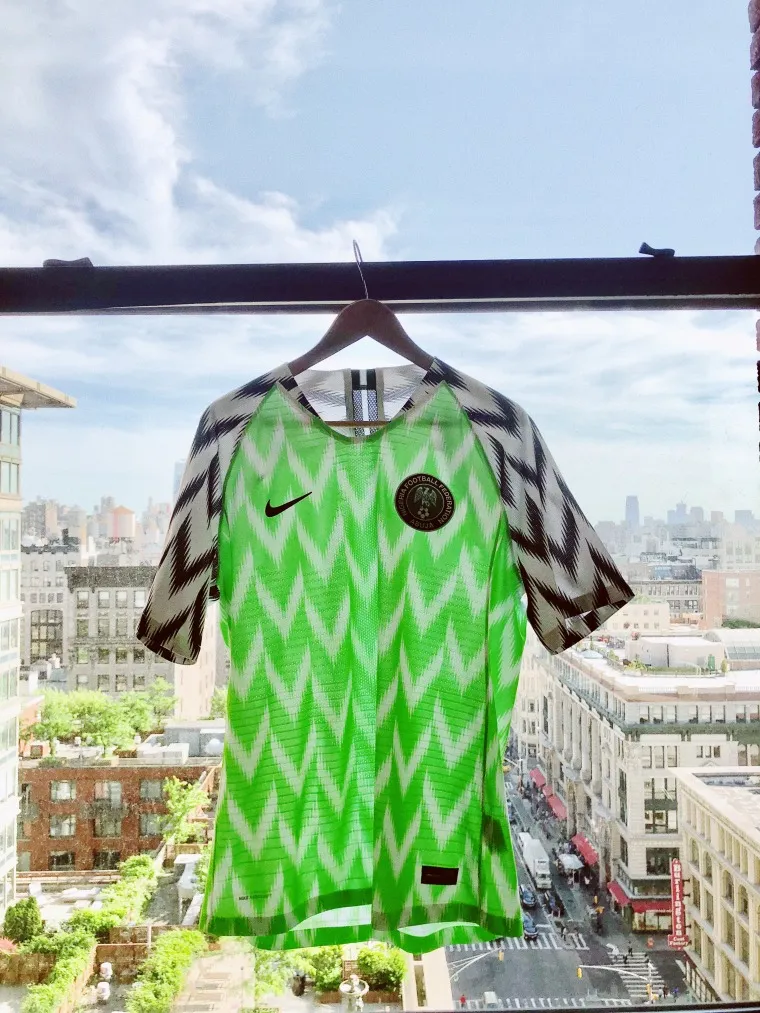
The shirt that broke the drop
On 1 June 2018, Nike put Nigeria's home World Cup kit on sale. Depending on which account you believe, it was gone in minutes. Nike had logged more than three million pre-orders before launch 3, and queues wrapped around Niketown London for a jersey belonging to a team most pundits expected to exit in the group stage. The Super Eagles shirt — a fever-bright green cut through with a black-and-white zigzag lifted from Nigeria's beloved 1994 kit, its sleeves patterned like eagle wings — did something no football shirt had done before. It behaved like a sneaker drop. The FADER called it a fashion phenomenon 1; resale prices doubled and tripled within days 3.
That moment is the hinge. Before 2018, a national-team jersey was sportswear you wore to watch football. After it, the kit became a cultural artifact — a wearable claim on identity that moves in the same economy as streetwear, sneakers and hype. And the shirt that flipped the category was African.
Why the naija kit worked
The design was not a costume of Africanness bolted onto a template. It was specific. The zigzag was a memory — a direct quote of the 1994 kit worn by the golden Super Eagles generation of Okocha and Amokachi. The palette was loud in a way that read as confident rather than exotic. Nike leaned into an identity the diaspora already owned, then let Nigerians in Lagos, London and Atlanta finish the job by styling it as everyday fashion.
That is the mechanism worth naming. The kit's value did not come from Nike alone; it came from a global Nigerian audience treating the shirt as a flag they could wear off the pitch. BusinessDay framed it as a marketing masterpiece, but the real engine was cultural authorship — the shirt meant something before the marketing arrived, and the marketing simply refused to get in the way.
The 2026 cycle: heritage as the brief
What looked like a fluke in 2018 is now the standard operating procedure. For the 2026 World Cup, the kit brief across African nations reads like a design-history syllabus. Puma, which outfits the largest share of African teams — Ghana, Senegal, Ivory Coast, Morocco and Egypt among them — built each shirt around a specific cultural reference rather than a generic swoosh of colour 4.
Ghana's shirt carries a spider-web motif drawn from Kwaku Anansi, the trickster spider of Akan folklore 5. Egypt's geometry nods to pharaonic pattern and the pyramids. Morocco's away kit borrows from zellige tilework and traditional textiles. South Africa's design threads in a tribute to the country's twelve official languages. These are not decorative flourishes; they are arguments about who a nation is, printed on polyester and sold globally. The heritage is the product.
And it does not stop at the shirt. At the 2026 tournament, African squads turned airport arrivals into runways — DR Congo's Léopards touching down in Houston in tailored suits with leopard-print detailing, a deliberate piece of Congolese fashion styling 6. Footy Headlines documented squads ditching standard tracksuits for custom looks that read as national statements. The kit was only the anchor of a much larger wardrobe.
Who actually holds the pen
Here is the tension MonoKromatik cares about. The shirts are gorgeous, the references are real, and the money is enormous — but the pen is still mostly held by Nike, Puma and Adidas in Herzogenaurach and Beaverton. African heritage is the raw material; the intellectual property, the margins and the manufacturing sit offshore. A folktale becomes a fabric pattern, and the value largely accrues to a European or American balance sheet.
The most interesting move in the current cycle is where that starts to shift. Nike's special-edition 2026 Nigeria kit was handed to Olaolu Slawn — the Nigerian-born, London-based artist — who reworked the shirt through his graffiti style with "Naija" scrawled across the chest 7. House of Heat covered the collaboration as a genuine creative handover rather than a logo swap. That matters. When a Nigerian artist authors the graphic language of a Nigerian kit, the culture stops being source material and becomes co-author — even if the swoosh still owns the shirt.
The read
The jersey renaissance is one of the clearest examples of African design power translating directly into commercial heat. A football shirt now competes with sneakers and luxury drops for attention and resale value, and African kits — the naija zigzag first, the 2026 heritage wave after — are repeatedly the ones that break through. The demand is proof of concept: the world will pay a premium for African identity when it is rendered with specificity and confidence.
The unfinished work is ownership. The next Nigeria kit that sells out in three minutes should route more of that upside to the designers, artists and manufacturers on the continent it draws from. The Slawn collaboration is the tell that the industry knows it too. Fashion has already conceded the point that African kits are the most culturally valuable objects in the sport. The open question is who gets to bank that value.


