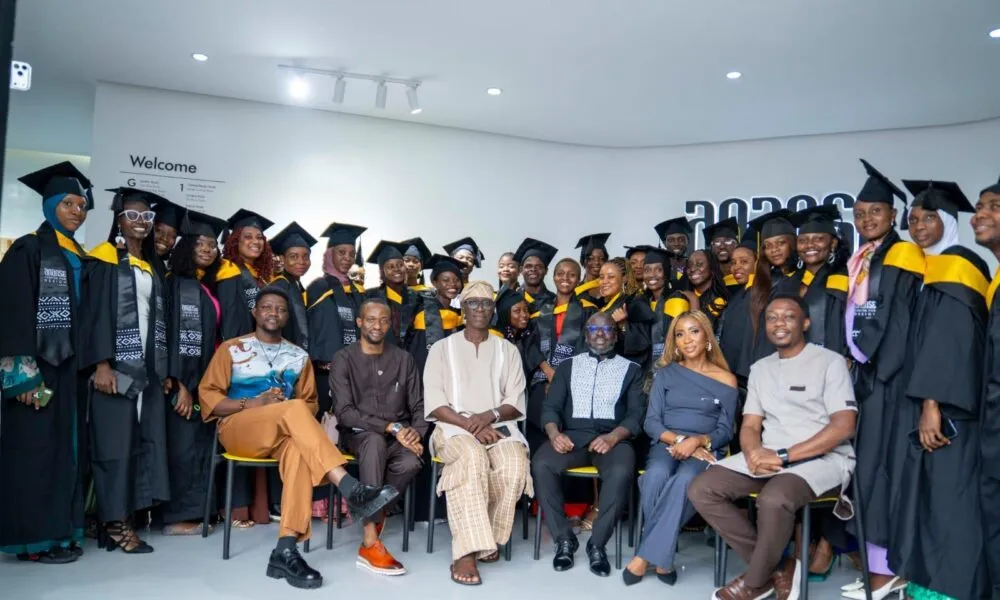
Eleven weeks before roughly thirty fashion entrepreneurs collected certificates in Lekki, the most credible route their training points toward closed down.
Industrie Africa — the Dubai-based platform that had spent seven years building a viable export channel for African designers, placing more than eighty of them in front of international buyers — shut its e-commerce operation on 30 April 2026. Its founder Nisha Kanabar cited US tariffs of 15–30 per cent, the end of the de minimis exemption, logistics costs and infrastructure. Roughly 80 per cent of its sales had come from the United States. 3 What survives is an advisory and physical-retail business, IA+, not a shop.
On 19 July, the Ananse Centre for Design in Lagos graduated the first cohort of its Fashion Incubator. The curriculum, as every outlet reported it, runs through design, leatherwork, garment production, quality assurance, sustainability, branding, e-commerce and market access. 1
Market access is the phrase worth sitting with.
What is actually confirmed
The centre opened on 10 October 2025 at Nike Art Gallery Road in Lekki Ikate — 1,200 square metres of training rooms, content studios, photography and CAD labs, specialised leather and footwear studios, a showroom and co-working space. 2 It is the physical arm of Ananse, an e-commerce and market-access platform launched in 2021 by Samuel Mensah, a Ghanaian former investment banker, now operating across Nigeria, Ghana, Kenya, Senegal, Côte d'Ivoire and South Africa with DHL and Ecobank among its partners.
The incubator is a scholarship programme. Participants did not pay. It is funded by the Mastercard Foundation, the Ishk Tolaram Foundation and TVET 1, and Nigeria's Federal Ministry of Art, Culture and Creative Economy has signed a five-year memorandum to scale the model nationally, with stated targets of 5,000 creatives and 50,000 jobs, around 70 per cent of them women. 2
Graduates keep access to the production facilities, content studios, business support and digital commerce "through the wider Ananse ecosystem," in the phrasing used across the coverage.
The count nobody agrees on
The Guardian reported 35 graduates. Punch reported 30. BellaNaija, The Nation and others said "more than 30." 1 No outlet published a list of names.
That disagreement is not trivia. Every outlet carries the same two quotes, word for word — Mensah on how "Africa has no shortage of talent" and that "what has often been missing is access to world-class training, infrastructure and commercial opportunities," and Hub Country Lead Onome Umukoro on the graduation being "the beginning" rather than "the finish line." The curriculum lists are identical. The benefit lists are identical. No graduate is quoted anywhere.
This is one press release, republished. 4 Six outlets carrying it is not six sources, and the fact that they cannot agree on how many people graduated is the clearest evidence that nobody counted.
We are reporting it as what it is, because the alternative — picking 30 or 35 and stating it — would be inventing a precision that does not exist.
The question the release does not answer
For a publication whose subject is who ends up owning African creative work, one thing matters more than cohort size: what does the incubator take?
Nothing in Ananse's materials, in the Mastercard Foundation announcement, or in any coverage states an equity stake, an IP assignment, a royalty, an exclusivity clause or a marketplace lock-in. Not "no equity is taken" — simply silent.
Here is the structure that is on the record. Donor money pays to produce skilled designers. Those designers are then routed toward market access through a privately owned commercial platform, which monetises through its marketplace and a cash-advance facility. The donors carry the cost. The designers carry the risk. The durable assets — the marketplace, the customer relationships, the transaction data — sit with the company.
That is not automatically extractive. Read it the other way and it is exactly what infrastructure looks like: somebody has to build the channel, and channels cost money. But the terms decide which of those two things it is, and the terms are the part nobody has published.
The comparison is instructive because the sector already contains both answers, stated openly. Green Access, run through Lagos Fashion Week's Style House Files, takes nothing, stays deliberately small — five finalists a cycle — and is still running. Birimian, founded by Laureen Kouassi-Olsson in Côte d'Ivoire, takes equity and says so plainly, deploying around €5m a year with Trail Capital across a target of twenty to thirty brands, structured for long holds rather than a private-equity flip. 5
Ananse sits between them and has not said which it is.
What this is, and what it is not
There are no outcomes. Two days after a graduation there could not be. No placements, no revenue, no stockists, no export orders, no named business. We are not treating that as a failure — it is simply the stage the thing is at, and saying so is more useful than a projection.
What can be said is that the training layer is being built in Lekki at the moment the selling layer contracted. Teaching thirty-odd designers e-commerce and export is infrastructure for authorship only if a viable channel exists at the far end of it. Industrie Africa's closure is evidence that, for cross-border retail into the United States, it currently may not.
That does not make the incubator wrong. It might make it early, or it might mean the channel it feeds has to be the domestic and intra-African one rather than the export one that just proved unprofitable. Those are different businesses with different economics, and the difference will show up in whether these graduates are selling in Lagos in a year or waiting for a buyer in New York.
Four questions
We have put these to Ananse and will publish any answer in full:
- How many people were in the first cohort?
- How long was the programme?
- Are graduates contractually tied to the Ananse marketplace, in any form, for any period?
- What is the take rate on a sale through the platform?
None of these is a gotcha. All four are ordinary disclosures for a programme funded by development capital and feeding a commercial platform, and any of them would move this from a launch we are describing to a structure we could assess.
If they answer, there is a case study here in six months, when there are outcomes to rate. If they do not, the non-answer is the finding.
