The €125m question
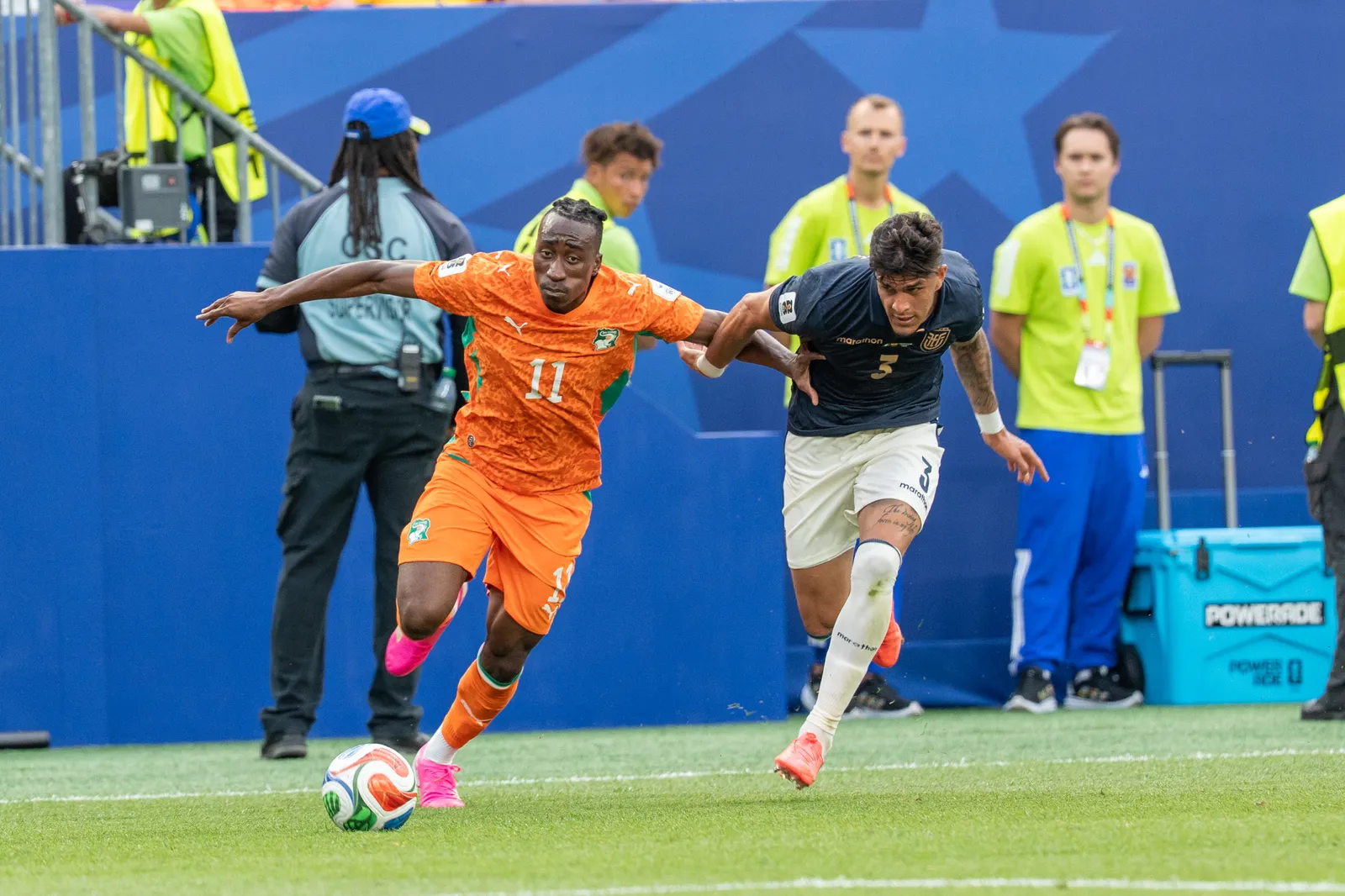
This year a 19-year-old from Ivory Coast became the most expensive African footballer who has ever lived. Yan Diomandé moved to Real Madrid for a reported €125m, rising toward €140m with add-ons — past Nicolas Pépé's old record, and into the bracket of the most expensive teenagers in the sport 1. It is a staggering valuation of African talent. It is also a near-perfect illustration of where that value lands: the fee flowed from one European club to another, with RB Leipzig — who had signed him earlier — capturing the upside. The player is African. The value capture is not.
Hold that next to another number from the same twelve months, because the two only make sense together.
The record that's real
AFCON 2025 in Morocco was the most commercially successful tournament in the history of African football. CAF's commercial revenue reached $192.6m — up 90% on the prior cycle — split across roughly $126m in sponsorship, $46.5m in media rights and $19m in ticketing and hospitality, with commercial partners climbing from 9 in 2021 to 17 in 2023 to 23 in Morocco 2. The tournament drew a global television audience north of 3.2 billion and some 6 billion digital views, ranking it the third-biggest national-team event on earth behind only the World Cup and the Euros 3. Morocco's broader tournament economy reportedly topped €1.5bn — enough, local reporting claims, to cover around 80% of its 2030 World Cup hosting costs 4.
So this is not a story about African football being commercially small. It isn't, and it hasn't been for a while. It is a story about capture — and about how unevenly a continent that produces the talent and hosts the spectacle holds on to the money the game generates.
When Africa owns the event, it captures the value
Start with the good news, because it is instructive. Morocco's model worked: host the tournament, own the stadiums and the airports and the hotel build-out, and bank the economic return that flows through the host economy 34. Event value is capturable when you own the event, and AFCON 2025 is the proof of concept. It is why the next decision on the calendar matters so much — more on that below.
That is the lens this desk applies to everything, flagged as a lens, not an accusation: when an asset compounds, who keeps the upside? For the AFCON event, in 2025, a lot of it stayed home. The problem is the rest of the value chain.
Where the value leaks
The continent's single most valuable football asset is not a tournament. It is players — and that is exactly where capture is weakest. By the time Diomandé is a €125m line item, the realised value is being traded between European balance sheets; the Ivorian football ecosystem that first produced him captures a sliver of it, if that 1. He is not the exception but the pattern of the 2026 window: Morocco's Ayyoub Bouaddi to Manchester City for around €95m, Senegal's Nicolas Jackson to Aston Villa for up to £65m, a long list of African talent moving to the Premier League, Bundesliga and Serie A 10. European clubs captured the continent's best, at record prices, and almost none of those record prices were paid to African clubs.
This is the uncomfortable core of it. You can be the richest talent source in world football and still be a supplier — paid once, early and cheaply, for an asset someone else will monetise for a decade.
The ownership layer Africa isn't in
Zoom out from transfers to structures and the gap widens. The modern game is consolidating into networks: by recent counts, more than 120 multi-club ownership groups now control over 330 clubs worldwide, moving talent, data, coaching and commercial leverage across borders inside a single balance sheet 912. City Football Group alone runs around a dozen clubs across five continents — with one conspicuous absence: Africa 8. The networks that are quietly becoming the operating system of global football treat the continent as a scouting territory, not a seat at the table.
That is the ownership question underneath the transfer question. It is not only that African clubs sell talent too cheaply; it is that African capital rarely owns the structures that capture the talent's full life-cycle value. And the media layer tells the same story — African football's audience is vast and under-monetised, with domestic rights routinely worth a fraction of the engagement they command 7.
The model that keeps it home
There is a counter-model worth studying, and it is African-rooted. Right to Dream began as a Ghanaian academy and is now a vertically integrated network — backed by Egypt's Mansour Group — spanning the academy in Ghana, FC Nordsjælland in Denmark, a club in Egypt, and, from 2025, San Diego FC in Major League Soccer 11. Whatever one makes of the particulars, the logic is the one the rest of the continent's football economy lacks: own the chain, so the value a Ghanaian teenager creates compounds inside a structure Africans control, instead of leaking out at the first cross-border transfer. That is the difference between selling your talent and owning its upside — and it is a template, not a miracle.
The commercial opening
Here is why this is a business story and not a lament. A value-capture gap this large, in an asset class this proven, is a commercial opening — and the window is unusually well-timed. CAF has just run a global tender for the commercial rights to the next three Africa Cups — 2028, 2032 and 2036 — covering media, broadcast and sponsorship, with bids closing in August 2026 56. The next decade of African football's commercial value is being priced right now. That creates concrete openings for three kinds of player:
- For corporates and sponsors: African football delivers World-Cup-adjacent reach — 3.2 billion viewers — at a fraction of the entry cost of European or global properties, and the category slots are being re-tendered as you read this 25. The opportunity is to lock an authored, multi-cycle position early, before global agencies reprice the inventory.
- For rights-holders, federations and clubs: the leak is at the development and ownership layer, not the audience layer. The move is to build structures — academy-to-club chains, sell-on and equity participation, owned media — that capture realised value over a player's life, instead of a single undervalued fee 711.
- For brand and marketing teams: this is the highest-engagement, lowest-cost cultural territory in global sport, and it rewards ownership over activation — authored, long-run positions tied to talent and competitions, not one-off tournament spots.
That is the opportunity MonoKromatik maps for a living: who captures the value across African sport, where it leaks, and how a brand or a rights-holder builds a position that keeps more of it. The full framework, the deal ledger and the segmented playbook sit in our African-sport intelligence report; the bespoke version — your category, your property, your market — is what the value-capture advisory is for.
The lens, and the open question
The honest read is that African football is winning the argument it used to lose — the audience is proven, the commercial ceiling is high, Morocco showed event value is capturable — and still losing the one that matters most: ownership of its own best asset. Whether the next decade closes that gap or widens it is genuinely open, and it turns on decisions being made this year: how the AFCON rights are structured, whether African capital builds or buys into the ownership layer, and whether the continent's clubs learn to price talent as an asset they own rather than a product they ship. The players are African. The only question left is who ends up owning the business they built.


