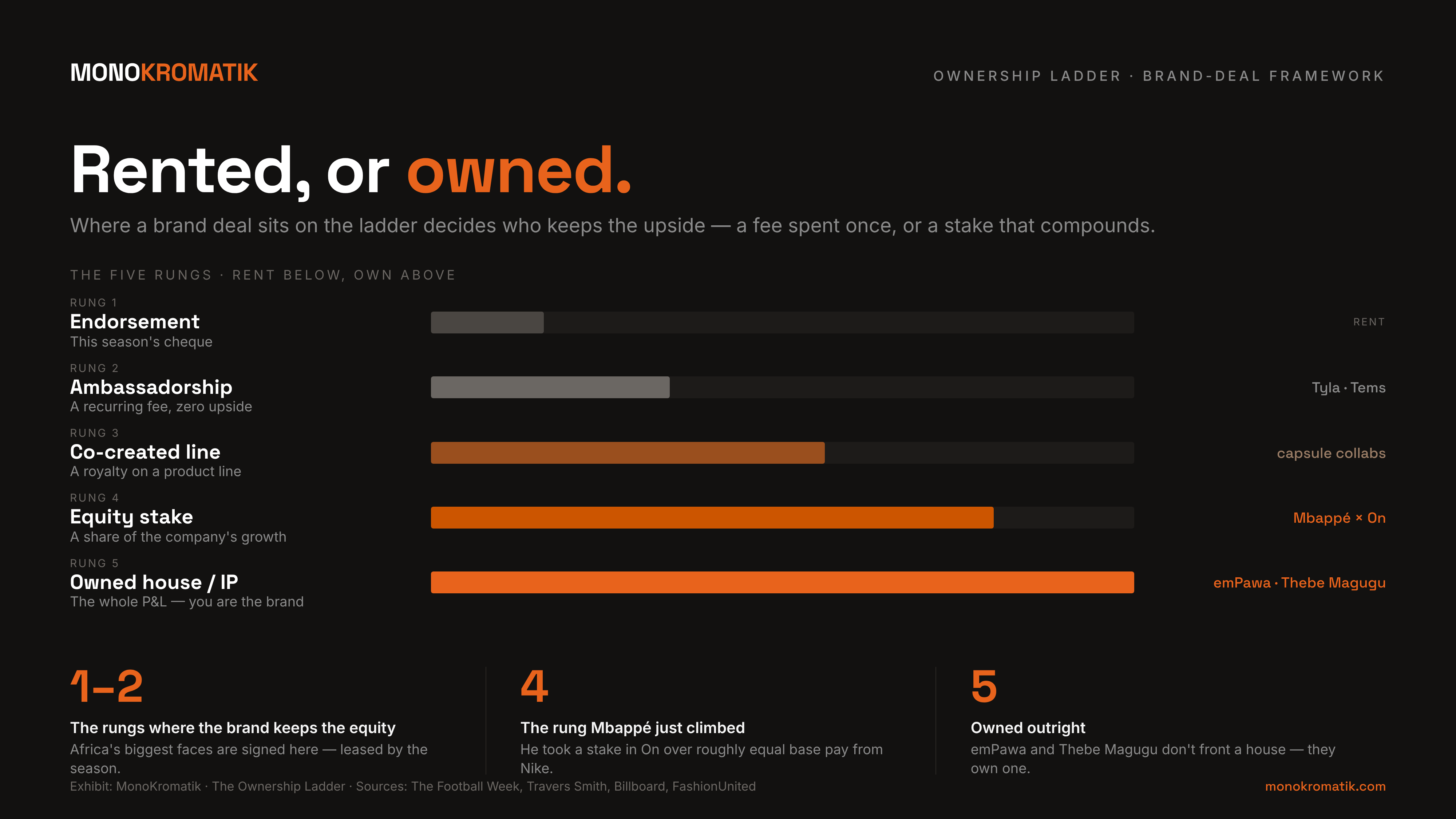
Most arguments about African stars and global brands get stuck on whether a deal is good. The more useful question is where it sits. Below is the ladder we use to place any brand partnership — and the moves to climb it. It is the working tool behind our argument that ambassador is not owner.
The five rungs
| Rung | The deal | What it captures | Who sits here |
|---|---|---|---|
| 1 · Endorsement | One-off campaign fee | This season's cheque | Early-career talent |
| 2 · Ambassadorship | Multi-season, exclusivity | A recurring fee, zero upside | Tyla × Kate Spade, Tems × Omega |
| 3 · Co-created line | Named capsule, revenue share | A royalty on a product line | Signature collabs |
| 4 · Equity stake | Shares in the brand / sub-brand | The company's compounding growth | Mbappé × On |
| 5 · Owned house / IP | You are the brand | The whole P&L | emPawa, Thebe Magugu |
FREE DOWNLOAD
Get The African Ownership Map
One page: Africa’s most valuable brands, sorted by who really owns them — every entry sourced. Free when you join The Weekly Signal.
The Weekly Signal · brand, culture and commercial intelligence for Africa and its diaspora. Unsubscribe anytime.
The rule is one line: value that compounds lives at Rung 4 and up. Everything below is rent. When Mbappé left Nike for On he reportedly turned down roughly equal base money for an equity stake and a signature sub-brand 1 — a move a legal briefing summed up as going "from brand ambassador to brand owner" 2.
The playbook — both sides of the table
If you're a brand custodian (CMO, brand lead): climbing the ladder is your win, not a concession.
- Renting a face is a bidding war; sharing equity is a lock-in. Ambassadors leave for the next cheque; equity partners stay a decade.
- Co-owned IP is a moat — a capsule or sub-brand you build with the talent can't be cloned by a rival signing the same person next season.
- The deal-structure checklist to move from Rung 2 to Rung 4: (1) an equity or warrant line; (2) a co-created IP ownership split; (3) first-party audience and data rights; (4) renewal plus category anti-poach; (5) a cultural-authorship clause (credit and creative control); (6) vesting that rewards tenure.
- Stop the extractive one-season campaign that trains the market — and the talent's agent — to price you as a renter.
If you're an artist, athlete or their team: how to negotiate up a rung.
- Make the Mbappé move when you can carry it: take the stake over the bigger base 1.
- Clauses to demand: equity or revenue share; a signature sub-brand with IP co-ownership; audience-data access; paid category exclusivity; performance kickers.
- When to take the fee anyway: early career or a real cash need — but negotiate an option or warrant so you can buy back in later. Never leave the ladder entirely. This is the structure Mr Eazi's emPawa Africa was built to normalise: moving artists from talent-for-hire to equity participation 3.
The Shared-Equity Score
Grade any deal 0–3 on four axes — a public, lightweight version of our Cultural-Signal methodology:
- Ownership — does the talent hold equity or IP? (0 = pure fee, 3 = equity + owned IP)
- Authorship — who controls the creative? (0 = brand dictates, 3 = talent-led)
- Compounding — does value accrue every year, or get spent once?
- Reversibility — if it ends, who keeps the audience?
Read: 0–4 = extractive / rented · 5–8 = shared · 9–12 = owned.
Run the live deals through it. Tyla × Kate Spade 4 and Tems × Omega 5 both land at the low end of "shared" — Rung 2, strong authorship, no equity — with Rung 3–4 on the table at renewal. That gap is the actionable part: the authorship is already African; the ownership line is what's missing.
Why it matters
A brand that only rents cultural capital is one renewal away from losing it. A star who only ever leases their name builds someone else's balance sheet. The ladder is how both sides see the next rung — and decide to climb it.